

In brief
- The Maison&Objet 2026 fair was held from 10 to 14 September at the Paris Nord Villepinte Exhibition Centre.
- The event brought together 1735 international exhibitors under the theme of collective energy, ‘Pulse in Motion’.
- The young French guard distinguished itself with notable innovations, ranging from table art by Volca Paris to art furniture by Floriane Schmitt.
The autumn edition of the Maison&Objet 2026 fair took place from 10 to 14 September at the Paris Nord Villepinte Exhibition Centre, bringing together 1735 international exhibitors around new trends in the art of living. Under the dynamic theme ‘Pulse in Motion’, this session attracted numerous professionals from interior architecture, design, and luxury hospitality. Among the most notable signatures, five young French brands are shaping the contours of a creation that is at once poetic, technological, and eco-responsible.
Volca Paris at the Heart of Maison&Objet 2026
Volca Paris and the Art of Sculptural Porcelain
Pauline Brémont conceived her brand during her product design studies, working on the sublimation of the soft-boiled egg. Inspired by the Piton de la Fournaise, which she observed during her travels to La Réunion, the designer created unique porcelain pieces whose centre evokes a volcanic relief. This sculptural plate is primarily aimed at haute gastronomy professionals as a medium of expression for chefs. Against traditional major manufacturers like Bernardaud, Volca Paris stands out with its raw and architectural minimalism.
Pauline Brémont’s research is part of a contemporary reinterpretation of table art, where the plate is no longer a mere passive receptacle, but a narrative extension of the chef’s work. The choice of porcelain, a demanding material if ever there was one, allows for striking contrasts between the polished smoothness of the edges and the rough, almost telluric, texture of the plate’s centre. This meticulous work of modelling and firing requires perfect mastery of material shrinkage at high temperatures. By evoking the raw power of the island of La Réunion, the young Parisian house brings an unprecedented sensory dimension to Michelin-starred tables, attracting an international clientele in search of distinctive tableware, far removed from industrial standards.
Hexa Pinball or the Revival of the Pinball Machine
Founded in 2022 in Bordeaux by Alexandre Mak, Hexa Pinball asserts itself as the sole manufacturer of pinball machines in France. The house designs machines combining nostalgia and contemporary technologies, offering a high degree of customisation for high-end hospitality and private residences. The company relies on an ecosystem of artisan craftsmen exclusively based in France, from carpenters to developers and illustrator artists. Thanks to its connectivity and high-resolution screens, the object adapts perfectly to the demands of modernity.
Alexandre Mak’s project responds to a true renaissance of vintage leisure objects within the most exclusive residential and hotel interiors. By establishing itself in Bordeaux, Hexa Pinball has successfully brought together a network of local expertise to revive a French industry that was once flourishing but has now disappeared from the industrial landscape. The manufacture of a modern pinball machine is a matter of precision engineering: it involves harmonising the woodworking for the cabinet, the electronic development of the game circuits, and the integration of interactive digital interfaces. Illustrators invited to design the graphic décors transform each model into a unique pictorial work. This high-end positioning particularly appeals to interior designers looking to integrate aesthetic and conversational entertainment elements into private lounges or prestigious hotel lobbies.
Floriane Schmitt’s Textile Sculptures
Floriane Schmitt and the Poetry of Textile Design
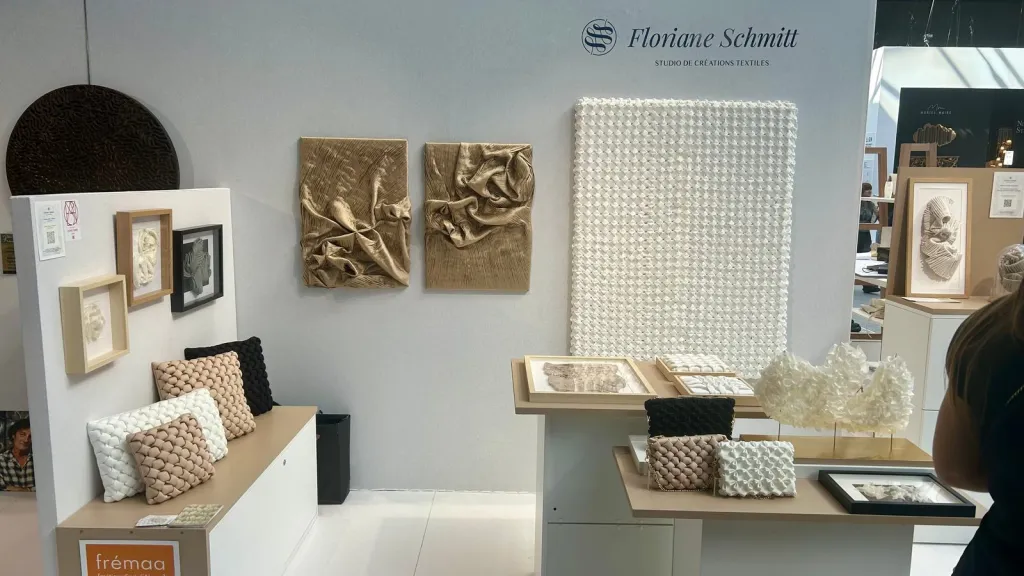
Based in Strasbourg, textile artist Floriane Schmitt explores a three-dimensional approach to fabric through exceptional wall art. Trained in fashion design, she chose to apply haute couture techniques to interior architecture. Her unique pieces shape relief without any rigid structure, playing on tensions, drapes, and material superpositions. Each collection is conceived as a free exploration of textile movement and volume, offering a poetic alternative to classic wall décors.
Floriane Schmitt’s Strasbourg workshop has become the laboratory for a unique formal research, where fabric abandons its utilitarian function to become a full-fledged architectural material. By transposing technical gestures from pattern making and art couture, she manages to give linen, wool, or cotton true structural autonomy. Her creations capture light in an organic way, changing appearance according to the time of day and the orientation of the lighting. In addition to their undeniable aesthetic value, these textile sculptures provide a gentle solution to the acoustic problems of contemporary interiors often dominated by concrete, glass, and metal, thus imparting a cosy and warm atmosphere to reception areas.

Rosie and Flameless Scented Innovation
Established on the Atlantic coast, the Rosie brand offers a refined reinterpretation of scented objects. Sylvia Bernard, its founder, has developed minimalist vases and candles, handcrafted from vegetable wax and fragranced with essences from Grasse. The particularity of these creations lies in their ability to diffuse their scent without any combustion while guaranteeing perfect sealing. This eco-responsible and innovative approach brings true aesthetic and sensory value to contemporary interiors.
Sylvia Bernard’s approach reflects a desire to reconcile interior perfumery with the demands of ecological transition and environmental health. Inspired by the preserved environment of the Atlantic coast, the designer conceived a cold diffusion system that preserves the integrity of the olfactory molecules developed in Grasse, the historical capital of perfume. The absence of a wick and combustion eliminates any soot or smoke emissions, offering a healthy alternative for fragrancing living spaces. The objects themselves, with their sculptural minimalist lines, discreetly integrate into the most refined décors, acting as both visual art pieces and permanent olfactory diffusers of great subtlety.
The Poetic Geography of Un vingt-cinq millièmes
Created in April 2025 near Lyon by Martin Bussillet, the young house Un vingt-cinq millièmes transforms cartography into personalised works of art. Thanks to a licensing agreement with the Institut Géographique National, the workshop prints topographical hiking maps on a variety of decorative supports. Enthusiasts of the great outdoors can thus immortalise their geographical memories on canvases, wallpaper, or custom-made puzzles. The Parisian fair provides an ideal springboard for this regional brand to structure its national distribution network.
The concept of Un vingt-cinq millièmes is based on emotional attachment to territories and nostalgia for explored landscapes. The very name of the brand echoes the reference scale of the famous IGN hiking maps, where every detail of the relief is faithfully reproduced. By combining the scientific rigour of national geography with a contemporary artistic sensibility, Martin Bussillet offers narrative and highly customisable decoration. Whether it’s an alpine summit conquered during an expedition, a wild coastline, or a childhood village, each map becomes a unique graphic artwork. The reception received during this autumn session confirms the growing interest of interior designers in these bespoke creations capable of personalising the visual identity of an exceptional place.
The International Avant-garde of Future On Stage
Future On Stage and the International Avant-garde
Alongside these French creators, the Future On Stage springboard highlighted three particularly promising international newcomers. The jury recognised the work of Baguette Studio with its rotomoulded wax lamps, the graphic cardboard luminaires from Dutch publisher Risette, and the luminous structures from the British brand Lightmass^. These three approaches illustrate the vitality of young contemporary creation in the face of eco-design and technological innovation challenges.
The Future On Stage programme has now established itself as an unmissable event for trend observers in search of disruptive ideas. Baguette Studio’s original approach demonstrates surprising mastery of wax, a traditionally ephemeral material here repurposed to sculpt durable luminaires with sculptural and organic forms. From the Netherlands, the Risette house proves that modest materials like cardboard can acquire exceptional elegance and sophistication through rigorous geometric cutting and architectural folding. Finally, the British project Lightmass^ pushes the limits of structural lightness by creating luminous installations of aerial technicality, redefining the perception of space through light. These three laureates outline a promising path for global design, where conceptual audacity combines with respect for natural resources.
The Dynamism of Creation in the Face of Contemporary Challenges
Beyond the individual journeys of these creators, the Villepinte fair highlighted a profound evolution in the expectations of professional buyers and lifestyle prescribers. This edition’s theme, focused on movement and collective energy, underscores the need for strong artistic proposals that go beyond mere decorative function. The projects presented this year demonstrate a clear return to local expertise and an evident desire to relocate artistic production by relying on regional workshops.
This dynamic is particularly visible in how creators approach the lifecycle of their creations. From the artisanal porcelain techniques of Volca Paris to the personalised cartography of Un vingt-cinq millièmes, the emphasis is on the physical and emotional durability of objects. Pieces are no longer designed to be quickly replaced but to integrate permanently into interiors, acquiring a temporal patina and emotional value. This high-end positioning, based on respect for manufacturing time and noble raw materials, confirms the central role of the French and international scene in redefining the standards of tomorrow’s art of living.