

At a glance
- How much? 1,526 billion euros of global luxury spending in 2026, 0% to +2% year on year at constant exchange rates, according to the Altagamma-Bain Monitor.
- When? Presented in Milan on 17 November 2026 at the 25th Osservatorio Altagamma; press release dated 18 November.
- The driver: experiential luxury, 533 billion euros (+2% to +4%), ahead of personal goods at 367 billion.
- Fewer buyers: 315 million for personal goods, down from 330 million in 2025.
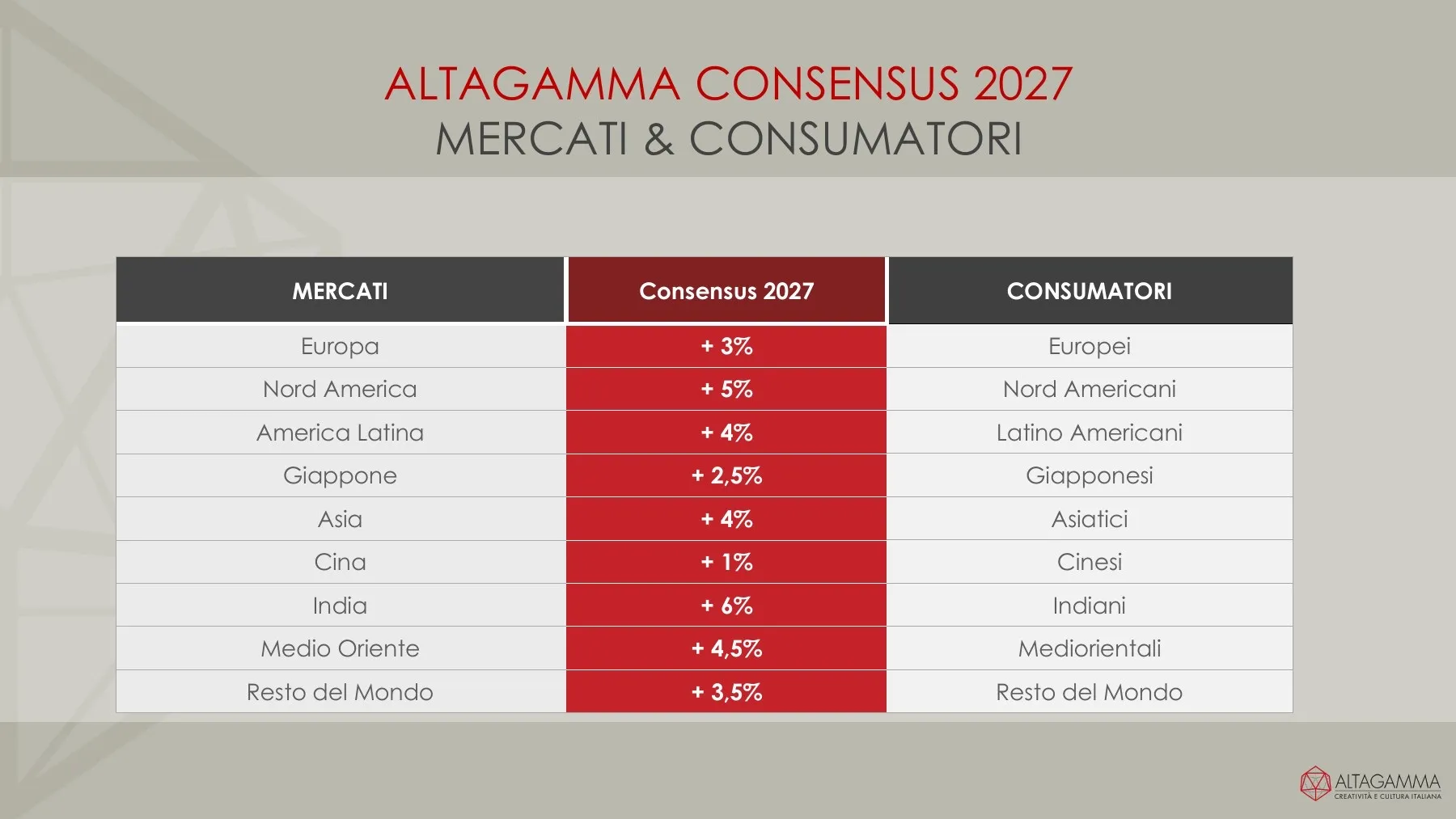
- In 2027: +6% for India and jewellery, +5% for North America, EBITDA +5%, according to the Altagamma Consensus.
Global luxury is not shrinking; it is changing shape. In 2026, experiences outweigh all personal luxury goods combined: 533 billion euros against 367 billion. The annual study by the Altagamma Foundation and Bain & Company describes a stable market, held up by the wealthiest clients, and a selective recovery in 2027.
A stable market above 1,500 billion euros
The Monitor puts global luxury spending at about 1,500 billion euros in 2026, 1,526 billion in the category breakdown, a change of 0% to +2% at constant exchange rates compared with 2025, and 16% to 22% above 2019. Luxury durables and assets remain the largest block, at 626 billion euros, but are down 3% to 5% at current exchange rates. Excluding luxury cars, they amount to 114 billion. For the listed groups, see the luxury market in the third quarter of 2026.
533 billion euros for experiences
High-end hospitality, cruises and fine dining benefit from a preference for travel and shared memories; fine wines are edging up while spirits are falling. In yachting and private aviation, access models that replace ownership are gaining ground. “Luxury today is no longer just about ownership, but also about experience,” said Giovanna Vitelli, president of Altagamma since June 2026 and chair of the Azimut|Benetti group, for whom “the world does not just want to buy Made in Italy, it wants to live Italy”.

Jewellery up 8% to 10%, footwear down
After two years of slight contraction, personal luxury goods are growing by 1% to 3% at current exchange rates and by 2% to 4% at constant rates. Bain estimates growth of 7% to 9% in the Americas and 5% to 7% in Japan and Asia excluding China; Europe gains 1% to 3%, while mainland China loses 1% to 3% and the Middle East, Africa and Oceania fall by 10% to 14%. Jewellery leads the categories, at +8% to +10%, ahead of eyewear (+4% to +6%) and watches (+3% to +5%), while footwear loses 3% to 5%.
315 million buyers, 15 million fewer
Around 450 million consumers remain active across all luxury markets. Buyers of personal goods fall to 315 million in 2026, from 330 million in 2025 and 400 million in 2022. Top clients spend around 780 billion euros, more than half of the market. Giovanna Vitelli sees a shift towards experiences, wellbeing and longevity.
Second-hand luxury: 202 billion euros
Second-hand luxury reaches an estimated value of around 202 billion euros in 2026, up 4% to 6%. From 2019 to 2025 it grew by 7% to 8% a year, three to four times faster than the primary market. Another shift: according to Bain, 70% of luxury queries put to artificial intelligence tools do not mention any brand. The value of the leading brands is tracked in the Interbrand 2026 ranking.
2027: India and North America out in front
Presented by Stefania Lazzaroni, director general of Altagamma, the Altagamma Consensus 2027 brings together 17 analysts, including Bain & Company, BCG and Deloitte, on personal luxury goods at constant exchange rates. India (+6%) and North America (+5%) lead, ahead of the Middle East (+4.5%), Europe (+3%), Japan (+2.5%) and China (+1%).
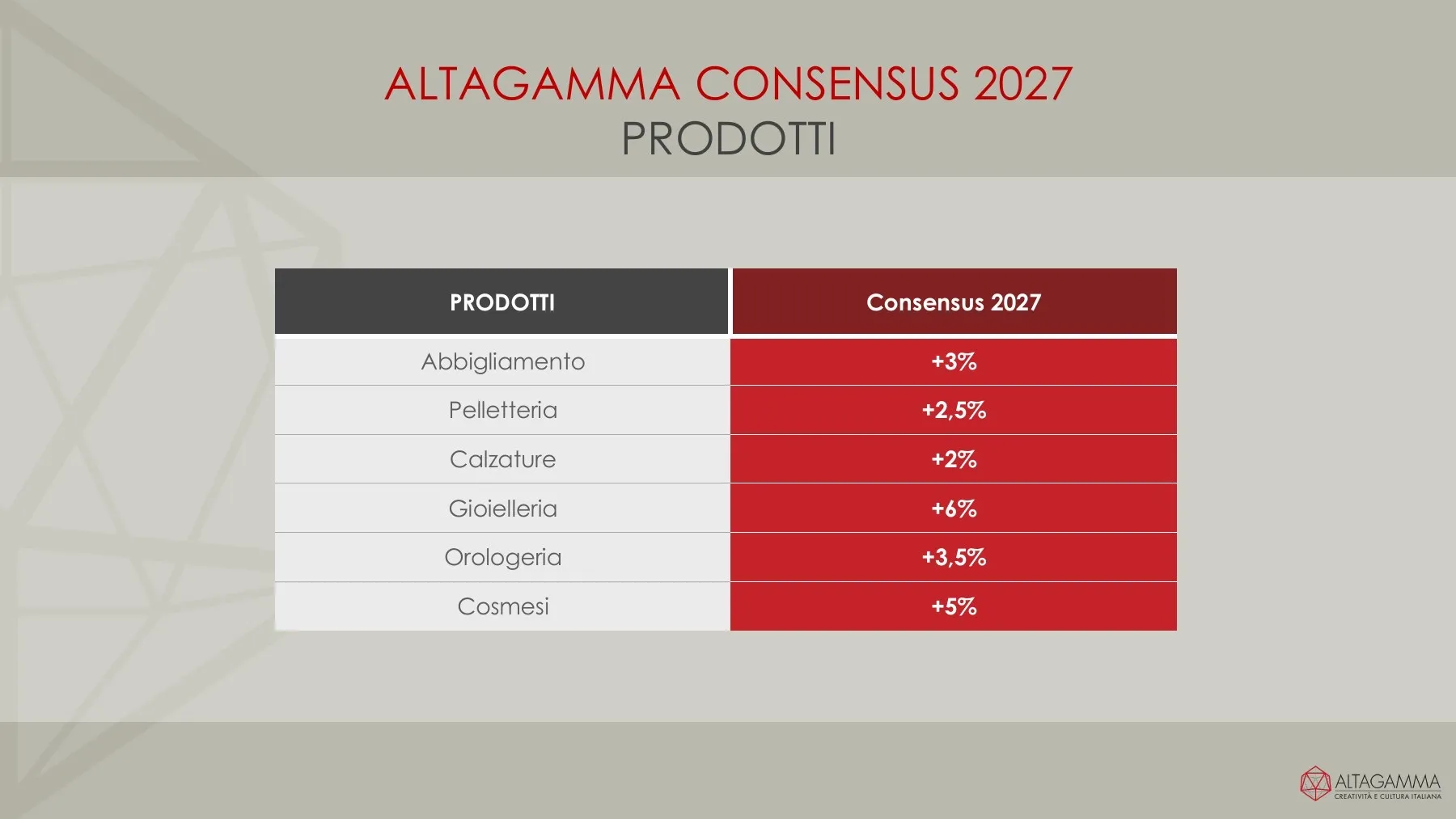
Jewellery (+6%) and cosmetics (+5%) lead watches (+3.5%) and leather goods (+2.5%). Analysts expect EBITDA to rise by 5%, with organic revenue up 4% to 6%, with no significant increase in volumes. Further out, the global market would reach 2,200 to 2,600 billion euros by 2035. In their statements, Altagamma’s vice-presidents point out that more than 50% of global superyacht orders are built in Italy. For a company-by-company view, see the half-year results of LVMH, Kering and Hermès.
| Studies | Altagamma-Bain Worldwide Luxury Market Monitor 2026, Altagamma Consensus 2027 |
| Presented | Milan, 17 November 2026 |
| Global market 2026 | 1,526 billion euros, 0% to +2% at constant rates |
| Experiential luxury | 533 billion euros, +2% to +4% |
| Personal goods | 367 billion euros, +2% to +4% at constant rates |
| Durables and assets | 626 billion euros, -5% to -3% |
| Second-hand | 202 billion euros, +4% to +6% |
| 2027 forecasts | India +6%, North America +5%, China +1% |
| 2035 outlook | 2,200 to 2,600 billion euros |
Information verified on 18 November 2026. Sources: Altagamma Foundation press release of 18 November 2026, Altagamma Consensus 2027, Osservatorio Altagamma 2026, statements by Altagamma’s vice-presidents.