
In brief
- The iconic Copenhagen restaurant reopens its doors under the leadership of executive chef Pablo Soto.
- Co-founder René Redzepi is leaving the operational management of the kitchens to take on the role of creative director.
- The establishment is adopting a monthly changing menu priced at 6,500 Danish kroner (approximately €870).
- Due to a prolonged closure period this year, the restaurant will be absent from the Guide Michelin 2026.
The iconic Noma restaurant in Copenhagen officially reopens its doors this month
The iconic restaurant in Copenhagen officially reopens its doors this August 2026, ushering in a major transformation phase marked by the absence of its founder in the kitchen. Long the ultimate embodiment of Scandinavian haute cuisine, the Danish establishment is embarking on a renewed model after several months of internal and media turbulence. Now led in the kitchen by executive chef Pablo Soto, the maison intends to redefine its gastronomic identity while establishing a healthier working culture.
- Establishment: Noma
- Location: Copenhagen, Denmark
- New executive chef: Pablo Soto
- Creative direction: René Redzepi
- Format: Gastronomic menu renewed monthly
- Price: 6,500 DKK (approx. €870) including food and wine
A managerial shift after the turmoil
To accompany this reopening, the Copenhagen restaurant is rethinking its operating principles from top to bottom. René Redzepi, who has embodied the address for over two decades, is now focusing solely on the role of creative director. This withdrawal follows the publication of testimonies from former employees reporting controversial working methods and a prolonged reliance on unpaid interns. In the face of repeated criticism regarding the kitchen culture, the 48-year-old chef publicly apologised before announcing he was stepping back.
A cultural and managerial transformation
The new management claims it wants to break with these past methods to establish a more balanced atmosphere. An internal audit has led to the implementation of regulatory measures to ensure the well-being of staff. According to Pablo Soto, this restructuring phase should provide more stability and meaning for the teams, reflecting a global shift in the fine dining sector towards more respectful management practices.
A constantly evolving culinary offering
A new gastronomic menu every month
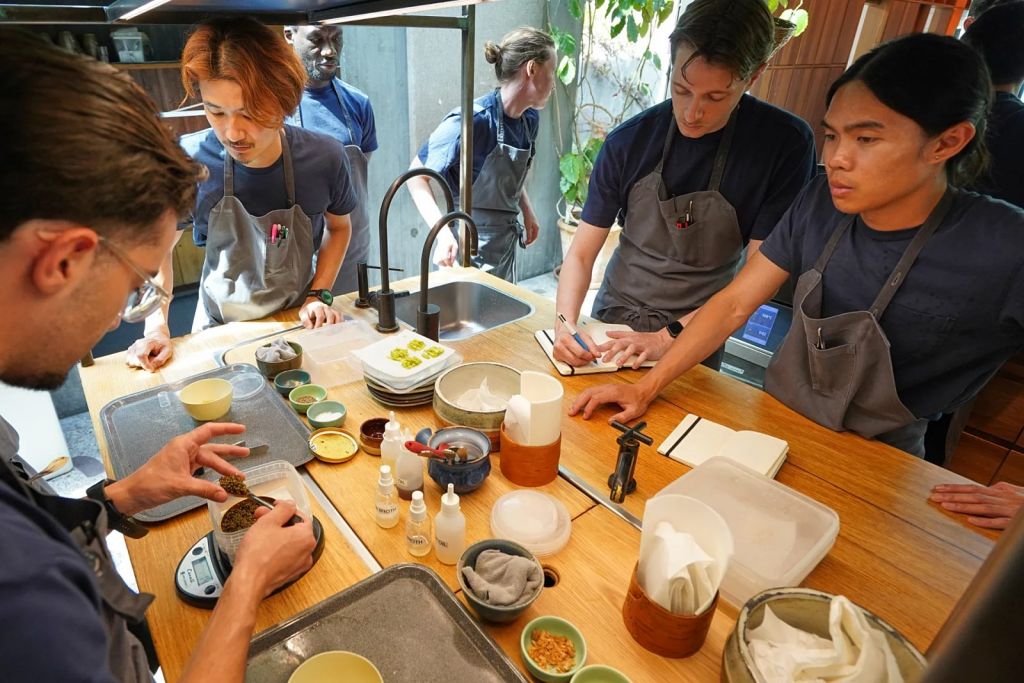
On the culinary front, the new team is introducing a different dynamic. Under the leadership of Pablo Soto and Mette Brink Søberg, head of research and development, the menu is abandoning its ritual division into three major annual seasons (vegetable, game, seafood) in favour of a constantly evolving menu, reinvented each month according to local and wild arrivals. Recent creations, such as a red fruit gazpacho enhanced with flower petals picked from the adjacent gardens, illustrate this quest for spontaneity.
The formula is based on a fixed price of 6,500 Danish kroner per person for the full gastronomic experience. Despite the high bill and the media coverage of the internal difficulties, public appeal remains intact. The restaurant is thus almost fully booked for the entire first quarter of opening, confirming the persistent interest of international gastronomes in the experience offered in Copenhagen.
The legacy of New Nordic cuisine
Since its creation in 2003, the establishment has established itself as one of the most influential culinary laboratories in the world. By basing its philosophy on foraging and the rediscovery of forgotten Nordic ingredients, the maison has profoundly transformed contemporary gastronomy. In two decades, the establishment has established itself as the global beacon of the New Nordic movement. This trajectory has been rewarded with five first places in the World’s 50 Best Restaurants ranking.
The reputation of the address has gone far beyond the circle of discerning gastronomes, notably thanks to major audiovisual projects. René Redzepi notably starred in the documentary series Omnivore on the platform, popularising the quest for rare ingredients and the work of producers. It is this technical and conceptual heritage that the current teams intend to preserve, while breathing new energy into it.
Stepping back from the guides
A future written outside the Guide Michelin
This reopening is nevertheless taking place outside the traditional rankings. Having closed its doors for a large part of the year to carry out pop-up projects abroad, the restaurant did not reach the number of opening days required by the Guide Michelin inspectors. The establishment will not appear in the 2026 edition of the Guide Michelin due to insufficient opening time. The maison is thus relinquishing the third star awarded in 2021.
For the restaurant’s management, regaining star distinctions is not an absolute priority. The management team prefers to focus its efforts on creative innovation and the sustainability of its human model. Industry observers agree that the maison’s ability to renew itself, while keeping its founder at a distance from day-to-day management, will be crucial to ensuring its long-term survival.