

In brief
- Acteurs et lieu : The Maison Bugatti completes the series in its historic Molsheim workshops.
- Nouveauté : Assembly of the final W16 Mistral, marking the definitive end of the W16 engine.
- Chiffres clés : Production limited to 99 units of 1,600 hp and a speed record of 453.91 km/h.
- Prochaine étape : Transition to the hybrid Tourbillon model equipped with a V16 developed with Cosworth.
In brief
- The Molsheim workshop has assembled the ultimate unit of the W16 Mistral, concluding the W16 engine series.
- In total, 99 units of this roadster were produced before the transition to hybridisation.
- The W16 block set a speed record of 453.91 km/h in November 2024.
- The Bugatti Tourbillon succeeds it with a naturally aspirated hybrid V16 engine designed with Cosworth.
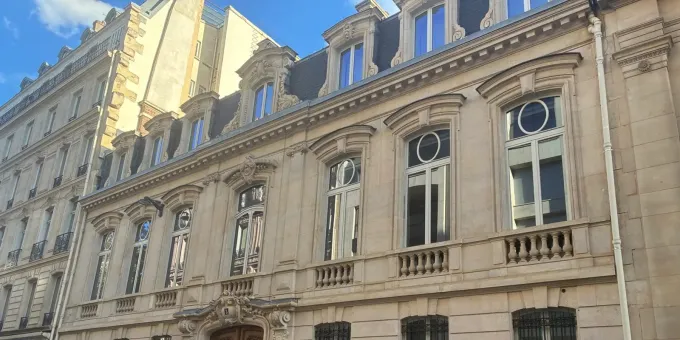
The Molsheim manufacturer has just assembled the final Bugatti W16 Mistral, sealing the definitive end of the W16 engine after more than two decades at the pinnacle of the automotive industry. This ultimate roadster marks the final point of a legendary mechanical architecture, before giving way to the launch of production for the Tourbillon. Nestled in the heart of the Alsatian estate of Château Saint-Jean, the historic site thus sees a masterly page of modern engineering turn, concluding a chapter shaped by the meticulous work of local artisans and the brand’s master craftsmen.
- Maison: Bugatti
- Moteur: 8.0-litre quad-turbo W16
- Puissance maximale: 1,600 hp
- Production Mistral: 99 units
- Prochaine architecture: naturally aspirated hybrid V16 (Cosworth)
A final bespoke model for history
A final model of absolute rarity
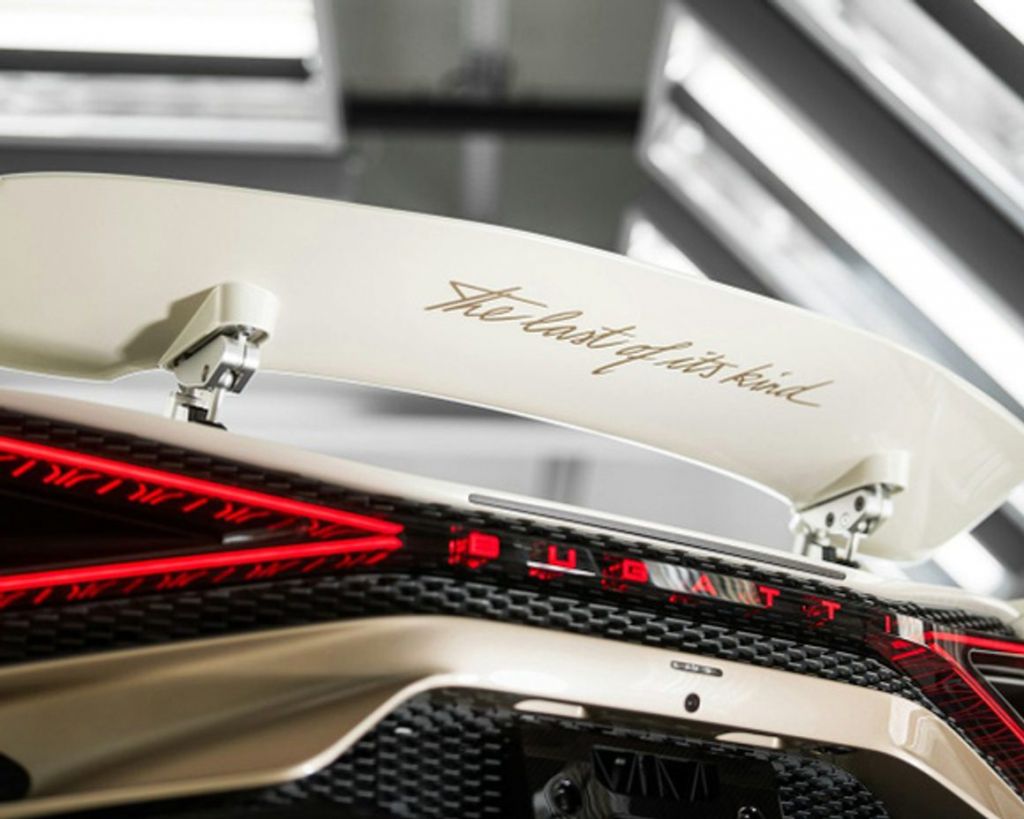
Draped in a two-tone “Pearl” and “Sparkle” livery, the final W16 Mistral to leave the Alsatian workshops is like no other. Its owner has customised every detail to pay tribute to the brand’s heritage, incorporating Ettore Bugatti’s signature embroidered in the cabin as well as a crystal plaque crafted by Lalique. On the gear lever, a sculpture of a falcon’s head replaces the famous elephant, a revealing clue as to the vehicle’s destination to the Middle East.
This model concludes the strictly limited series of 99 units of the Mistral. Its delivery comes at the exact moment when the assembly line shuts down permanently for this generation, yielding its artisanal space to the future ultra-exclusive assemblies of the Maison. The attention paid to this final configuration bears witness to the extreme standards of Molsheim’s personalisation departments, where cabinetmaking, leatherwork and art crystalware meet to offer a level of exclusivity worthy of the greatest masterpieces of fine craftsmanship.
The integration of Lalique crystal elements echoes the deep historical links between fine Alsatian glassware and the car manufacturer. This marriage of noble materials and mechanical engineering creates a bridge between traditional decorative arts and the cutting edge of automotive performance. Every interior detail, from the upholstery stitching to the metal inlays, has been adjusted by hand to ensure that this unit, number 99, becomes an absolutely unique collector’s item for decades to come.
Alsatian craftsmanship and the art of haute personalisation
The personalisation of this final roadster is part of the long tradition of bespoke design inherent to the history of the Alsatian brand. Since its founding, the Maison has distinguished itself by its ability to fashion vehicles to special order, meeting the most demanding desires of collectors worldwide. In the Molsheim workshops, technicians and master craftsmen work in an environment where industrial rigour gives way to the precision of manual gesture.
The choice of the falcon motif for the gear selector perfectly illustrates this creative flexibility. By substituting the sculpted bird of prey for the rampant elephant originally imagined by Rembrandt Bugatti, the owner infuses a cultural symbolism unique to his region of origin. The synergy between the crystal cutting, the finish of the two-tone paints and the bespoke upholstery work demonstrates the workshops’ ability to transform state-of-the-art mechanics into an individualised sculptural work.
Bugatti W16: twenty years of mechanical supremacy
The legacy of more than two decades of innovation
Born from the bold vision of Ferdinand Piëch in the early 2000s, the W16 engine aimed to combine unprecedented performance with the refinement of a grand touring vehicle. First introduced on the Veyron to break the mythical 400 km/h barrier, then magnified by the Chiron from 2016, this quad-turbo mechanical block symbolised the ability to go from the racetrack to the opera in absolute comfort.
The W-configuration sixteen-cylinder architecture, with its imposing 8.0-litre displacement and supercharging entrusted to four turbochargers, represented a monumental technological challenge during its design. It was necessary to push the limits of thermal constraints, invent complex cooling systems and design materials capable of withstanding unprecedented mechanical stress. Over the years and technical developments, this extraordinary engine saw its power climb to culminate at 1,600 horsepower on the brand’s ultimate creations.
Before drawing its final curtain, the W16 architecture offered the automotive world an ultimate demonstration of power. In November 2024, on the Papenburg test track, the W16 Mistral became the fastest production roadster in the world, reaching a certified speed of 453.91 km/h. An iconic achievement to crown twenty years of engineering. Reaching such a speed in the open air required aerodynamic work of surgical precision to manage airflow while maintaining vehicle stability and comfort in the cockpit.
The reasons behind a major technological shift
If the Alsatian firm chooses to retire its flagship engine, it is not due to a lack of efficiency or performance. Developing 1,600 horsepower in its ultimate version, the W16 had simply reached the absolute pinnacle of its potential. Rather than extending this mechanical system with minor evolutions, the brand’s management preferred to close the chapter at the height of its glory.
The evolution of regulatory constraints and the desire to explore new mechanical sensations pushed engineers to start from a blank sheet. The decision to abandon this monument of automotive passion enshrines the W16 as a non-reproducible heritage masterpiece. The ultra-exclusive automotive sector is indeed undergoing a period of profound transformation, where the search for energy efficiency must be reconciled with maintaining exceptional mechanical sensations.
By stopping production of the quad-turbo block at the end of this series of 99 units, the manufacturer preserves the absolute exclusivity of existing models. For collectors and enthusiasts of fine mechanics, every vehicle equipped with this engine becomes an invaluable witness to an era of excessive and uncompromising thermal engineering.
The Molsheim Manufacture in the era of the hybrid V16
The dawn of a new hybrid era with the Tourbillon
The discontinuation of the Mistral line comes just days after the inauguration of La Manufacture, the brand-new workshop dedicated to manufacturing the Bugatti Tourbillon. The new hypercar introduces a naturally aspirated V16 engine developed in collaboration with engine manufacturer Cosworth, combined with three electric motors. The transition between two eras takes place seamlessly at the historic Molsheim site.
By replacing supercharging with electrification and the lyrical soaring of a naturally aspirated V16, the brand embarks on a new technical narrative. It will be up to the Tourbillon to perpetuate this quest for perfection, following in the footsteps of an engine that once seemed irreplaceable. The choice of a naturally aspirated engine designed with British specialist Cosworth promises to offer an unprecedented sound signature and spectacular revving, complemented by the immediate responsiveness provided by the three electric motors.
The inauguration of the new La Manufacture building marks the adaptation of Alsatian infrastructure to modern technological requirements. This redesigned site makes it possible to combine the assembly of complex high-voltage components with the traditional artisanal care devoted to each chassis. Molsheim thus confirms its role as a sanctuary for exceptional automobiles, capable of evolving its expert craftsmanship in the face of contemporary world changes.