


In brief
- Key players and locations: Swiss and Parisian manufactures, including Patek Philippe, Cartier and Rolex, are reinventing the precious bracelet in 2026.
- Key figure: The Patek Philippe Golden Ellipse 5738/1R incorporates 363 components, including 300 links in 18-carat rose gold.
- Innovation: The creation of complex platinum and gold meshes offering the flexibility of fabric, replacing traditional dress leather.
- Challenge: Mastering artisanal chain-making to elevate the architecture of the bracelet to the status of an ergonomic work of art.
In brief
- Haute horlogerie houses are putting the craftsmanship of precious metal back at the centre of creation with unprecedented link structures.
- The Patek Philippe Golden Ellipse 5738/1R combines 363 components to offer the flexibility of a gold fabric.
- Cartier, Rolex, Chopard and Jaeger-LeCoultre reinterpret platinum, yellow gold and white gold through assemblies.
The greatest watchmaking houses are reinventing bracelet watches in 2026 with creations crafted from precious metals of absolute rarity. Where the English language describes the timepiece by its position on the wrist, French precisely highlights the element that secures it. When crafted in gold or platinum with a refined design, this bracelet transcends its simple technical function to become a true exercise in style, highly sought after by collectors worldwide.
The craftsmanship of precious metal in contemporary haute horlogerie
For many years, the leather strap remained the undisputed standard of the classic dress watch. However, the mastery of fine metallurgy and traditional chain-making is sparking renewed enthusiasm within haute horlogerie. Crafting a bracelet entirely from precious metal requires extreme meticulousness: each link must be cast, machined, polished, and then assembled by hand to perfectly hug the curve of the wrist without friction or stiffness.
The use of platinum, rose gold, yellow gold or white gold imposes specific technical constraints on the workshops. The density of platinum requires dedicated tooling, while gold alloys require complex surface treatments to maintain their original lustre over the decades. By placing the architecture of the mesh at the same level of priority as the mechanical movement, Swiss and Parisian manufactures reaffirm the status of the bracelet watch as a total work of art.
Patek Philippe Golden Ellipse 5738/1R: the textile flexibility of rose gold
Patek Philippe Golden Ellipse 5738/1R
The Golden Ellipse retains its iconic proportions based on the golden ratio. This singular geometry, half-rectangle, half-ellipse, has its origins in the principle of the divine proportion. With this reference 5738/1R combining an intense black dial with a rose gold case, the Geneva-based manufacture introduces a bracelet of rare complexity. This demanding assembly brings together 363 individual components, including 300 oval links mounted in rows of eight on straight bars.
The visual effect and the feel on the wrist evoke the fluidity of a precious fabric. The development of this link required years of research to achieve total flexibility while maintaining foolproof structural strength. The meticulous spacing between each component also promotes air circulation, offering optimal thermal comfort in all seasons and preventing any discomfort related to temperature variations.
The striking contrast between the black dial background and the warm hue of the 18-carat rose gold enhances the elegance of this collector’s piece. Each element of the bracelet benefits from rigorous manual finishing, ensuring harmonious light reflections during wrist movements.
Cartier Privé Tank Normale: the weight of platinum and the London heritage
Cartier Privé Tank Normale
Within the prestigious Cartier Privé collection, a true sanctuary dedicated to the Maison’s historic shapes, the Tank Normale reinterprets one of the most famous geometric figures in watchmaking heritage. This version, crafted entirely in platinum, features a ruby cabochon on the winding crown, a distinctive signature of the brand’s pieces fashioned from this noble metal. The case, with its classic proportions of 32 × 25 mm, is paired with an imposing bracelet composed of seven rows of solid links.
The thickness of the mesh gives the piece an assertive presence on the wrist and a sense of density characteristic of platinum. The design draws inspiration from timepieces created by the Cartier London branch during the 1930s, a period of creative effervescence particularly prized at international auctions for its generous shapes and architectural audacity.
The adjustment work between the rectangular case and the first row of the bracelet ensures seamless visual continuity. The brushed and satin-finished polishing on the platinum links highlights the taut lines of the watch while minimising daily scratch sensitivity.
Rolex 1908 Settimo: the perfect continuity of the seven-row link
Rolex Perpetual 1908
Designed to enrich the 1908 dress collection, the Settimo bracelet reflects a particularly accomplished aesthetic research at Rolex. Its name, which means “seventh” in Italian, refers to the seven articulated links that make up its yellow gold structure. The element completely conceals the invisible Crownclasp clasp, of which only the small iconic crown signals its opening.
To accentuate the purity of its line, this bracelet maintains an identical width along its entire length, without any tapering towards the buckle, ensuring perfect harmony with the case. This parallel design requires a perfect balance of masses to preserve wearing comfort without weighing down the overall aesthetic of the watch.
The yellow gold used by the Geneva-based manufacture offers a luminous brilliance that highlights the craftsmanship of the joints. Each row of links interacts with the next thanks to a system of internal pins completely invisible from the outside, offering an impeccable drape on the wrist.
Chopard L’Heure du Diamant: the roll architecture sublimated in white gold
Chopard L’Heure du Diamant
Chopard’s L’Heure du Diamant line illustrates the jewellery mastery of the Swiss Maison. This model is distinguished by its openworked and gem-set case middle, as well as its white gold bracelet structured according to the “roll” typology with a single link per row. The full mirror polish and the softness of the finishes transform this sport-inspired architecture into a jewellery creation of great delicacy.
The fluid alignment between the design of the links and the fluting bordering the dial bears witness to the extreme care taken in the assembly details. The openworked case middle allows light to pass through to make the precious stones sparkle, while the white gold of the bracelet provides a sober and refined metallic setting.
This alliance between the art of gem-setting and the engineering of metal mesh reflects the dual expertise of the Geneva-based house, capable of combining the rigour of haute horlogerie with the poetry of haute joaillerie.
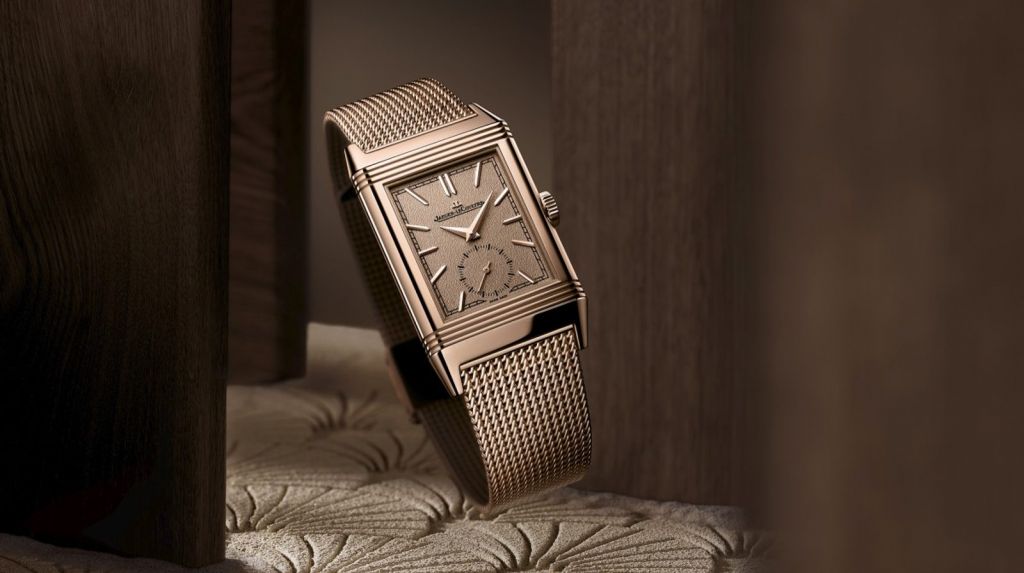
Jaeger-LeCoultre Reverso Tribute Monoface Or Deco: Milanese charm
Jaeger-LeCoultre Reverso Tribute Monoface
The combination of a Milanese mesh with a rectangular case is a technical challenge successfully met on the Reverso Tribute Monoface “Or Deco”. Crafted from delicately woven rose gold threads, the Milanese mesh offers a silky touch and a vintage visual effect that evokes the heyday of the Art Deco style.
The tight weaving of rose gold threads adapts precisely to the geometric lines of the watch, creating a unified and warm aesthetic. Connecting a flexible, woven bracelet to a rigid swivelling case requires a specific attachment piece to avoid any unsightly gap at the lugs. To offer impeccable ergonomics and suit all wrist sizes, the manufacture offers this piece in two distinct bracelet sizes.
The warm shade of rose gold highlights the iconic gadroons of the Reverso case. This creation by the Sentier-based manufacture demonstrates the viability of metallic Milanese mesh applied to rectangular-shaped timepieces.