

In brief
- Laura Ingalls Wilder’s books have sold more than 73 million copies worldwide, confirming this saga’s status as one of the pillars of children’s literature and American mythology.
- The previous television series, which became an intergenerational social phenomenon, recorded 13.3 billion minutes of streaming in 2024 alone, illustrating exceptional cultural resilience several decades after its creation.
The Netflix production involves advisors from the Osage Nation to re-evaluate the representation of Indigenous peoples
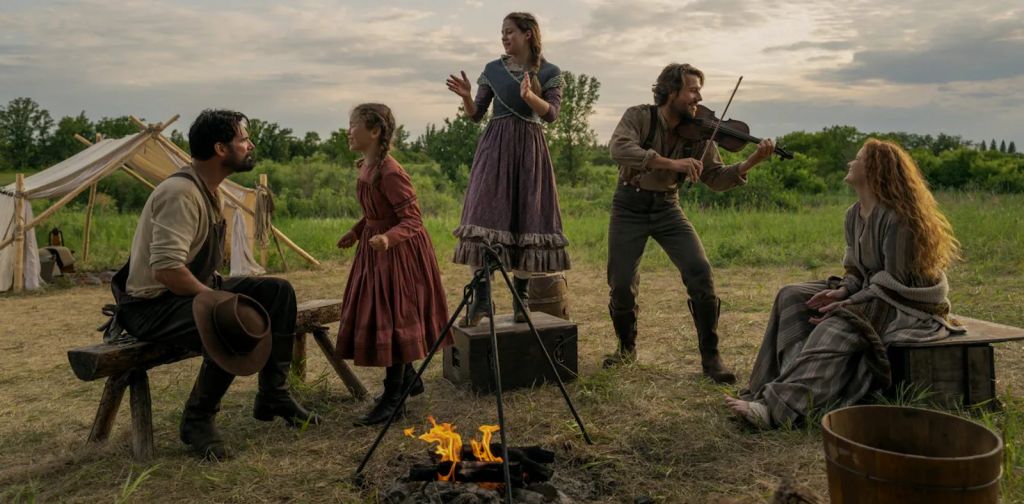
In a move aimed at breaking away from the narrative simplifications of the past, the Netflix production is involving advisors from the Osage Nation to re-evaluate the representation of Indigenous peoples within the story. This collaboration marks a structural turning point in the way historical entertainment is conceived, by integrating voices that have for too long remained on the fringes of the construction of the American national narrative. It is no longer just about telling the adventure of a family of pioneers, but about anchoring their trajectory in a complex geopolitical reality where the ancestral presence of Indigenous nations is no longer a backdrop, but an essential and dynamic component of the plot.
A series at the heart of memorial tensions
The adaptation announced by Netflix brings back to light the identity and memorial tensions that have run through the history of the United States since its founding. This project does not merely dust off a classic; it is part of a deeper movement aimed at questioning the founding narratives of the Westward expansion. By revisiting the chronicles of the Ingalls family, the streaming platform is tackling a monument of popular culture that has shaped the imagination of millions of readers and viewers, while sometimes obscuring the shadows of the colonisation of the central plains.
The political dimension of this return is not accidental. The story of the pioneers has always been used as a tool for cohesion or, conversely, as a subject of discord depending on the era. By choosing to address head-on the questions of territorial sovereignty and coexistence between settlers and Indigenous nations, this new version places itself at the intersection of current debates on historical memory. It offers a reading that seeks to reconcile the nostalgia of a warm home with the rigour of a historical context often marked by forced displacements and deep cultural misunderstandings.
The return of a myth in times of crisis
Originally broadcast between 1974 and 1983 under the direction of Michael Landon, the epic of the Ingalls family has confirmed its evocative power with contemporary audiences. Landon, as an actor, producer, and director, knew how to transform Laura Ingalls Wilder’s stories into a celebration of family values and perseverance. During the recent health crisis, the series saw a massive resurgence of interest, illustrated by a record listening volume that testifies to a constant search for traditional landmarks in a world that has become uncertain. This digital success proves that the public, faced with instability, readily turns to environments where the stakes are clear and emotional bonds are unconditional.
The appeal of life on the prairie during lockdown periods is explained by this need to return to basics. The apparent simplicity of rural life, community mutual aid, and resilience in the face of natural elements offered a reassuring mirror to modern anxieties. Michael Landon perfectly understood this dynamic in his time, injecting universal social issues into the series which, although rooted in the 19th century, resonated with the concerns of the 1970s and continue to do so today.
A timeless myth in the face of crises
During every major period of collective doubt, from the post-crash 1930s to the 1973 oil shock, the bucolic world of the pioneers has served as an emotional refuge, finding a direct echo in current trends of cottagecore and rural self-sufficiency. In the 1930s, as the United States struggled with the Great Depression, Laura Ingalls Wilder’s novels offered a vision of courage and independence that contrasted with economic despair. Today, the cottagecore aesthetic, which celebrates an idealised return to the land, craftsmanship, and a peaceful domestic life, draws heavily from the iconography of the prairie.
This fascination with self-sufficiency is not just aesthetic. It reflects a deep aspiration to regain control over one’s existence in the face of the complexities of globalisation and omnipresent technology. The “little house” then becomes the symbol of a rediscovered individual sovereignty, where every daily gesture has a direct and tangible meaning. This fantasy of self-sufficiency, although often far from the brutal realities of the pioneer era, remains a powerful driver of Western popular culture, fueling both social networks and the editorial strategies of streaming platforms.
Historical reality versus the idyllic narrative
The family’s authentic journey across the plains of the Midwest proved to be marked by severe trials, between material deprivation and extreme precariousness. Behind the warmth of the home and the smiles of the television series lie freezing winters, devastating locust invasions, and a constant struggle for food survival. The original novels, although rich in detail on subsistence techniques, long obscured the violence of the territorial dispossession suffered by Indigenous peoples. These stories conveyed biased representations intended to legitimise the settlement of colonists, often presenting the lands of the West as empty or “virgin” spaces, waiting to be developed by the work of pioneers.
The Westward expansion, the engine of American development in the 19th century, relied on laws like the Homestead Act, which encouraged settlement on lands that were nevertheless the ancestral territory of many Indian nations. The historical reality is therefore one of direct confrontation for space and resources, a dimension that the new Netflix production intends to explore with more nuance. By moving away from the idyllic narrative, the goal is to show that the heroism of the settlers was part of a larger mechanism of conquest, the consequences of which are still felt today.
Between legend and historical reality
This critical re-reading led the American Library Association to remove the author’s name from its children’s literary award in 2018, marking a major institutional break with the original myth. This decision made an impression, highlighting that works once considered models of virtue could contain racial stereotypes and dated prejudices. It is not about erasing Laura Ingalls Wilder’s work, but about placing it in its production context and recognising the emotional impact that some of its passages may have had on readers from Indigenous communities.
The distinction between legend and historical reality thus becomes a major educational and cultural issue. By recognising the limits of the author’s perspective, modern institutions and creators seek to offer a more complete vision of American history. This approach in no way diminishes the literary interest of the saga, but it invites a more conscious and respectful reading of the diversity of human experiences that forged the continent. The Netflix series is part of this desire for dialogue between the mythologised past and the truth requirements of the present.
The ideological footprint of Rose Wilder Lane
The editorial success of the saga owes a decisive part to the author’s daughter, Rose Wilder Lane, who encouraged her mother to publish at the age of 65. An influential journalist and accomplished woman of letters, the latter did not settle for an editorial role. She actively reworked her mother’s manuscripts to make them an implicit manifesto. Lane infused Laura’s stories with a political and philosophical dimension centered on radical autonomy. Her intervention allowed personal memoirs to be transformed into a national epic celebrating the individual in the face of adversity and outside interference.
The collaboration between mother and daughter was the result of permanent creative tension. While Laura wanted to remain faithful to her memories as a little girl, Rose sought to universalise these experiences to support her own political convictions. This influence is particularly felt in the systematic emphasis on personal responsibility and in the distrust of government aid, a theme that would become central to American conservative thought during the 20th century.
Libertarianism and the Wilder legacy
As one of the founding figures of the American libertarian movement alongside Ayn Rand and Isabel Paterson (designated as the figureheads of this doctrine), Rose Wilder Lane shaped an apology for individual self-sufficiency designed exclusively for the benefit of white pioneers. Her radical political commitment flowed through the chapters of the saga, where Charles Ingalls’ independence is held up as a supreme virtue. This worldview rejects all forms of collective dependence in favour of personal effort and private property as the foundations of freedom.
This libertarian legacy explains why the work has been so lastingly adopted by certain currents of thought in the United States. The “little house” is not just a home; it is a fortress of autonomy where the individual finds fulfilment through their own labour. By anchoring these values in the heart of a child, the saga ensured the transmission of a certain vision of the American ideal, centered on the “self-made man” and territorial conquest. The new adaptation will therefore have to navigate between this marked ideological heritage and a contemporary desire for inclusivity and social justice.
The geographical and cultural dimension of the Midwest
Geographical space plays a role as a character in its own right in the world of the little house. From the dense forests of Wisconsin to the windswept plains of Kansas and South Dakota, each environment imposes its own challenges and shapes the character of the characters. The conquest of this immense space is at the heart of American identity, representing both infinite opportunity and mortal danger. The new Netflix series promises to showcase these iconic landscapes, not only for their visual beauty but for what they represent in terms of obstacles and promises.
The Midwest, often perceived as the geographical and moral heart of the country, is the stage for this transformation of wilderness into agricultural land. This mutation led to major ecological changes, to which the original narrative bears witness. By deepening the geographical dimension, the new production can also address the environmental consequences of expansion, thus offering an additional perspective on the legacy of the pioneers. The interaction between man and his environment, a central theme of the 19th century, thus finds a direct resonance with the ecological concerns of our time.
A re-reading at the heart of contemporary debates
The new version produced by Netflix sparked strong media reactions as soon as it was officialised in early 2025. While some conservative voices denounced potential progressive leanings, the original actors recalled that the 1970s storyline already directly addressed racism and societal violence. Michael Landon did not hesitate to deal with sensitive subjects such as anti-Semitism, disability, or addiction, proving that the series had always possessed a sharp social conscience behind its appearance as a family tale.
By introducing plots related to the Indian Homestead Act of 1875 and working with Osage representatives, the platform offers a plural vision of the American past, combining memorial requirements and the highlighting of iconic landscapes. This approach makes it possible to move away from a binary vision of history to explore the complexity of human interactions in a territory in full mutation. The goal is not to deconstruct the myth to destroy it, but to enrich it with new perspectives that make it fairer and more representative of historical reality, while preserving the universal emotion that has made the saga a success for nearly a century.
The stakes for Netflix are high: to satisfy those nostalgic for the original series while capturing a new audience sensitive to issues of representation. By anchoring the story in increased historical rigour, the production hopes to transform this classic into a modern work capable of sparking debate while offering the escape promised by the wide-open spaces of the prairie. This equation between fidelity to the spirit of Laura Ingalls Wilder and the requirement for contemporary truth defines what will undoubtedly be one of the major cultural events of the coming years.