

In brief
- The Hope diamond has no official price: the Smithsonian, which has kept it in Washington since 1958, has never published an evaluation.
- The only value documented by the Smithsonian dates from its dispatch by post in 1958: a one million dollar insurance, for 145.29 dollars in postage and insurance fees.
- The estimates in circulation, from 200 to 350 million dollars, and the “insurance value” of 250 million often cited are not confirmed by the museum.
- Pierre Cartier sold it for 180,000 dollars to the wealthy American Evalyn Walsh McLean in the early 1910s, according to the Smithsonian.
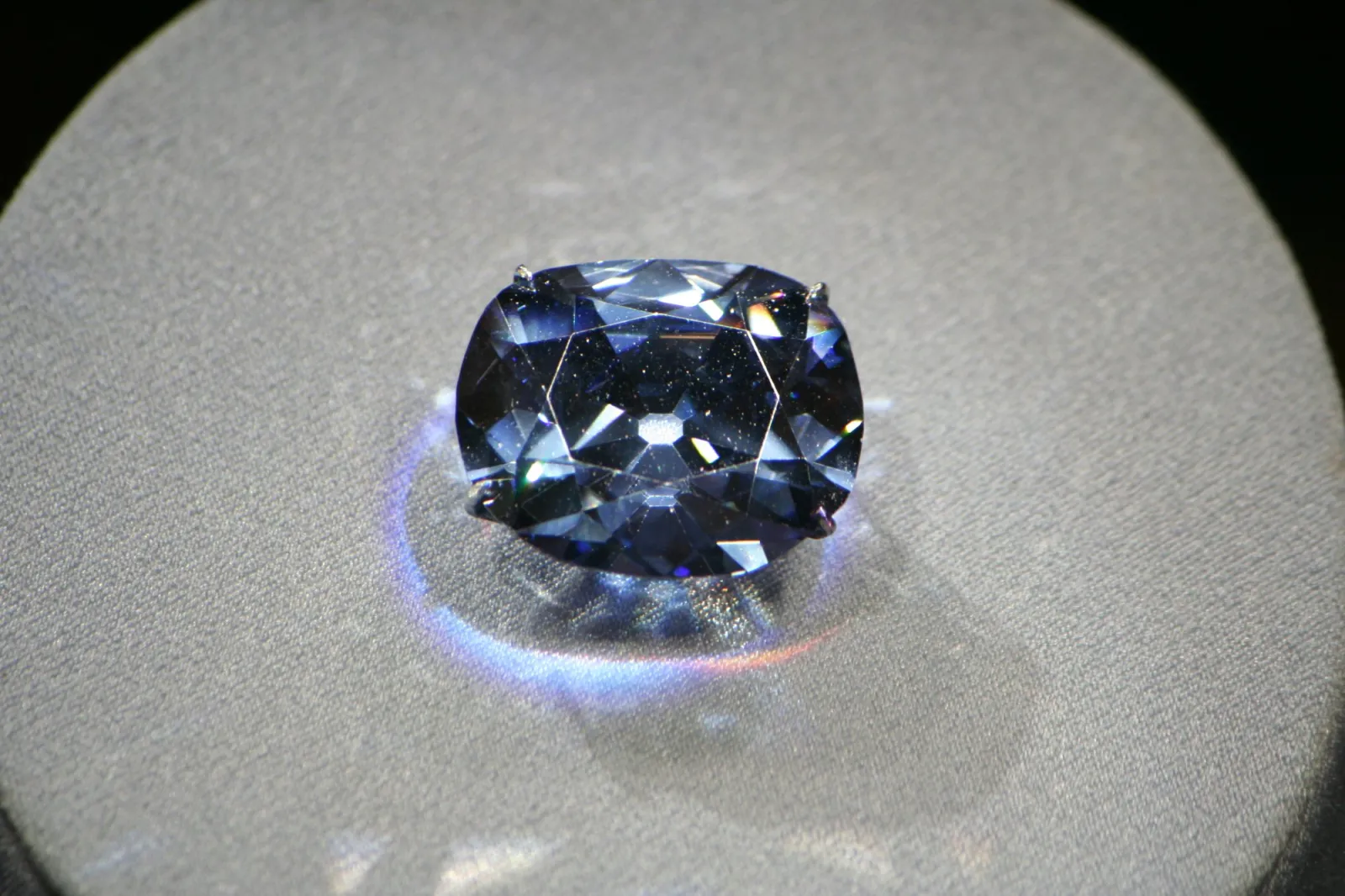
- It weighs 45.52 carats and glows with a red phosphorescence under ultraviolet light.

The Hope diamond is undoubtedly the most famous stone in the world, and one of the most visited: it takes pride of place at the Smithsonian National Museum of Natural History in Washington. Its price, however, remains an enigma maintained by legends. Here are the figures that can truly be sourced, from Louis XIV to the cardboard box that delivered it to the museum.
How much is the Hope diamond worth?
The Smithsonian does not communicate any value for the Hope, which it considers a national collection item and not an asset. The only official figure dates from 8 November 1958: on that day, the New York jeweller Harry Winston dispatched the diamond to the museum by registered mail. According to the National Postal Museum, the shipment cost 145.29 dollars, including 2.44 dollars in postage, with the remainder covering a one million dollar insurance.
More recent amounts, from 200 to 350 million dollars according to several estimates, and the insurance value of 250 million often put forward do not come from the Smithsonian. These are market evaluations, impossible to verify since the stone is not for sale. Converted into euros, they would roughly give between 170 and 300 million, but they should be read as orders of magnitude, not as a price.
The Hope in figures
| Feature | Detail |
|---|---|
| Weight | 45.52 carats (weighed out of its setting in the 1970s) |
| Colour | deep blue, red phosphorescence under ultraviolet light |
| Presumed origin | India, Golconda region (Kollur mine), 17th century |
| Ancestor | the French Blue of Louis XIV, stolen in 1792 |
| Setting | platinum, signed Cartier, surrounded by 16 white diamonds, chain of 45 diamonds |
| Cartier sale | 180,000 dollars, to Evalyn Walsh McLean (1911-1912) |
| 1958 insurance | 1 million dollars, for the postal shipment to the museum |
| Owner | Smithsonian Institution, gift from Harry Winston on 10 November 1958 |
| Location | National Museum of Natural History, Washington |
| Current price | none published; unconfirmed market estimates |
| Sources | Smithsonian, National Postal Museum |
From the French Blue to Washington
The merchant Jean-Baptiste Tavernier brought back a large blue diamond from India, which he sold to Louis XIV along with other stones in the late 1660s. The king had it recut into a heart of approximately 69 carats, the French Blue. Louis XV had it mounted in 1749 on a badge of the Order of the Golden Fleece. In September 1792, the looting of the royal storehouse caused it to disappear.
A blue diamond reappeared in London in 1812. The Smithsonian estimates, based on solid evidence, that it is the recut French Blue. The banker Henry Philip Hope acquired it around 1830, for approximately 90,000 dollars according to the Smithsonian, and the stone remained in his family until 1901. Pierre Cartier then sold it to Evalyn Walsh McLean, a figure of Washington high society, for 180,000 dollars. Upon her death, Harry Winston bought all of her jewellery in 1949, then gifted the Hope to the Smithsonian in 1958.

The curse, a commercial legend
The reputation of being a cursed stone has followed the Hope since the beginning of the 20th century, at the time it was changing hands between merchants. The Smithsonian dedicated an episode of its podcast to untangling fact from fiction: none of the misfortunes attributed to the stone have been linked to it in a documented manner, and the legend mainly served to increase buyer interest. It did not prevent Evalyn Walsh McLean from wearing it for decades.
Compared to blue diamonds sold at auction
In the absence of a price for the Hope, the market offers points of comparison. The Oppenheimer Blue, 14.62 carats, reached approximately 57.5 million dollars at Christie’s in 2016, and the Blue Moon of Josephine approximately 48.4 million. The absolute record remains pink: the CTF Pink Star, 71.2 million dollars at Sotheby’s in 2017. With three times more carats than the Oppenheimer Blue and three centuries of royal history, the Hope would likely exceed these amounts, but no sale will ever verify it. All these records are detailed in our ranking of the most expensive diamonds in the world, and other legendary stones in the most beautiful famous diamonds in the world.
Prices verified and updated on 13 October 2026. Sources: Smithsonian Institution (National Museum of Natural History, history of the Hope diamond), Smithsonian National Postal Museum (1958 packaging), Sotheby’s (CTF Pink Star).
← Back to the ranking: The most expensive diamonds in the worldAll luxury records, gathered on one page →