

In brief
- LVMH has recorded a 37% stock market decline since the beginning of 2026.
- The luxury market in China fell by 18% in 2024 and by 4% in 2025.
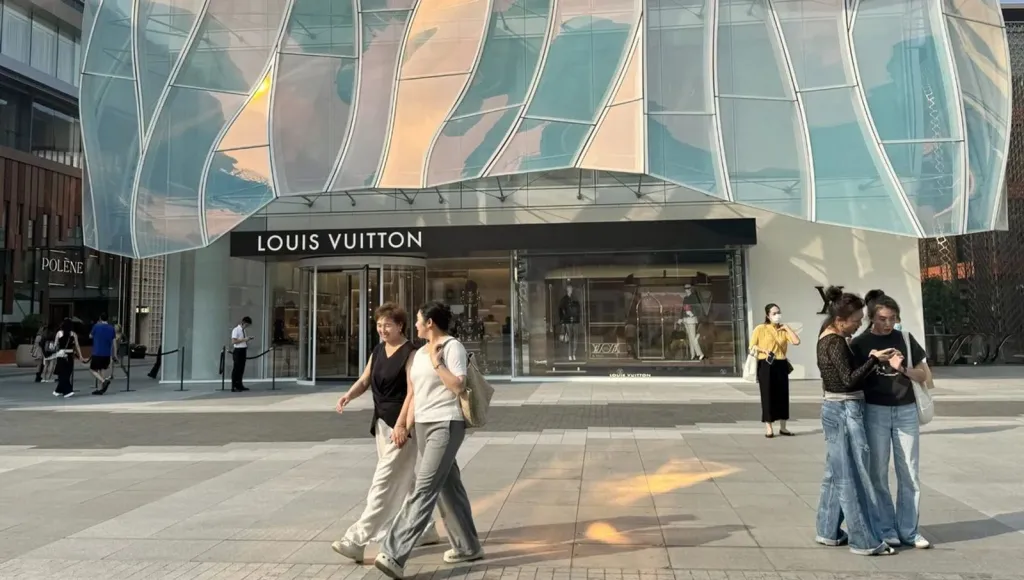
- Louis Vuitton is reducing its presence in the provinces, going from 6 to 3 boutiques in the South-West.
- The Speedy 20 bag is sold for 17,500 yuan in China, nearly 400 euros more than in France.

French luxury is facing a historic slowdown in consumption in China, forcing iconic houses into a strategic transformation of unprecedented scale. For several decades, the Asian giant represented the main engine of growth for the high-end fashion and leather goods industry. Today, this model based on continuous geographical expansion and an insatiable appetite from local buyers is reaching its limits. Louis Vuitton, the flagship brand of the LVMH group, finds itself forced to review its territorial presence in a country where the codes of prestige are evolving towards more discretion, a quest for meaning, and sobriety.
This transition is taking place in a global economic context that is particularly tense for the luxury sector. Major houses, accustomed to double-digit growth rates, must now contend with more cautious consumers, volatile financial markets, and profound socio-cultural shifts. The reorganisation of physical distribution networks is becoming a priority to preserve operational profitability, while avoiding over-representation that could trivialise the image of exclusivity inherent to haute couture and prestige leather goods.

The strategic retreat to metropolises
The strategic refocusing of historic flagships
Gone are the days of frantic expansion in second-tier cities. During the boom years, European brands embarked on a race to open boutiques in rapidly developing Chinese provincial capitals. At the end of August 2026, Louis Vuitton closed its only store in Guiyang, marking a clear desire to concentrate on major economic hubs like Beijing and Shanghai. These megacities concentrate most of the country’s financial wealth and are home to the high-net-worth individuals most resilient to economic fluctuations.
In the South-West of the country, the brand now has only three stores, down from six at the peak of its historical presence. This geographical consolidation reflects a complete paradigm shift. It is no longer a matter of seeking out the customer wherever they are through a dense territorial network, but rather of encouraging a select clientele to travel to exceptional flagships. This rationalisation of the physical retail network aims to target exclusively the wealthiest clients, capable of maintaining their high level of spending despite the ambient economic sluggishness and the general decline in household confidence.
Maintaining points of sale in mid-sized metropolises represented operational and real estate costs that were increasingly difficult to justify in the face of declining footfall. By refocusing its forces on the ultra-prestigious windows of the major avenues of Shanghai and Beijing, the French fashion house seeks to maximise the customer experience and offer highly exclusive private salons. These high-end spaces are specifically designed to host very high-net-worth clients during personalised sales sessions, away from the general public.

A middle class in search of meaning and discretion
The economic slowdown is weighing heavily on the Chinese middle class, which has long been the historical engine of growth for the sector. This segment of the population, once highly inclined to acquire branded products to display their social success, is now reassessing its budgetary priorities. According to Bain & Company, sales of leather goods fell by 11% last year in the country, illustrating a growing distaste for products with overly visible and ostentatious logos. Purchasing behaviour is shifting towards a quiet sobriety, often described as quiet luxury.
Successive price increases applied by brands after the pandemic have also weighed on consumption dynamics. With two waves of price hikes in 2024, the price of iconic pieces reached new heights, widening the gap with the real purchasing power of middle-class consumers. For example, the Speedy 20 bag is sold for 17,500 yuan in China, nearly 400 euros more than in France. This significant price gap, justified by import taxes and logistical costs, prompts many potential buyers to delay their purchases or turn to other channels.
Chinese consumers are now prioritising individual well-being, domestic or international travel, and cultural experiences over purely status-driven purchases. The need for social ostentation through objects is gradually fading in favour of a desire for authenticity and personal enrichment. Faced with this major cultural transition, the mere prestige of a historic logo is no longer enough to trigger a purchase. Customers demand a deeper narrative, demonstrable excellence of craftsmanship, and real utility value that justifies the financial investment made.
The breakthrough of local heritage houses
The emergence of strong local competition
Faced with the European giants of Avenue Montaigne and Place Vendôme, new local players are emerging in the Asian market, skillfully playing the card of cultural identity and national heritage. This is notably the case for the jeweller Laopu, whose high jewellery creations are directly inspired by the traditional ornaments of empresses and classical Chinese aesthetics. This artistic and heritage-based approach particularly appeals to a young clientele, more than a third of whom are between 26 and 35 years old. These young professionals seek creations that reflect their own cultural history while respecting impeccable quality standards.
For these new consumers born in the era of their country’s economic assertion, luxury is no longer defined solely by Western labels and the prestige of traditional European brands. They seek, above all, an intimate resonance with their own cultural heritage, which is pushing French fashion brands to deeply rethink their marketing discourse and communication in this crucial market. To compete with these agile local brands, Parisian houses must offer targeted artistic collaborations and integrate elements of Chinese history and folklore into their collections, or risk losing their cultural relevance.
The rise of this sense of cultural belonging, often referred to as the Guochao trend, values national design and local artisanal craftsmanship. This structural trend is profoundly altering the hierarchy of brands in the minds of consumers. European labels must prove that they are not merely exporting a standardised model, but are capable of understanding and respecting the subtleties of local culture through adapted products and respectful artistic initiatives.
The impact of controversies and nationalism
New geopolitical and reputational risks
The political, social, and digital dimension is becoming a major risk factor for international luxury groups operating in the territory. During the summer of 2026, Louis Vuitton saw its sales drop by 30% in July following a controversy related to a lawsuit filed against the Chinese tea chain Molly Tea. The court’s ruling against this local brand triggered an immediate wave of nationalist reactions and calls for boycotts on Chinese social networks. This episode demonstrates the speed at which the image of an international group can be destabilised by non-financial issues.
This incident highlights the vulnerability of foreign brands to a generation of young Chinese consumers who are extremely connected, reactive, and increasingly sensitive to the attitude, ethics, and local roots of fashion houses. The historic prestige of a centuries-old monogram is no longer enough to protect a brand against a sudden turnaround in digital public opinion. Western brands must now navigate the local media landscape with extreme caution, ensuring that their legal or commercial actions are not perceived as attacks on local businesses or traditions.
To limit these major reputational risks, the communication departments of major luxury groups are strengthening their monitoring of local social networks. A fine understanding of cultural sensitivities and nationalist dynamics has become an essential skill for preserving market share. In an increasingly polarised market, every communication campaign, every choice of partnership, and every strategic decision is subject to rigorous analysis to avoid any misstep likely to compromise the global reputation of the house in its main export market.

For more information on economic news, you can visit the website of.