

In brief
- Collaboration initiated in 2022 at the Révélations salon between master glassmaker Myriam Hubert and the maison Cartier.
- Monumental works installed in boutiques in Riyadh, Tokyo, New York and Dubai.
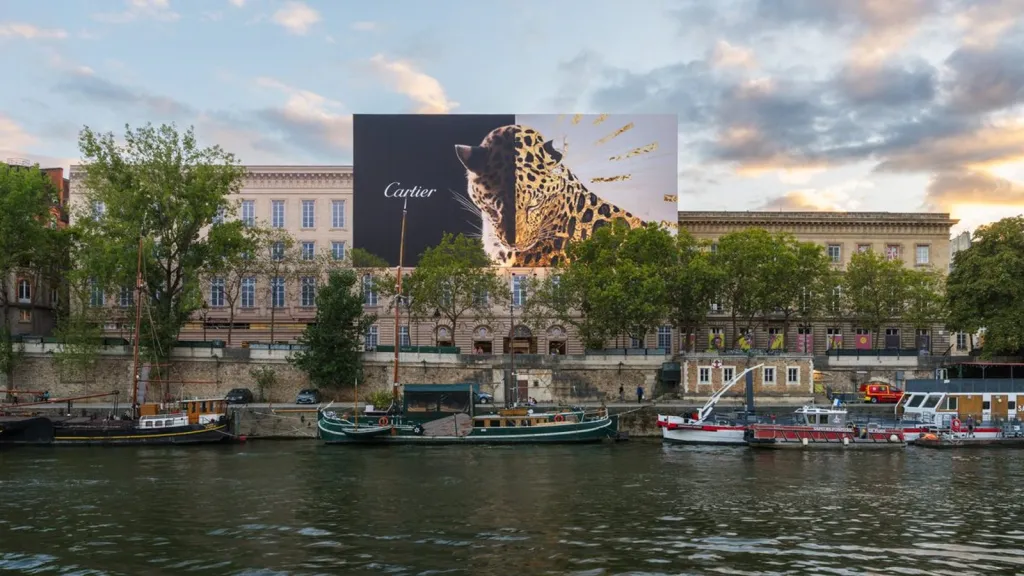
- Creation of a panther in black and gold glass mosaic for the façades of the Monnaie de Paris and the Madeleine.
- Participation in the Publicis Luxe campaign honoring five female art artisans.
The collaboration between Nîmes-based master glassmaker Myriam Hubert and the maison Cartier takes a new monumental step by appearing on the most beautiful buildings of the French capital. This prestigious alliance, which unites the technical rigour of craftsmanship with the aesthetic standards of high jewellery, bears witness to exceptional recognition for French glassmaking expertise. Through creations that combine light, transparency and material, the artist breathes an unprecedented poetic dimension into the visual codes of the famous maison on Rue de la Paix. By occupying prestigious spaces on an international scale and historical monuments in the heart of Paris, this artistic synergy demonstrates the vitality of French artistic crafts and their leading role in asserting the identity of great contemporary luxury maisons.
The story of this encounter is part of a fundamental movement where high luxury rediscovers the invaluable value of manual gesture and the unique piece. Faced with global standardisation, Myriam Hubert’s bespoke creations bring an extra soul and a singular vibration that resonate perfectly with the heritage of Cartier. This long-term collaboration illustrates how a young female art artisan, based in the south of France, can captivate the attention of one of the most prestigious jewelers in the world and transform high-flying concepts into realities of glass and light.

Nîmes excellence at the service of the jeweler
From the Nîmes workshop to shop windows worldwide
It is in the heart of the Courbessac village-district, behind a red door, that Myriam Hubert shapes her glass marquetry pieces. In this workspace shielded from view, time seems to stand still to make way for the extreme concentration and surgical precision required by the manipulation of glass. Each fragment is rigorously selected, cut and arranged to compose vibrant surfaces that capture and refract light in a unique way. It is this meticulous work, blending geometric rigour and artistic sensitivity, that gives her works an almost living depth.
Spotted in 2022 at the Révélations salon, the international biennial of artistic crafts and creation traditionally held in Paris, the artist has since collaborated with the maison Cartier on major international projects. This major event in the creative world served as a catalyst, allowing the maison’s artistic directors to detect the narrative potential and technical excellence of the master glassmaker’s creations. Since this first decisive encounter, the partnership has continued to intensify, propelling the work of the Gard workshop to the four corners of the globe. The artist’s creations have thus found their place within the most exclusive windows and prestigious spaces of the brand, from Tokyo to New York, via Dubai.
The artist notably finalised in 2025 an ornamental panel measuring 3.10m by 2.90m destined for the Riyadh boutique in Saudi Arabia. This colossal work required months of preparation, structural calculations and assembly work of rare complexity. To meet the architectural requirements of this Middle Eastern flagship, Myriam Hubert had to push the physical limits of glass marquetry, creating a structure capable of withstanding the constraints of transport and installation while maintaining absolute visual delicacy. This major project demonstrates the capacity of the Nîmes workshop to design and export monumental works destined for the most luxurious showcases on the planet.
A glass panther on Parisian façades
A monumental glass panther on Parisian monuments
The work of the Nîmes artist is now on spectacular display in the heart of Paris. For the brand’s latest campaign, Myriam Hubert created a panther in black and gold glass mosaic, the jeweler’s emblematic animal. This mythical figure, first introduced into the maison’s universe at the beginning of the twentieth century, embodies wild grace, untameable elegance and sophistication. By transposing this legendary motif into the register of glass mosaic, the artist has preserved the tension of movement and the magnetism of the feline’s gaze while giving it a mineral and luminous texture of great modernity.
This work is displayed on the monumental tarpaulins of the Monnaie de Paris, the Hôtel-Dieu and the Madeleine church, creating a visual dialogue between glass craftsmanship and jewellery. These historic buildings, symbols of French architectural and cultural heritage, serve as extraordinary showcases for this contemporary creation. The striking contrast between the centuries-old stone of Parisian monuments and the sophisticated brilliance of black and gold glass offers passers-by a memorable visual experience. This very large-scale public exhibition demonstrates the crucial importance of outdoor communication for luxury maisons, which temporarily transform the urban space into an open-air art gallery.
Each monumental tarpaulin faithfully reproduces the subtlety of the nuances of the original mosaic. The golden glints capture the variations of the Paris sky, while the deep blacks structure the nervous silhouette of the animal. This large-scale display system not only celebrates Cartier’s visual identity, but also highlights the technical virtuosity of an exceptional artistic craft to an extremely wide audience, thus breaking down the boundaries between high creation and the street.
The promotion of female expertise and manual creation
Beyond simple aesthetic collaboration, this initiative is part of a broader movement to recognise the role of women in artistic crafts and high creation. Historically, master glassmaker workshops have often been dominated by male figures due to the physical constraints associated with working with materials and heavy tools. By establishing herself as one of the leading figures in this demanding discipline, Myriam Hubert paves the way for a new generation of female creators who bring a fresh perspective, a different sensitivity and an innovative approach to textures and colours.
This highlighting of female work resonates strongly with the historical philosophy of the maison Cartier, which has often surrounded itself with women of character and visionaries to shape its aesthetic identity. The current collaboration perpetuates this tradition of audacity and artistic independence, showing that traditional techniques can be reinterpreted with a unique contemporary sensitivity. The alliance between the delicacy of glass and the strength of the lines created by the artist perfectly illustrates this creative duality.
Artisanal intelligence in stop motion
Under the aegis of the Publicis Luxe agency, a new campaign highlights five French female art artisans. Myriam Hubert contributed by creating a glass zebra for the fable “The Panther and the Zebra”, filmed using the stop motion technique. This cinematographic project of great visual poetry associates the stillness of the glass material with the illusionist movement of traditional animation cinema. Each tiny movement of the glass pieces, captured frame by frame, brings the fantastic animal to life, creating a luminous choreography where the material seems to awaken and come alive before the spectators’ eyes.
This artistic approach underlines the maison’s desire to celebrate the human gesture and material over artificial intelligence. In an era marked by the proliferation of digitally generated images and automated creation processes, Cartier makes the deliberate and militant choice to value “the intelligence of the hand”. The use of stop motion, a technique that requires infinite patience, millimetre precision and a sensitivity that algorithms cannot reproduce, becomes a manifesto in favour of artistic authenticity. Each subtle imperfection, each unforeseen reflection on the cut glass bears witness to the artisan’s intervention and gives the commercial film an organic texture and an incomparable emotional value.
The industrial and logistical challenge of regional artistic crafts
The international reach of Myriam Hubert’s workshop must not mask the material and daily realities faced by art artisans based outside major urban centres. The creation of monumental pieces requires not only exceptional artistic talent, but also adapted infrastructure and a smooth logistical environment. Transporting fragile and heavy raw materials, such as large glass sheets, as well as shipping finished works several metres long to distant destinations, constitute permanent logistical challenges that require specific arrangements and solid local support.
For many art artisans, the choice to settle in the regions responds to a need for space, tranquility and connection with a territory. However, the sustainability of these workshops depends on a fragile balance between the creative freedom offered by these locations and the operational constraints imposed by international clients with extremely strict requirements. The capacity of local authorities to support these exceptional businesses then becomes a crucial issue for maintaining rare expertise in the regions.
An uncertain future in the heart of Nîmes
Despite this global reach, the artist and her partner Rémi face local logistical challenges that threaten the continuation of their activity in the Gard. The absence of a pavement layout in front of the workshop complicates the delivery of glass sheets, a technical constraint that could force Myriam Hubert to leave Nîmes to pursue her extraordinary professional adventure. Large glass sheets, essential for the creation of her monumental panels for international destinations like Riyadh, require delivery conditions of absolute safety. Without an adapted road infrastructure facilitating the unloading of these highly fragile materials, the daily work of the workshop becomes a complex and risky obstacle course.
This situation highlights the sometimes striking gap between the international recognition enjoyed by French art artisans and the very concrete material difficulties they face on the ground. While her works are displayed in giant format on the most beautiful Parisian monuments and adorn luxury showcases on the other side of the world, it is a simple question of local urban planning that today weighs on the future of the Nîmes workshop. Resolving these infrastructure issues is essential to retain these unique talents who are the pride and economic dynamism of their adopted region.