

The Radio France Internationale programme, entitled 8 milliards de voisins : La mode peut-elle encore avoir du sens ?, offers an essential and highly topical reflection on the profound transformations taking place in the global textile industry. Broadcast in the form of an in-depth forty-eight minute and thirty-second interview, this radio programme directly addresses the paradoxes of a sector in the midst of an identity, economic and ecological crisis. The starting point for this major discussion is the publication, in June 2026, of the book Grande Couture by Débats Publics publishing house, written by Cameroonian designer Imane Ayissi. Through his own extraordinary creative journey, the designer questions the viability of current industrial models and offers an alternative vision where clothing once again becomes a vector of culture, respect and transmission.
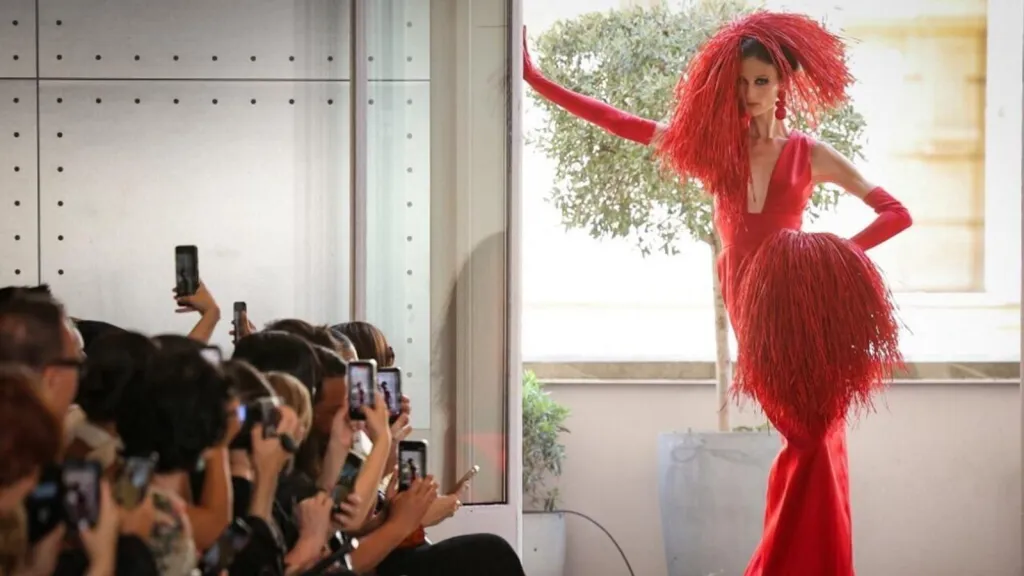
Fashion history reached a major milestone in 2020 when Imane Ayissi became the very first designer from sub-Saharan Africa to join the official calendar of Paris’s prestigious Haute Couture Week. This institutional recognition by the Fédération de la Haute Couture et de la Mode marked a decisive turning point in the global appreciation of savoir-faire from the African continent. The programme looks back at this unique trajectory, illustrated in particular by the presentation in Paris, on 6 July 2026, of Imane Ayissi’s Autumn/Winter 2026-2027 Women’s Haute Couture collection, captured by AFP lenses under the eye of photographer Thomas Samson. This Parisian show perfectly embodies the essence of his art, where each silhouette celebrates a harmonious encounter between the technical demands of Parisian couture and the textile richness of the African continent.


Imane Ayissi’s journey and the consecration of African creation
Imane Ayissi’s rise in haute couture
Imane Ayissi’s career stands out for its multidisciplinary and profoundly artistic nature. Before devoting himself fully to fashion design and haute couture, he made a name for himself in the field of dance, joining the national ballet of Cameroon, and later working as a model for major international couture houses. This physical experience of movement and the body lends his creations a unique fluidity and dynamic, where clothing is never a constraint but a natural extension of movement. His work is characterized by a constant and rigorous dialogue between traditional African fabrics, often overlooked or undervalued by the Western market, and the demanding codes of European couture.
Through his collections, Imane Ayissi strives to redefine the global perception of African fashion. He refuses to confine the continent to reductive aesthetic clichés such as the exclusive use of wax cloth, whose industrial and colonial origins are historically complex. Instead, the designer highlights genuine textile treasures rooted in ancestral savoir-faire, such as Kente, Manjak, Ndop or hand-woven raffia. By introducing these exceptional fabrics into the Paris Haute Couture calendar, he achieves an aesthetic decolonisation of minds. This process restores economic and cultural pride to local artisans, while demonstrating that these age-old techniques are perfectly suited to the contemporary demands of luxury and international design.
The quest for meaning in the face of fast fashion excesses and standardisation
Facing the excesses of industrial fashion
The question of meaning in fashion arises crucially today in a saturated market, dominated by fast fashion and ultra-fast fashion giants. These global retail platforms produce massive volumes of low-priced clothing, accelerating consumption cycles to the detriment of environmental resources and workers’ rights. Faced with this destructive standardisation, the RFI programme considers sustainable alternatives. The rise of second-hand and recycling demonstrates growing consumer awareness, yet these practices still struggle to offset the overall carbon footprint of an industry in perpetual overproduction.
In this context of systemic crisis, craftsmanship and bespoke creation represent clear solutions for the future. Imane Ayissi and the guests on the programme emphasize that true sustainability lies in embracing a slower pace. Creating a garment by hand, respecting the pace of growing and spinning natural materials, and celebrating the artisan’s craft are all actions that restore an emotional and ethical connection with our wardrobe. When fashion is conceived as a work of art and a vector of cultural identity, it stands in radical opposition to disposability. It invites us to consume less but better, placing intergenerational transmission back at the heart of the purchasing decision.
The voice of experts and the academic column
Perspectives from experts and sociologists
To explore this complex debate further, the RFI presenter is joined by experts offering complementary perspectives. Marie-Jeanne Serbin Thomas, editor-in-chief of the famous magazine Brune. a. au féminin, delivers a sharp analysis of evolving trends and the representation of women and Afro-descendant cultures in fashion media. Drawing on her editorial experience, she examines the invisible barriers that designers from the Global South must still overcome to establish themselves permanently in the Western market, while also welcoming the emergence of a new generation of committed designers who are reshaping the global landscape.
Towards the end of the broadcast, the programme takes on a sociological and academic dimension with the column Décalages culturels, prepared by Charlie Dupiot. Produced by RFI with the active support of Université Paris Cité and developed from an original idea by Chae-Yeon Bournel-Bosson from Français facile avec RFI, this column focuses on the daily reality of students on French campuses. In this segment, Christian, head of professional integration for work-study students at Paris Cité, talks with Philippe Pierre, a renowned sociologist and specialist in intercultural matters, who also teaches intercultural management. Together, they decipher the codes of self-presentation through the delicate exercise of writing a CV. They analyse how writing a CV reveals major cultural differences between students who struggle to highlight their skills due to cultural modesty, and those who have mastered personal marketing techniques to sell themselves effectively in the job market.
Useful fashion information
To further explore the topics covered in this programme and listen to the full discussions between guests on the ethical and artistic evolution of the fashion industry, various broadcasting channels are available online.