

In brief
- Filming for the second season of the France Télévisions series has moved into the basement of the Corum in Montpellier, an iconic venue in the Occitanie region.
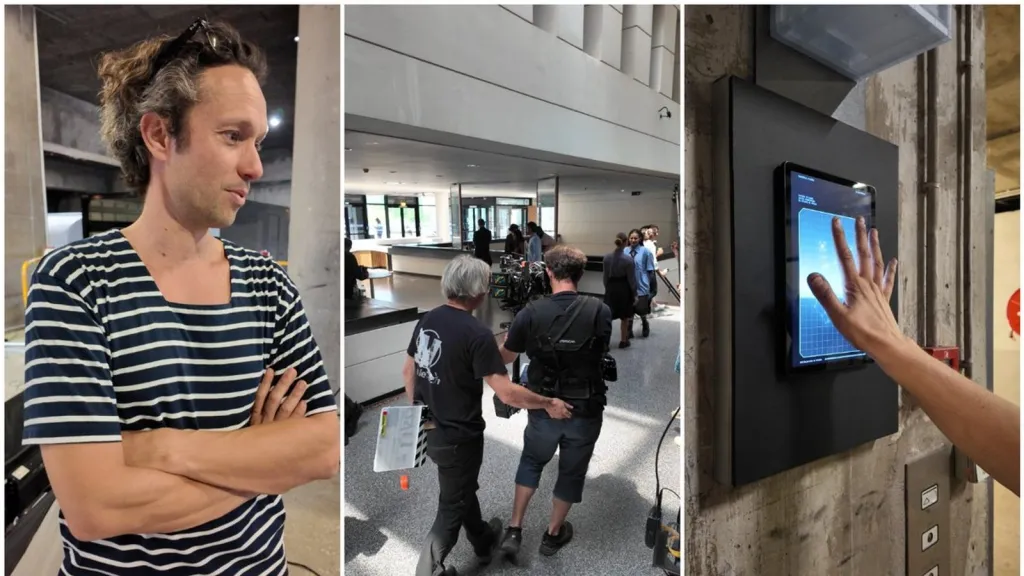
- Sète-based architect Thibault Pinto leads a dozen seasoned technicians to transform an underground car park and its technical access points into a striking and complex science-fiction set.
- The infrastructure of the Palais des Congrès is ideally suited to this transformation, offering the brutal volumes and industrial perspectives necessary for the production’s visual atmosphere.
- Stage manager Audrey Combes-Laget has programmed around thirty interactive screens to simulate a futuristic bunker, a precision task that blends digital graphics and hardware integration.
- These computer interfaces, visible on monitors and tablets, are essential for providing technological depth to the narrative of this second season of Bugarach.
- The broadcast of the new episodes is expected on screens in early 2027, marking a new milestone for science fiction produced within the Montpellier audiovisual ecosystem.
In September 2026, the teams from the series Bugarach in Montpellier took over the Corum to craft a spectacular science-fiction set under the direction of architect Thibault Pinto. This major project, carried out in the secrecy of the Hérault complex’s basements, reveals the complexity and rigour of the behind-the-scenes roles in French television production. The choice of this location was no accident. The Corum, which usually hosts international congresses and prestigious concerts within the Opéra Berlioz, possesses concrete architecture and technical zones whose aesthetics naturally lend themselves to speculative fiction universes. By exploiting the most remote areas of this iconic Montpellier building, the production optimises local resources while benefiting from a unique spatial setting, far from conventional film sets.
This temporary installation bears witness to the vitality of the audiovisual sector in the Montpellier metropolis, which asserts itself more each year as a stronghold for small-screen creation. The logistical deployment required to transform a loading dock or a service corridor into a futuristic command centre demands flawless coordination between different trades. From carpenters to electricians, and decorative painters, every contributor plays their part to ensure total immersion for the actors and, later, for France Télévisions viewers.

The Artisans in the Shadows at the Corum
At the heart of the Corum, activity is non-stop. The artisans in the shadows are working hard to ensure every visual detail is consistent with the aesthetic established during the first season, while raising the level of ambition for this second opus. The work of Thibault Pinto, an architect based in Sète, consists of translating script intentions into real volumes. He must juggle the technical constraints of the existing building, such as ceiling height or the location of support columns, to harmoniously integrate the added set elements. This collaboration between classical architecture and set design creates a particular synergy, where the raw concrete of the Corum becomes the ideal backdrop for a story set in the near future.
The technical staff, composed of a dozen specialists, must demonstrate great adaptability. Working in the basements involves managing complex logistical flows, transporting heavy equipment via service lifts, and maintaining a safe working environment in a confined space. Every wooden panel, every spotlight, and every prop must be positioned according to a rigorous plan, validated upstream by the production. The success of this set rests on this ability to erase the primary nature of the location to make way for the imagination of the series Bugarach.
The Art of Science-Fiction Set Design Under the Corum
After taking over the Vendargues studios, true pillars of regional production, the teams of the series Bugarach took possession of the basement of the Corum in Montpellier. For this season 2 of the science-fiction creation by France Télévisions, the aesthetic challenge is significant. Under the direction of Sète architect Thibault Pinto, a dozen technicians are busy operating a radical transformation of the site. A whole troupe of builders, painters, prop masters, and electricians is working in the shadows to materialise this futuristic universe. Their mission: to transform a simple utilitarian space into a strikingly realistic film set. The objective is to create a visual break from everyday life, while maintaining a certain architectural credibility essential to the science-fiction genre.
The use of the lower levels of the Corum allows for playing on a claustrophobic and underground atmosphere, a central theme of this new plot. Architect Thibault Pinto uses the building’s lines of force to guide the viewer’s eye and reinforce the monumental aspect of the bunker. The choice of materials, paint finishes imitating worn metal surfaces or high-tech composite coatings, contribute to this illusion. Each area of the set is designed to offer multiple viewing angles for the cameras, thus allowing for dynamic and varied staging despite the confined nature of the set. This technical expertise is the result of several weeks of preparation prior to the physical assembly on site.
The Digital Illusion of a Science-Fiction Set
Creating a credible future does not only involve walls and furniture. It requires a fine integration of technology into the characters’ daily lives. For Bugarach, this dimension is carried by a very particular attention paid to human-machine interfaces. Digital illusion is a pillar of modern scenography, where the virtual complements the tangible to bring a coherent universe to life. This work begins long before arriving on set, with the graphic design of elements that will appear on screen, and continues with meticulous physical integration during the construction phase of the set at the Corum.
A Major Technological Metamorphosis
The visual transformation relies heavily on the meticulous work of the exterior management. In the dim light of the basement, under the heat of the air vents that recall the building’s industrial activity, around thirty screens display lines of code and fingerprints to create the illusion of a true technological bunker. Audrey Combes-Laget, in charge of management, personally oversees the animation of each terminal. On tablets and monitors, codes scroll and security interfaces come to life fluidly. This precision work will then be taken over by the prop masters, responsible for handling these mock technologies during filming, ensuring that every gesture of the actors is in sync with the displayed digital flows.
This technological installation requires a substantial electrical and network infrastructure, temporarily deployed in the bowels of the Corum. Technicians must ensure the stability of video streams to avoid any interruption during takes. Managing reflections on screens, the brightness of panels relative to stage lighting, and the synchronisation of content are all technical challenges met by Audrey Combes-Laget’s team. These thirty screens are not simple background elements; they actively participate in the narrative, providing crucial visual information for the plot’s progression and reinforcing the sense of urgency inherent to the speculative fiction genre.

A Millimetre-Perfect Race Against Time
The production schedule allows for no delays, a constant reality in the audiovisual industry where every additional day of filming represents a significant cost. With filming scheduled to begin on Tuesday at noon, the teams had less than 48 hours to complete the overall installation. On Monday evening, the excitement was palpable in the basements of the Corum, punctuated by the whirring of drills and the opening of bulky equipment crates. To orchestrate this ballet of drills and jigsaws, technicians refer to architectural plans meticulously taped to the concrete walls of the Corum. These working documents are the team’s compass, indicating with surgical precision the location of every screw and every cable.
The series producer, Olivier Compère, supervises this tight timing where every minute is optimised. His presence on the ground testifies to the importance of this construction phase. He must ensure that artistic intentions are respected while adhering to budgetary and temporal imperatives. The pressure is constant, because as soon as the first “action” sounds on Tuesday at noon, the set must be perfectly operational, safe, and aesthetically irreproachable. This logistics of urgency is the daily lot of productions of this scale, demanding endurance and responsiveness from the professionals involved.
The Secret of the Masterpiece
Beyond the purely technical and organisational aspect, the creation of a series set also relies on the preservation of a certain magic. Some elements are so crucial to the plot that they are subject to special protection measures during the assembly phase. The curiosity of passers-by or Corum employees is contained to avoid any information leaks on social media. This culture of secrecy is essential to maintain public interest until broadcast. The technicians themselves are aware of the importance of this discretion, working on elements whose narrative scope they know without revealing details outside the production circle.
The Mystery of the Centrepiece
At the end of a loading dock, hidden from prying eyes, technician Marcello Urbina Alarcon is busy on an imposing wooden structure, whose exact function remains jealously guarded by the production. This mystery surrounds what is described as the most crucial design element of the set, a centrepiece that alone crystallises the aesthetic of this season 2. The primary objective of this physical transformation remains to create a major surprise effect for viewers during the broadcast. This type of structure requires high-level craftsmanship, blending traditional carpentry and decorator tricks to give wood the appearance of much more exotic or technological materials.
Marcello Urbina Alarcon, through his precise gestures and attention to detail, embodies this technical excellence necessary for the credibility of imaginary universes. The structure he is assembling will likely serve as a focal point for many key scenes, requiring absolute sturdiness to accommodate actors and filming equipment. To appreciate the final result of this metamorphosis orchestrated with passion in Montpellier, the date is set for early 2027 on France Télévisions screens. Until then, the Corum will have regained its calm and usual use, leaving behind only the images captured during these few days of intense work in the shadows of its basements.
The adventure of Bugarach at the Corum perfectly illustrates how urban architectural heritage can become a precious ally for fiction. By repurposing the primary functions of public spaces, series creators manage to build distant worlds in the very heart of our cities. This collaboration between the city of Montpellier, its iconic locations, and audiovisual professionals continues to bear fruit, promising a season 2 rich in visual discoveries and strong emotions for fans of French science fiction. The work accomplished in September 2026 will remain as a testament to the ingenuity of the technicians who, far from the spotlights, build the dreams of tomorrow.
Find out more
- Add to preferred sources on Google
- Thibault Pinto
- Subscribe to read more
- Log in
- Settle my outstanding balance (2 min)