

In brief
- The 18th edition of the Biennale de Lyon will be held from 19 September to 13 December 2026 under the direction of Catherine Nichols.
- The 2026 Prix Marcel Duchamp will take over the musée d’Art moderne de Paris from 2 October 2026 to present its four nominated artists.
- Major carte blanche exhibitions will celebrate Sheila Hicks at the palais des Beaux-Arts de Lille and Caroline Desnoëttes at the Collège des Bernardins.
For the autumn 2026 season, contemporary art takes centre stage in the European cultural scene through a programme of exceptional richness, driven by aesthetic dialogues and the metamorphosis of materials. From the dynamism of the Biennale de Lyon to the most anticipated retrospectives in the capital, cultural institutions are preparing to unveil premier immersive journeys. This abundance of artistic proposals testifies to the vitality of a sector in constant flux, where the boundaries of creation shift to encompass ecological, poetic, and memorial issues. Major museums and art centres are asserting themselves more than ever as spaces for experimentation and transmission, inviting the public to take a fresh look at our era.
William Kentridge unfolds his poetic work in Brussels
Major artistic events in Europe
From his iconic charcoal drawings to his theatrical and cinematic installations, the committed work of South African artist William Kentridge is on display at the Palais des Beaux-Arts (Bozar) in Brussels. This historical journey traces his singular career from the 1980s to the present day, blending intimate narratives and political questions. The exhibition will be held from 18 September 2026 to 7 March 2027 within the famous Circuit Ravenstein. This masterpiece of Art Deco architecture offers an ideal setting for the plurality of mediums explored by the artist. By exploring notions of collective and individual memory, Kentridge’s work resonates deeply with contemporary history, offering a poetic reflection on human fragility through plays of shadow and erasure.
The 2026 Biennale de Lyon: contemporary art questions the living
For its 18th edition, the Biennale d’art contemporain de Lyon, orchestrated by curator Catherine Nichols, explores the theme “Moving from one dream to another”. Inspired by the traboules of Lyon and the poetic economic theories of Robert Filliou or Walter Benjamin, the event brings together over 70 international artists to question the interdependencies of the living world. The works will occupy iconic venues such as the macLYON and the Grandes Locos from 19 September to 13 December 2026. The integration of the Grandes Locos, former rehabilitated industrial workshops of the SNCF, highlights the importance of anchoring art in the region’s industrial and heritage history. Through these monumental spaces, the exhibition is conceived as a cartography of our shared imaginaries, questioning our modes of existence and the ties we forge with our natural and social environment.
The alliance of heritage history and plastic innovation
Autumn 2026 marks a turning point in how cultural institutions approach exhibition space. The dialogue between historical heritage and avant-garde artistic practices is intensifying, allowing famous architecture to be rediscovered in a completely new light. Monuments are transformed into living territories of expression, where stone and period structures host bold temporary installations. This temporal confrontation enriches the perception of visitors, who navigate between the evocation of the past and the prospective visions of contemporary creators. By mobilising varied techniques that integrate with existing volumes, artists succeed in transfiguring places of memory into spaces of active questioning.
Four finalists for the 2026 Prix Marcel Duchamp
Highlights of the Parisian scene
During the renovation work at the Centre Pompidou, the musée d’Art moderne de Paris is hosting the new edition of the prestigious Prix Marcel Duchamp. Four major creators come together: Joël Andrianomearisoa, the duo Brognon Rollin, Laura Henno, and Josèfa Ntjam, offering a striking panorama of the political, identity, and memorial questions of our time. The collective exhibition will open its doors on 2 October 2026 and close on 7 February 2027. This prize, a true barometer of contemporary creation, demonstrates again this year the diversity of aesthetic approaches among artists on the French scene. Whether they explore intimate narratives through textiles, documentary video, or multimedia installation, these creators seize upon the shadows of the modern world to propose works that are both poetic and committed.
Sheila Hicks’ textile dialogue at the palais de Lille
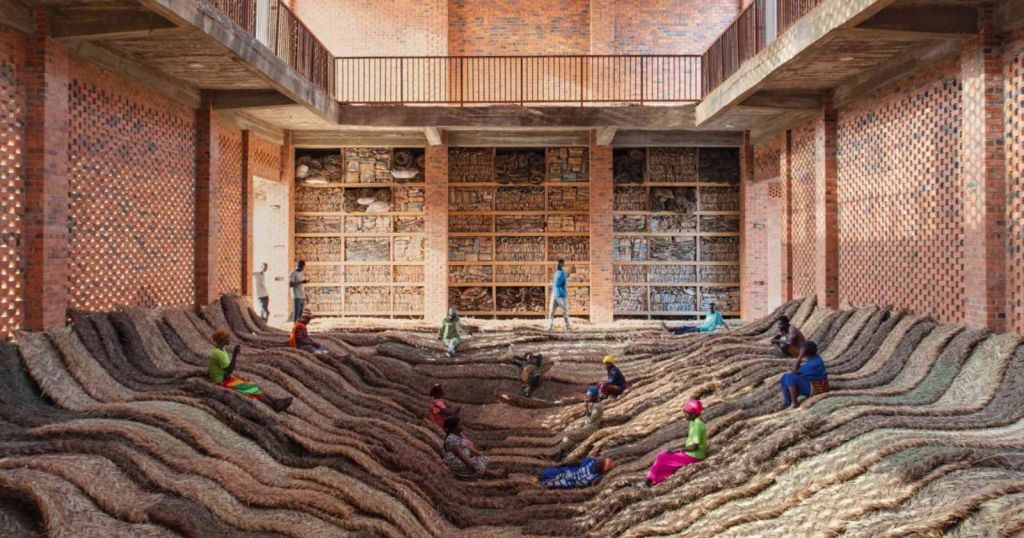
American artist Sheila Hicks, based in Paris since 1964, takes over the palais des Beaux-Arts de Lille with a monumental in situ installation, custom-designed for the atrium. This sculpture of coloured threads pays a vibrant tribute to the industrial and manufacturing past of the northern city while weaving itself into the heart of the institution’s permanent collections. This unique carte blanche will be accessible from 9 October 2026 to 8 March 2027. Known for her ability to sculpt space using wool, cotton, and linen fibres, the artist creates a colourful and sensory rupture within the museum’s classical architecture. This textile dialogue, full of suppleness and nuance, awakens the local history of drapery and spinning, while establishing a poetic bridge between traditional craftsmanship and modernity.
Caroline Desnoëttes’ organic installation in Paris
Entitled “Eaux vives”, the monumental installation by Caroline Desnoëttes invites itself into the historical setting of the Collège des Bernardins. This polyptych composed of 60,000 hand-shaped mulberry fibre paper drops offers a subtle dialogue between art and science, designed in collaboration with oceanographers and marine biologists. A total sensory experience to discover from 9 October to 1 December 2026 in the 5th arrondissement of Paris. By choosing the Gothic nave of the Bernardins, the artist plays on the verticality and light of the space to raise public awareness of the beauty and vulnerability of aquatic ecosystems. Each paper drop becomes a vector for environmental awareness, inviting active contemplation in the face of current challenges related to the preservation of our planet’s water resources.
The interdisciplinary dialogue between art and science
The convergence of disciplines is proving to be a major area of research for creators this autumn 2026. By partnering with environmental experts, historians, or scientists, artists go beyond the simple aesthetic framework to propose works that concretely question global ecological and biological dynamics. These innovative collaborations allow complex technical data to be translated into palpable visual and emotional experiences. Art thus becomes a privileged tool for transmission and awareness, capable of reaching a wide audience through immersive devices that engage the senses and spark collective reflection on the global issues of our century.
Lionel Sabatté explores the metamorphosis of matter
When matter and space metamorphose
The Musée de la Chasse et de la Nature is hosting the exhibition “Ce qui reste”, dedicated to the recent work of Lionel Sabatté, curated by Amélie Adamo. Through unusual materials such as dust, ash, earth from Lascaux, or dead skin, the artist brings hybrid animal creatures to life, questioning the passage of time and the cycle of life. The opening of this exhibition is scheduled for 15 October 2026. The world of Lionel Sabatté aligns organically with the intimate and mysterious setting of this museum located in the heart of the Marais. By rehabilitating these everyday scraps to create sculptures charged with a spiritual and mythological dimension, the artist establishes a poetics of ruin and rebirth, reminding us that every body is destined to transform.
The geometric tribute to François Morellet at the Trocadéro
To celebrate the centenary of the birth of François Morellet, the Cité de l’architecture et du patrimoine is partnering with the Centre Pompidou. The exhibition “Traits d’esprit” highlights the interventions of this major figure of geometric abstraction within public space and modern architectural structures. This original retrospective sheds light on a singular aspect of his creative path, marked by mathematical rigour, irony, and a constant desire to desacralise art. By taking over the Palais de Chaillot, Morellet’s works resonate with the building’s architectural lines, showing how the artist knew how to use light, neon lines, and systematic grids to disrupt the perception of space and invite the spectator to play with geometric perspectives.