
In brief
The summer biathlon tour in Norway offered a thrilling spectacle during the events reserved for young talents in the U21 category. Gathering in the prestigious setting of the Blink Festival, the future big names of the discipline faced off on the asphalt tracks of Sandnes during a particularly selective time-trial prologue.
- Ismaël Croizier takes fifth place in the U21 prologue at the Blink Festival in Sandnes.
- The Savoyard athlete thus secures a direct ticket to the mass-start A final.
This remarkable performance allows the young French athlete to approach the rest of the competition with confidence and ambition. By rising into the top five biathletes of this qualifying round, he avoids the complex repechages and places himself directly at the forefront for the final showdown.
The Blink Festival in Sandnes, an unmissable event for summer biathlon
Every summer, the Norwegian town of Sandnes transforms into the epicentre of summer Nordic sports. The Blink Festival gathers the world’s elite in cross-country skiing and biathlon for intense clashes on roller skis. In this unique urban setting, the route designed in the heart of the city imposes very specific technical demands on organisers and competitors alike. The asphalt of the Norwegian streets offers a radically different grip to fresh snow, pushing athletes to adjust their footing and pole thrust.
For young biathletes in the U21 category, this gathering represents a full-scale test of paramount importance. In the midst of summer preparation, when physical workloads are high ahead of the winter season, measuring oneself against the best Scandinavian specialists allows for an accurate assessment of fitness levels. The pressure of the crowd gathered along the safety barriers faithfully reproduces the fervour of major World Cup or IBU Cup stages.
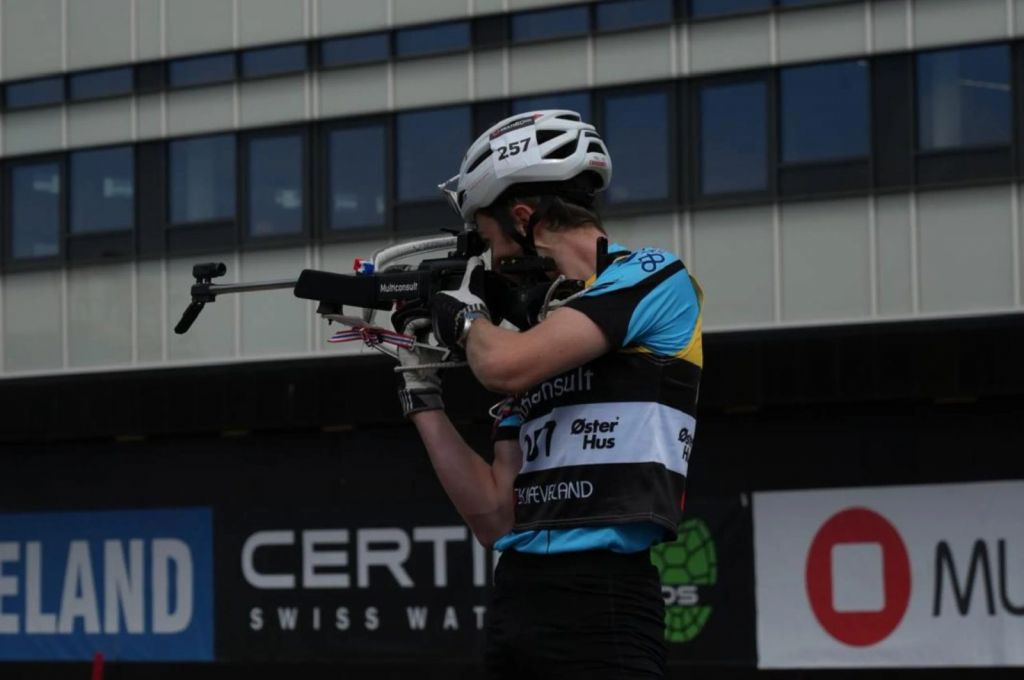
The format of the prologue, contested as an individual timed effort, leaves no room for tactics or drafting. Each competitor must manage their effort alone, from the first pole stroke to crossing the line, while maintaining extreme focus at the shooting range to knock down the black targets.
- With 8/10 shooting, Paul Cartier finishes eighteenth and joins the B final.
In a confrontation where the overall standard is particularly tight, the slightest fraction of a second lost on the track or at the targets comes at a high price. Paul Cartier learned this the hard way during this U21 prologue. Despite a solid performance at the shooting range, reflected in a very respectable score of 8/10, the young Frenchman was unable to secure his direct ticket to the grand final.
His eighteenth place in the general classification forces him to go through the B final. In this highly contested consolation round, he will have the opportunity to adjust his sights once more and use his physical power to chase the best possible result on the Scandinavian asphalt.
During the event in Sandnes, the Frenchman Ismaël Croizier secured his qualification for the U21 biathlon final by finishing fifth in the time-trial prologue held on a 1.1-kilometre urban circuit.
This short and extremely dynamic circuit demanded constant acceleration. With three complete laps to cover the overall distance of the prologue, bodies were pushed to their absolute limits from the very first metres of the race. Managing the tight corners in the town centre, combined with crossing sometimes slippery asphalt strips, selected the best technicians in the international field.
An impressive race pace in the streets of Sandnes
Competing on the Norwegian loop to be completed three times, Ismaël Croizier quickly set his tempo. Very fast on his roller skis, the representative of SC Peisey-Vallandry led the race at the halfway mark before heading into the second shooting session.
The biathlete from the Savoie committee displayed all his technical ease on the Norwegian asphalt. Trained on the heights of the Savoyard resort within SC Peisey-Vallandry, the young man possesses a gliding quality and pushing power particularly suited to summer biathlon. From the very first intermediate time check, he showed that he was capable of competing with the greatest Nordic prospects.
His opening part of the race, conducted at a blistering pace, made a strong impression. Approaching the shooting range for the first prone shoot with confidence, he managed to maintain a high skiing frequency on the first 1.1-kilometre lap. This ideal start allowed him to place his name at the very top of the provisional standings at the halfway mark, proving the quality of his summer preparation and his current excellent physical condition.
Leo Gundersen’s victory at the targets
Despite three errors during the standing stage, bringing his overall score to 6/10, the young Frenchman limited his deficit at the finish line. He conceded 48.1 seconds to the Norwegian Leo Gundersen, who shot a solid 7/10 to claim first place in the prologue.
The standing shoot, always tricky when the heart rate is at its peak after an intense effort on roller skis, proved decisive for the outcome of this time trial. Entering the shooting range with one of the fastest ski times, Ismaël Croizier made three mistakes on the knock-down targets. These missed shots forced him to ski penalty loops or suffer the corresponding time penalties, slowing his momentum towards victory.
However, his finish on the third and final 1.1-kilometre lap was exemplary. By picking up the pace on his skis, the Savoyard made up some of his deficit to cross the finish line in fifth place overall. The Norwegian Leo Gundersen, perfectly tuned in front of his home crowd, managed to tame the local pressure. With a shooting score of 7/10, Gundersen took first place in the prologue, 48.1 seconds ahead of Croizier, demonstrating the great consistency of Scandinavian skiers on home soil.
The contrasting fortunes of Paul Cartier in the B final
For Paul Cartier, the performance behind the rifle proved more precise with an 8/10 card. Nevertheless, the time gap at the finish line relegated him to eighteenth place, missing the cut for the grand final by just a few seconds.
The harsh reality of modern biathlon was a stark reminder for the young French athlete. By delivering a diligent performance at the shooting range with only two errors out of ten shots fired, Paul Cartier nevertheless posted one of the cleanest shooting scores of the day. Unfortunately for him, the ski time required to complete the cumulative 3.3 kilometres of the urban course was not enough to make up for the few seconds lost on the track.
Separated from the leading pack by a minimal margin, Cartier saw qualification for the A final slip away by a whisker. This eighteenth-place finish propels him into the B final, a race where grit and a desire for revenge are often powerful motivators. There, he will meet other competitors caught out by the high density of this prologue, with the firm intention of proving the value of his current fitness level.
Shooting management and physical demands of roller-ski biathlon
The effort produced during a summer biathlon event on roller skis differs considerably from races held on snow in winter. The lack of natural glide inherent to snow cover forces athletes to exert greater muscular strength in their upper limbs and torso. On a 1.1-kilometre circuit completed three times, the constant accelerations out of corners place huge demands on the cardiovascular system.
Arriving at the Sandnes shooting range with a heart rate close to maximum is one of the major challenges of the event. The transition between intense physical effort on the asphalt and the stability required to hold the .22 Long Rifle requires total mental control. A single heartbeat that is too fast or poorly synchronised breathing can deflect the bullet by a few millimetres, enough to miss the round target and fall behind on the scoreboard.
The stakes of the mass start at the Blink Festival 2026
Thanks to his top-5 ranking, Ismaël Croizier approaches the mass-start final with legitimate ambitions against the world elite of the junior categories. This summer test on the Scandinavian asphalt offers a valuable, high-pressure confrontation ahead of the winter events.
The mass-start format, or grouped start, promises a head-to-head battle of rare intensity. Unlike the individual time trial of the prologue, all finalists will set off side by side. On an urban course as narrow as the one in Sandnes, positioning within the pack, trajectory management, and speed of execution during shooting range visits will play a decisive role.
By securing fifth place in this qualifying phase, Ismaël Croizier has earned a prime spot on the starting grid. The SC Peisey-Vallandry member has all the assets to play a leading role against formidable Norwegian and international competitors. Beyond the raw result, this direct head-to-head confrontation serves as a dress rehearsal for the preparation of the upcoming winter season, gaining valuable experience at the highest level of the U21 category.