
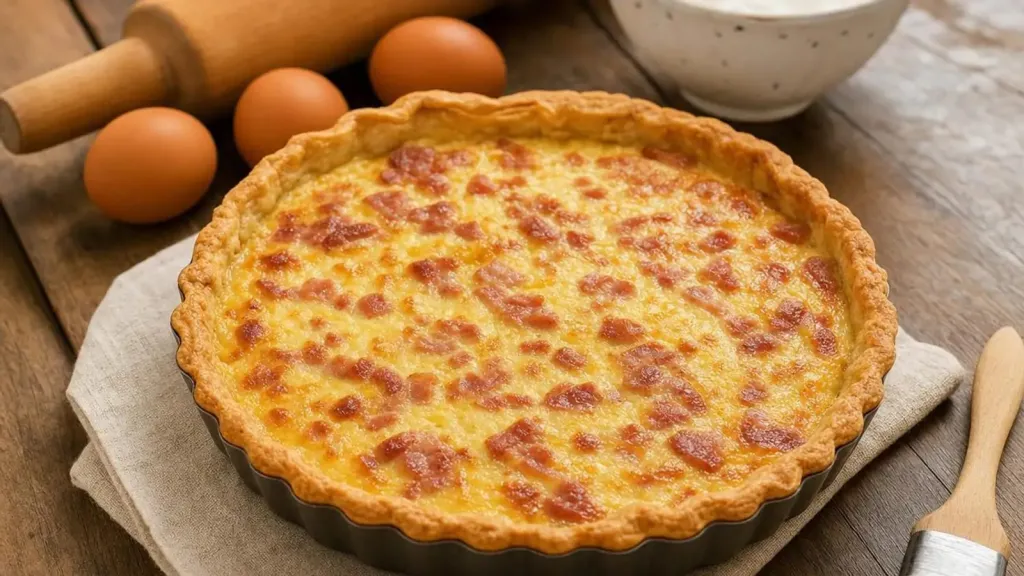
by La Rédaction Marmiton, published on 14/10/2026 at 21:00 In Nancy, the brasserie L’Excelsior makes the authentic quiche lorraine recipe a matter of honour, going as far as banning all cheese from its kitchens. In its kitchens, a duo of chefs reveals unexpected techniques to transform a simple tart into a regional emblem. Adding a handful of grated emmental to a savoury tart remains a common reflex in many households. However, stepping through the doors of the brasserie L’Excelsior in Nancy is enough to realise how much this habit upsets the defenders of regional traditions. Speaking to the cameras of the magazine 66 Minutes on M6, pastry chef Alice recalls the strict principles of the authentic quiche lorraine recipe, a speciality served every day at the tables of this famous Art nouveau institution. Far from the industrial or family variations that saturate the stalls, the local gastronomic reference categorically rejects the slightest piece of cheese. While the general public readily associates the dish with a golden, gratin-style crust, the Nancy artisans are leading a true battle of orthodoxy against this widespread culinary deviation. [fpvideo mediaid=”https://www.youtube.com/watch?v=z06gwd-p12Q&t=470s” no_top_page=”yes” autoplay=”no”] At the heart of Nancy’s cuisine, the mere mention of a cheese filling triggers a categorical rejection. Asked about the possible presence of emmental or gruyère under the pastry, the artisan of the brasserie offers a blunt comparison: “Cheese? Well, that is a bit of a sacrilege. It is a bit like saying that in carbonara in Italy, you would put cream.” Respect for the dish begins long before the seasoning, starting with the handling of the tart base. Having retrained in the profession after a career in medical equipment, this former sales representative explains that “it was chef Kevin who showed me the pastry recipe, and then I developed my own techniques for chiqueter”. This crimping operation consists of methodically scoring the edges to ensure a perfect hold and a classic aesthetic. The liquid preparation of the quiche has an official and centuries-old name in eastern France. The migaine refers to a culinary binding composed solely of beaten whole eggs, crème fraîche, salt, pepper and a hint of nutmeg. The local rule excludes any other liquid ingredient: “It is truly a base of egg cream and salt and pepper with nutmeg, and that is what we call the migaine.” The intensity of the filling then stems from a very precise proportion of meat, without onions or parasitic mushrooms. At the helm of the brigade for seventeen years, head chef Kevin ensures the historical weight is respected and insists that “this, you have to load it with lardons. 200 grams in total for 50 centilitres of cream”. The main domestic pitfall lies in the softening of the shortcrust pastry upon contact with the liquid cream. To guarantee an impeccable crispness when tasting, the team applies a proven chef’s tip: “The chef’s trick, to keep the crunch, is to pour this preparation onto a pastry that has just come out of the fridge.” Managing the oven also requires great rigour with two successive thermal stages. The process begins with a sharp 15-minute sear at 220 degrees, before a 20-minute stabilisation phase at 170 degrees. Upon leaving the tray, a waiting period is necessary to let the texture set before slicing: “They are good. In fact, they finish themselves off.”