

In brief
- A single performance scheduled for 12 January 2027 at the Théâtre de l’hôtel de ville in Saint-Barthélemy-d’Anjou.
- An adaptation of Victor Hugo’s masterpiece performed by a single actor on stage.
- A show accessible from age 12 upwards with a standard ticket price set at €24.
On 12 January 2027, the Théâtre de l’hôtel de ville in Saint-Barthélemy-d’Anjou will play host to a major theatrical adaptation of Victor Hugo’s novel Les Travailleurs de la mer (Toilers of the Sea). This production promises to immerse the audience in an intense maritime epic, exploring human solitude and self-transcendence when faced with the untamed forces of nature. This bold adaptation translates the scale of Hugo’s work into a staging of profound simplicity. The audience in Anjou will have the opportunity to rediscover this foundational text of national literature through a modern stage interpretation, highlighting the musicality of Hugolian prose and the dramatic power of its plot.
Programming this masterpiece forms part of Maine-et-Loire’s cultural outreach dynamic, which strives to present demanding works in an accessible manner. By revisiting this literary monument, the production offers a streamlined reading that focuses on the essential: the raw confrontation between man and ocean. The restraint of the artistic choices serves to illuminate the original poetry of the text, whilst offering contemporary theatregoers a memorable sensory immersion.

Les Travailleurs de la mer in a new light
The Hugolian legacy on stage
The original work, written by Victor Hugo during his exile in the Channel Islands, finds a particularly modern resonance in this stage version. Translating the novel to the stage requires meticulous adaptation work, preserving dramatic tension whilst condensing the book’s narrative density. By focusing on the most intense episodes of Gilliatt’s struggle against the elements, the production succeeds in making the writer’s prose immediate and physical, captivating the audience through a sustained pace and constant theatrical tension from start to finish.
The wild epic of a man facing the ocean
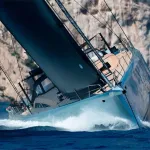
The plot centers on the destiny of Gilliatt, a solitary man confronted with the immensity and fury of the ocean. To win the heart of Déruchette, the protagonist embarks upon an undertaking deemed impossible: to salvage the engine of a modern ship stranded amidst a hostile reef. Gilliatt must overcome extreme trials, battling in turn hunger, exhaustion, storms and creatures of the deep. This titanic struggle becomes a profound meditation on the human condition and the mysteries of our world. Through Gilliatt’s ordeals, Hugo’s entire philosophy regarding the fight against the fatality of nature finds expression on the stage.
The confrontation between Gilliatt and the marine forces also symbolises the transition to the industrial era, embodied by the steam engine he attempts to extract from the reefs. This battle of a solitary man against the chaos of a hostile, rocky archipelago, far from any human presence, highlights his unwavering determination and tragic nobility. Hugolian writing, driven by the spirit of adventure, precisely describes the anatomy of a storm and the psychology of an absolute hero, whose moral strength overcomes the physical barriers of his environment.
A minimalist yet total direction
The choice of a pared-down aesthetic stems from a desire not to clutter the stage space with excessive technical artifices. From this perspective, the direction relies on theatre’s power of suggestion to bring the invisible to life. The roaring of the waves, the bite of the wind and the oppressive silence of the marine depths are evoked through subtle lighting and precise sound design. This approach allows the audience to feel the immensity of the ocean and the hero’s isolation in an intimate way, transforming the auditorium into a sounding board for the unleashed elements.
The power of stripped-back direction
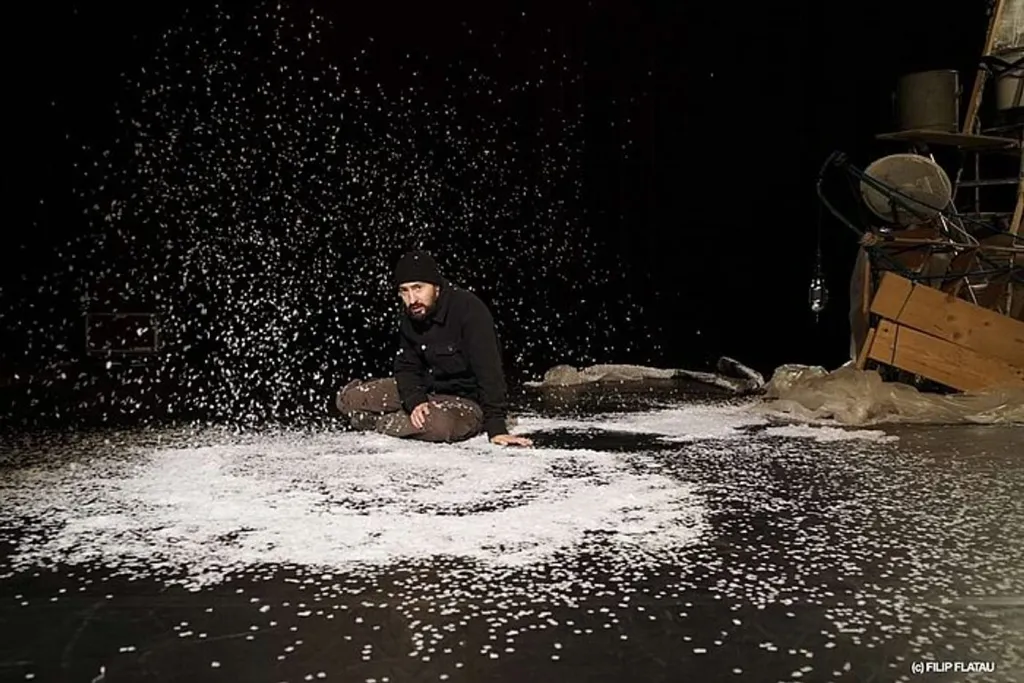
To bring this monumental canvas to life, the direction relies on the performance of a single actor. Alone on the stage boards, he alternately embodies the narrator and the story’s various characters, captivating the audience through his presence alone. The set consists exclusively of debris from a wrecked ship, which transforms throughout the narrative into props or landscapes. This economy of means stimulates the audience’s imagination and reinforces the poetic aspect of this extraordinary adventure. The actor becomes the central pivot of the performance, single-handedly carrying the physical immensity of the text.
This athletic and memory-intensive performance demands absolute commitment from the actor. Without artifices to mask hesitations, every gesture, glance and vocal modulation contributes to building the maritime universe. The physical nature of the performance reflects Gilliatt’s gradual exhaustion against the elements, whilst the clarity of his diction restores all the poetic beauty of Victor Hugo’s language. The scattered wooden and metal debris on stage takes on multiple dimensions under the actor’s touch, evoking in turn the ship’s cabin, the sharp reef or destructive waves.
A local cultural setting in Maine-et-Loire
A cultural interlude in Anjou
Presenting this major play at the Théâtre de l’hôtel de ville (THV) highlights the importance of local venues in the Angers conurbation. This cultural venue is committed to offering a diverse programme, blending artistic forms and fostering encounters between classic repertoire works and all audiences. Hosting a demanding production adapted from Victor Hugo demonstrates the institution’s commitment to nurturing ambitious creative theatre beyond major metropolitan centres. The cultural dynamism of Saint-Barthélemy-d’Anjou thus offers a high-quality space for contemporary creations that leave a lasting impression.
Accessible programming in Anjou
The show, suitable for ages 12 and over, appeals equally to lovers of classic literature and enthusiasts of contemporary creations. The venue provides tailored facilities to ensure comfort for all audience members during the evening. The auditorium at the Théâtre de l’hôtel de ville features facilities for guests with reduced mobility and an induction loop for hearing accessibility. The performance will run from 20:00 to 21:15, delivering an hour and fifteen minutes of pure emotion. This concise duration encourages maximum focus and allows for an uncompromising immersion into Hugo’s universe.
The attention paid to accessibility demonstrates the institution’s commitment to engaging the community in all its diversity. In particular, the induction loop helps overcome hearing difficulties, ensuring a perfect rendering of the nuances in the actor’s voice. Similarly, adapted access points facilitate entry for all theatregoers, turning this performance into a moment of collective sharing. The early evening start time is ideally suited for families and school groups attending during the week.
Jean Lurçat’s cultural getaway
The cultural offering of the Angers region extends far beyond the theatrical stage, encompassing a rich heritage and world-class textile arts. Visitors wishing to extend their stay in Anjou can explore local museums housing exceptional collections, thereby establishing fertile artistic connections between dramatic texts and the visual arts. This overall artistic vitality reflects a region where contemporary creation consistently builds upon a solid historical legacy to reinvent its cultural offerings.
An artistic interlude around tapestry
Alongside this theatrical event, art lovers visiting the Angers region can extend their cultural journey through textile arts. Currently, the historic wall hanging Le Chant du monde by Jean Lurçat is on a major loan. The tapestry by Jean Lurçat can be viewed at the Cité internationale d’Aubusson prior to its planned return to Maine-et-Loire in December 2026. In the meantime, the Aubusson institution invites visitors to discover Tolkien’s universe through an exclusive thematic exhibition. This showcase of textile creation illustrates the close ties existing between Maine-et-Loire and major tapestry production centres.
The famous wall hanging by Jean Lurçat, a true masterpiece of 20th-century textile art, echoes the centuries-old tradition of monumental tapestry deeply rooted in the Anjou landscape. This exceptional loan to Aubusson allows this heritage to shine beyond the borders of the Maine-et-Loire department, whilst preparing for its highly anticipated return at the end of 2026. Meanwhile, the Aubusson exhibition dedicated to Tolkien demonstrates how traditional weaving can capture modern fantasy worlds, creating a fascinating parallel with dramatic art, which likewise gives body and form to mythical tales and novelistic epics.
Production details
- Work: Les Travailleurs de la mer, based on Victor Hugo
- Venue: Théâtre de l’hôtel de ville (THV), Saint-Barthélemy-d’Anjou
- Date: Tuesday 12 January 2027, from 20:00 to 21:15
- Prices: €24 (full price), €20 (partners), €11 (concession price)
- Booking: Available via the theatre’s official box office.