

In brief
- A new photography exhibition in Saint-Jean-de-Luz will run from 11 September to 18 October 2026 at La Rotonde.
- Basque photographer Guillaume Fauveau presents his series ‘Ce que la mer reprend · Itsasoari begira’.
- The event is part of the European Heritage Days, under the theme ‘Heritage in Danger’.
As part of the European Heritage Days dedicated to the theme ‘Heritage in Danger’, the town hosts the photography exhibition in Saint-Jean-de-Luz from 11 September to 18 October 2026 at La Rotonde, revealing Guillaume Fauveau’s work on the changing Basque coastline. Through his series entitled ‘Ce que la mer reprend · Itsasoari begira’, the photographer offers a perspective that is both documentary and sensitive on a landscape that we wrongly imagine to be immutable.
This major cultural initiative directly questions our relationship with the territory and temporality. Heritage Days are traditionally an opportunity to celebrate historic monuments, ancient buildings and architectural expertise preserved through the centuries. By choosing to direct the public’s gaze towards natural spaces subjected to the pressure of the elements, the municipality and the artist shift the usual boundaries of this celebration to incorporate environmental fragility. The coastline, with its rugged terrain and dynamic balance, itself becomes a living historic monument, a geological and human archive whose sustainability is now being challenged by the combined forces of climate and ocean.
A Basque coastline in constant mutation
A Basque coastline in constant metamorphosis
The sea shapes daily life in Saint-Jean-de-Luz, observed from the cliffs, beaches or harbour quays. Yet behind this apparent eternity, the landscape is imperceptibly transformed: cliffs retreat, beaches metamorphose and protective structures crack.
The artist Guillaume Fauveau focuses on capturing this gradual shift of the coastline, immortalising the encounter between natural power and human installations. Through his photographs, the traces of physical erosion mingle with memories of landscapes on borrowed time.
The Basque coast is subject to ocean forces of remarkable intensity. The waves of the Atlantic Ocean, often amplified by winter storms, strike the region’s geological structures head-on. This phenomenon of permanent wear and tear is not limited to a simple geometric retreat of the land before the water. It is a daily renegotiation of habitable space and geographical boundaries. The flysch cliffs, those layered rock formations so characteristic of the local coastal landscape, suffer regular landslides, carrying away sections of coastal paths and altering historic access to maritime panoramas. The imposing breakwaters, erected over the decades to protect the bay of Saint-Jean-de-Luz from the onslaught of the swell, require constant maintenance work to withstand hydrodynamic pressure. The photographic work presented highlights precisely this silent struggle, almost invisible to the casual walker, but incredibly real for the inhabitants and attentive observers of this coastal edge.
Erosion at the heart of the analogue medium
Translating the vulnerability of the landscape through imagery
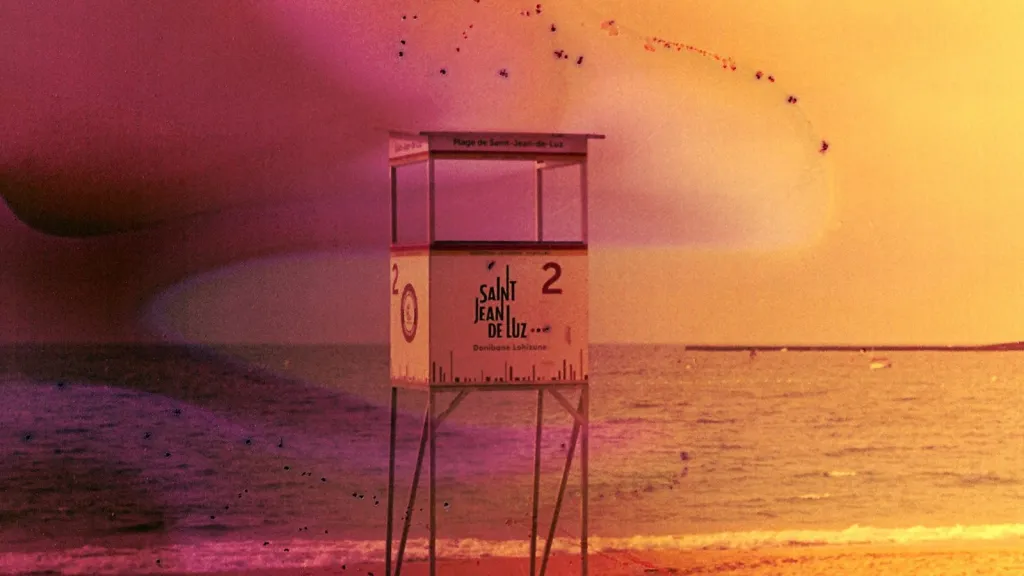
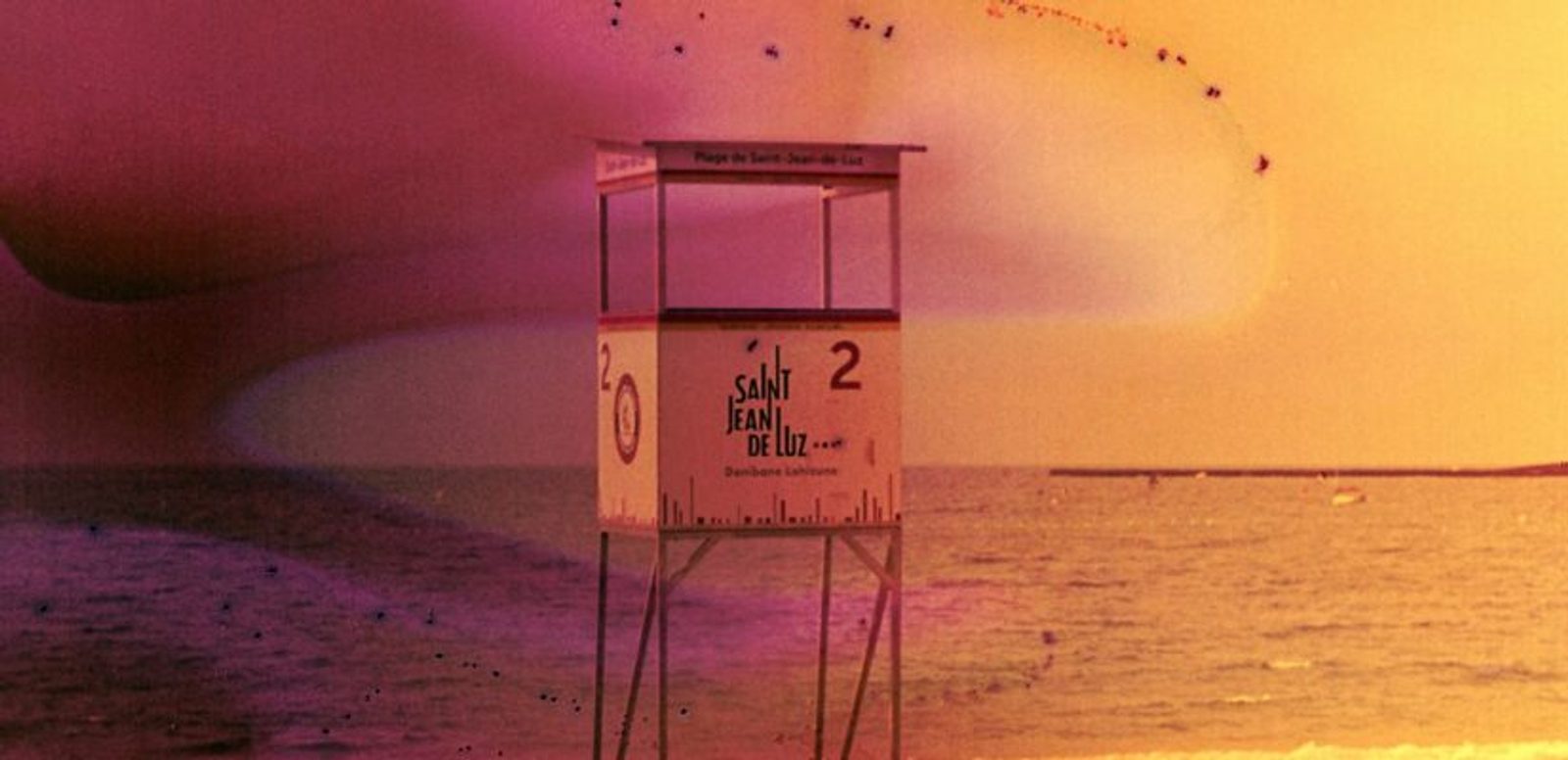
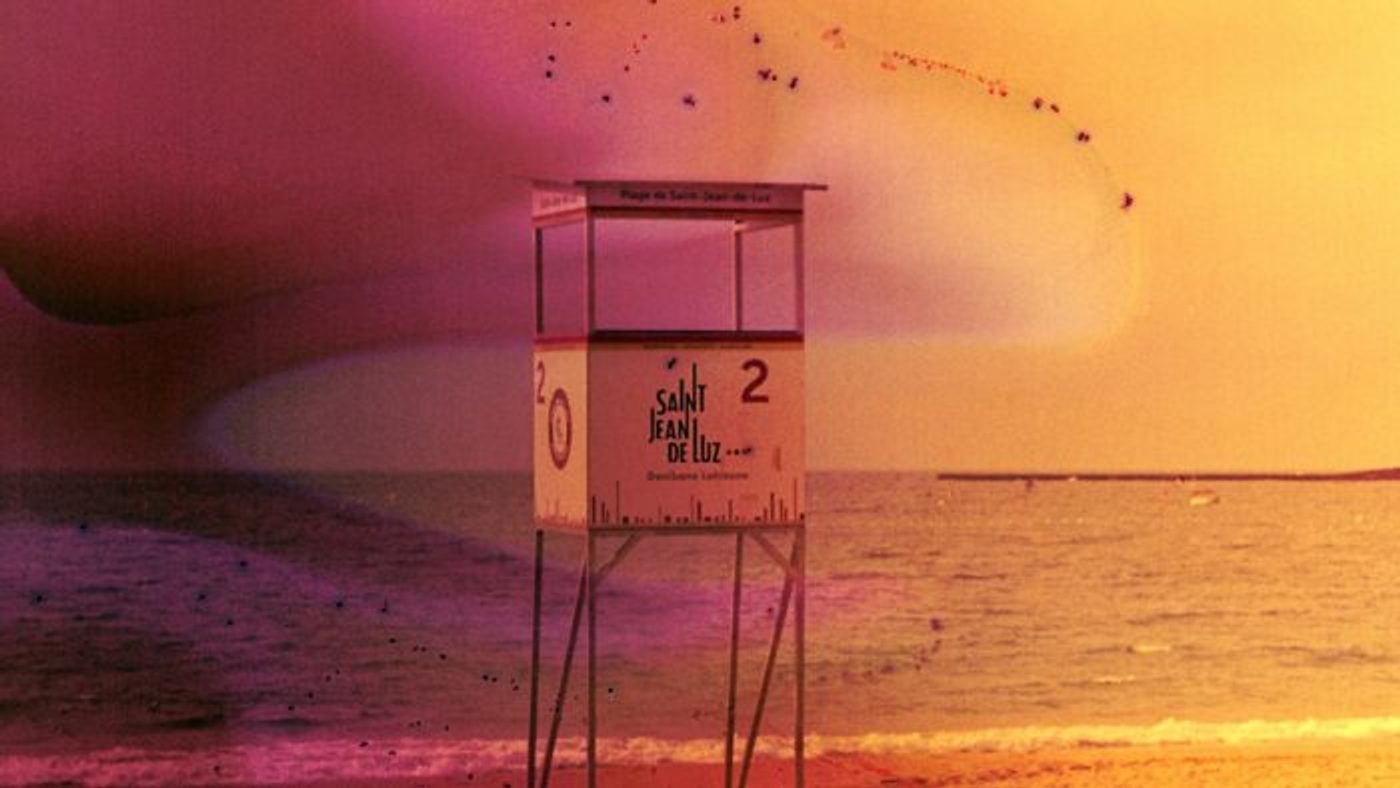
To visually translate this vulnerability, the photographer uses a unique artistic process by intervening directly on his analogue film. By subjecting his negatives to hot, salty and acidified water, he causes a deliberate degradation of the gelatin, altering the original colours.
Warm, red and orange hues thus invade the photographed landscapes, symbolising the physical alteration of the territory. This approach lends the works an almost carnal materiality, where the medium suffers the same assaults as the coastline it represents.
The analogue technique, by its physical and chemical nature, offers a particularly fertile ground for experimentation for this conceptual approach. Unlike the digital sensor which freezes information in the form of binary data, photographic film is a living material, composed of silver halide crystals suspended in a thin layer of gelatin. By introducing corrosive elements similar to those that the ocean inflicts on rocks and breakwaters, Guillaume Fauveau creates a direct parallel between the subject and its medium of representation. Acidity and salt act as microscopic eroding agents, eating away at the image, erasing certain details and revealing others in a completely unpredictable way. The runs, blisters and chromatic shifts obtained are not simple aesthetic filters, but the physical scars of the development process. The final image thus becomes the very expression of the alteration it seeks to expose, making the analogue medium a poetic and physical receptacle for the destructive forces of nature.
A documentary gaze anchored in the territory
The career of Basque photographer Guillaume Fauveau
Born in Bayonne in 1982, Guillaume Fauveau regularly collaborates with the independent and national press while developing long-term projects focused on social realities. His previous work on the Pausa migrant reception centre in Bayonne bears witness to this humanist sensitivity and his attachment to territorial dynamics.
His photographic style, situated on the borderline between document and poetry, avoids the trap of the spectacular to focus on the meticulous observation of the landscape’s uses and fractures.
Guillaume Fauveau’s territorial roots deeply influence his artistic approach. As a native observer of the region, he possesses an intimate knowledge of the places, their seasonal variations and the human stories associated with them. His experience in the field of photojournalism allows him to approach complex subjects with the rigour of an investigator, while maintaining a formal freedom unique to the visual arts. By avoiding sensationalist images of spectacular storms or sudden collapses, he chooses to document the long term, that of slow wear and tear and gradual shifts. His method is based on a regular presence in the field, walking the same paths, observing the same cliffs at different times of the year and day. It is this patience that allows him to capture the essence of a territory in transition, offering a precious testimony for future generations on the current state of our coastal environment.
La Rotonde, an architectural witness facing the ocean
The choice of La Rotonde as a setting for this exhibition is not insignificant. This iconic building in Saint-Jean-de-Luz, ideally situated directly on the edge of the bay, offers an exceptional panoramic view of the elements described in the exhibition. Its own architecture, designed to open onto the vastness of the sea while protecting itself from it, echoes the themes of Guillaume Fauveau’s series. By visiting the exhibition, the public is immersed in a constant back-and-forth between photographic representations of erosion and direct contemplation of the sea from the building’s windows. This immediate confrontation reinforces the impact of the artist’s message. Visitors can observe the breakwaters depicted in the photographs, then turn their gaze to the horizon to see these same structures battling the waves in real time. La Rotonde thus becomes a privileged observatory, a space of transition between art and geographical reality, amplifying the resonance of the works presented.
The concept of natural heritage in danger
The exhibition also offers a broader reflection on the notion of heritage. Long restricted solely to material assets built by man, the concept of heritage has gradually expanded to encompass natural landscapes and ecosystems. Guillaume Fauveau’s series questions this evolution by showing how coastal landscapes, which structure the visual and cultural identity of the region, are today threatened with disappearance. The loss of a beach or the collapse of a cliff are not only geological changes; they also represent the loss of collective landmarks, social practices and shared memories. Through the prism of art, the photographer invites us to consider nature no longer as an immutable and inexhaustible backdrop, but as a fragile heritage requiring attention and protection. This awareness, stimulated by the melancholy beauty of the images, encourages viewers to reflect on the actions necessary to adapt to these inevitable changes while preserving the very essence of this unique territory.
A photography exhibition in Saint-Jean-de-Luz marked by time
A poetic invitation to suspend time
Presented at La Rotonde in Saint-Jean-de-Luz, this exhibition encourages the viewer to suspend time to observe the silent changes in our environment. The event, which is free and open from Wednesday to Sunday, is a major cultural highlight of the autumn season on the Basque Coast.
To discover this work, visitors can go to La Rotonde, located in Place Maurice Ravel, with opening hours from 2.30pm to 7pm on weekdays and from 10am on Saturday mornings.
These opening hours allow a wide audience, including local residents, school groups and passing visitors, to engage with these works at their own pace. The exhibition layout has been designed to encourage contemplation and personal reflection. As they wander through the gallery space, visitors are invited to pay close attention to the subtle details revealed by the chemical degradation process, to question the materiality of the image and to compare their own memories of the Basque coastline with Guillaume Fauveau’s poetic and realistic vision. Free admission to this event highlights the municipality’s commitment to making contemporary art and environmental issues accessible to as many people as possible, thereby fostering dialogue and the sharing of ideas within the local community.