

In brief
- The Palais de Justice of Nîmes established itself as an essential filming location for French cinema as early as 2008, welcoming renowned directors captivated by the majesty of its architecture and its historical authenticity.
- Major filmmakers such as Claude Chabrol and Roschdy Zem chose to immortalise this prestigious setting in landmark works such as Bellamy and the poignant courtroom drama Omar m’a tuer.
Television productions such as Candice Renoir and Un si grand soleil have filmed there
- The world of television has also succumbed to the charm of this monument in the Gard, with numerous major dramas relocating their cameras there to shoot episodes and key plotlines between 2015 and 2020.
A visual signature blending solemnity and elegance
Over the years, the Palais de Justice of Nîmes has established itself as a sought-after filming location for the biggest names in French cinema. Far from being a mere administrative building or an ordinary courthouse, this historic building offers a solemn and timeless aesthetic that immediately captivates directors in search of raw authenticity. With its period courtrooms, adorned with antique paintings and finely crafted wood panelling, the “old palace” possesses a singular visual signature, instantly recognisable on the big screen. This majestic setting heightens the dramatic tension inherent in legal stories, offering a visual counterpoint of rare elegance to the human dramas played out before the camera.
A singular aesthetic for the Palais de Justice of Nîmes
The appeal of this architectural masterpiece to filmmakers is primarily due to its highly cinematographic spatial design. The courtrooms, rich in period details and a patina that cannot be artificially recreated, offer a natural setting of rare nobility. The southern light, filtered through tall, old-fashioned windows, creates striking contrasts that magnify the work of directors of photography. The assize court, in particular, has become a favoured location for filming the moments of truth in courtroom dramas. For technical crews, this life-sized set avoids the tedious construction of studio sets, while instilling in the actors a natural gravity and focus that only a true temple of the law can inspire.
The Gard and Occitanie, favoured lands for the seventh art
The omnipresence of the Palais de Justice of Nîmes on screen is part of a much broader dynamic, namely the growing attractiveness of the Gard department and the Occitanie region for the film and audiovisual industry. Thanks to exceptionally diverse landscapes, optimal sunshine throughout the year, and an exceptionally preserved historical heritage, this territory attracts dozens of national and international productions every year. Local authorities have structured a first-class welcome for filming crews, facilitating access to historical monuments and encouraging the emergence of a network of qualified local professionals. The Nîmes courthouse benefits fully from this synergy, establishing itself as one of the jewels in this policy of promoting heritage through film.
The indelible mark of Claude Chabrol
In 2008, a monument of French cinema, Claude Chabrol, took over the premises to direct what would remain one of his last major works, the film “Bellamy”. The director, renowned for his sharp depiction of provincial bourgeois mores, found in Nîmes the ideal setting to unfold his psychological detective plot. The silhouette of the filmmaker is still remembered, immortalised with a cigar in his mouth in the very heart of the assize court, exchanging precise instructions with his technicians and actively collaborating with Maurice Bestagno, who was then actually presiding over the jurisdiction’s assizes. This shoot left a deep impression on local minds due to its exceptional level of immersion, with the production integrating respectfully and meticulously into the daily life of the court to capture all its human and procedural truth.
A prime set for masters of cinema
The Palais de Justice of Nîmes does not merely serve as a passive backdrop; it stands out as a character in its own right in the works of great directors. Its neoclassical architecture, characterised by rigorous geometric lines, imposing columns, and monumental spaces, visually symbolises the rigour and impartiality of the judicial institution. For filmmakers, shooting within this monument allows them to play with the verticality of the spaces, amplify silences heavy with meaning, and give a unique resonance to the lawyers’ closing arguments. The transition from judicial reality to artistic fiction takes place here with remarkable fluidity, testifying to the mutual respect between the legal professionals who bring this place to life and the artists who draw inspiration from it to question society.
Courtroom drama according to Roschdy Zem
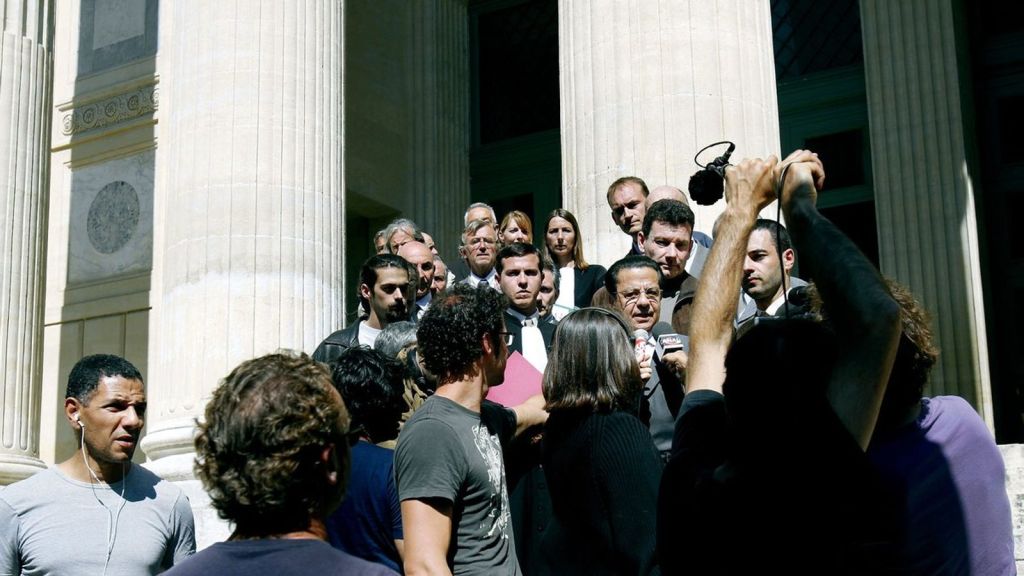
A few years after Claude Chabrol’s memorable visit, it was the turn of director Roschdy Zem to exploit the evocative power and solemnity of the building for his poignant film “Omar m’a tuer”, released in theatres in 2011. To trace the complex and painful judicial journey of Omar Raddad, portrayed with remarkable intensity by actor Sami Bouajila, the filmmaker chose to shoot pivotal scenes in the very heart of the Nîmes institution. Audiences particularly remember the sequences captured on the imposing steps of the court of appeal, a true outdoor media theatre, as well as the moments of suffocating tension filmed inside the assize courtroom. This use of a real setting, steeped in authentic judicial history, lent the feature film a striking realism, decisively reinforcing the dramatic and social impact of the cinematic message.
The transition to modern television’s major formats
Beyond works destined for cinema screens, the Palais de Justice of Nîmes has also successfully navigated the turn of the series revolution. The French audiovisual landscape has undergone a profound transformation in recent decades, marked by an increasingly high demand for visual quality in television productions. Audiences, accustomed to international standards, now expect television dramas to deliver the same level of realism and aesthetics as the big screen. By opening its doors to ambitious series, the Nîmes court has demonstrated its ability to adapt to the specific constraints of television, which often requires a fast-paced work schedule while maintaining impeccable attention to detail for every shot.
A regular fixture for television series
This regularity in welcoming television crews is explained by the exceptional versatility of the spaces offered by the monument. The palace allows for the simulation of a wide variety of judicial atmospheres, from the intimate chambers of an examining magistrate to grandiose ceremonial halls. Technicians particularly appreciate the acoustics of the venue and the layout of the corridors, which are ideal for the long tracking shots that characterise modern television writing. Furthermore, the geographical location of the city of Nîmes, ideally connected to major transport routes and close to major production hubs in the South of France, greatly facilitates the logistical organisation of these complex shoots, which mobilise dozens of professionals on a daily basis.
The must-see venue for television dramas
The Nîmes palace has thus become a familiar and recurring figure on the screens of French television viewers. In 2015, the production of the famous detective series “Candice Renoir”, starring actress Cécile Bois, took over the building to film intense confrontation scenes. To ensure total credibility for these sequences, the production called upon local legal professionals, such as a court clerk, who came to assist as extras to guide the actors’ movements. This constant quest for realism continued in 2020, when the crew of the hit daily soap opera “Un si grand soleil” also chose the prestigious setting of the Nîmes Court of Appeal to set up their cameras, confirming the central place of this architectural masterpiece in the national television heritage.