
In brief
- Record sale in Laguna Beach concluded for 82.6 million dollars on 14 October 2026.
- Second most expensive residential transaction in the history of Orange County.
- Modernist property of 1,341 m² including 8 bedrooms, 15 bathrooms and a one-hectare plot.
- Architecture suspended above the cliff designed by architect Fred Briggs in 1974.
The residential real estate market has just recorded a historic transaction on the Californian coast. A spectacular residence located in Laguna Beach, sold for 82.6 million dollars on 14 October 2026, stands as the second most expensive ever recorded in Orange County. Only a property in Emerald Bay, sold for 110 million dollars, exceeds this amount in local records.
Located on the southern coast of California, Orange County has established itself over several decades as one of the most sought-after markets in the United States for very high-standing residences. Between the economic dynamism of the Los Angeles region and the preserved living environment of the coastal towns, the sector attracts a clientele of investors and wealthy buyers looking for exceptional locations. Within this coastal enclave, Laguna Beach occupies a unique place. Historically recognised as an artists’ colony at the beginning of the 20th century, the municipality has managed to preserve a unique visual identity, characterised by a rugged topography where rocky cliffs plunge directly into the Pacific Ocean.
This steep geography confers a rare character of exclusivity to the plots overlooking the sea. Unlike the vast sandy stretches of certain Californian seaside resorts, the Laguna Beach coast offers natural promontories allowing for the construction of residences literally suspended facing the elements. Transactions exceeding the symbolic thresholds of tens of millions of dollars are part of an extremely restricted supply dynamic. The intrinsic rarity of seaside land, combined with particularly strict local urban planning policies designed to protect the natural landscape, limits the renewal of the real estate stock. In this context of reinforced exclusivity, the recent sale of this exceptional estate confirms the strength of demand for prestige real estate assets located on the most coveted sites of the Californian coastline.
Architecture suspended facing the ocean
A modernist architecture suspended facing the ocean
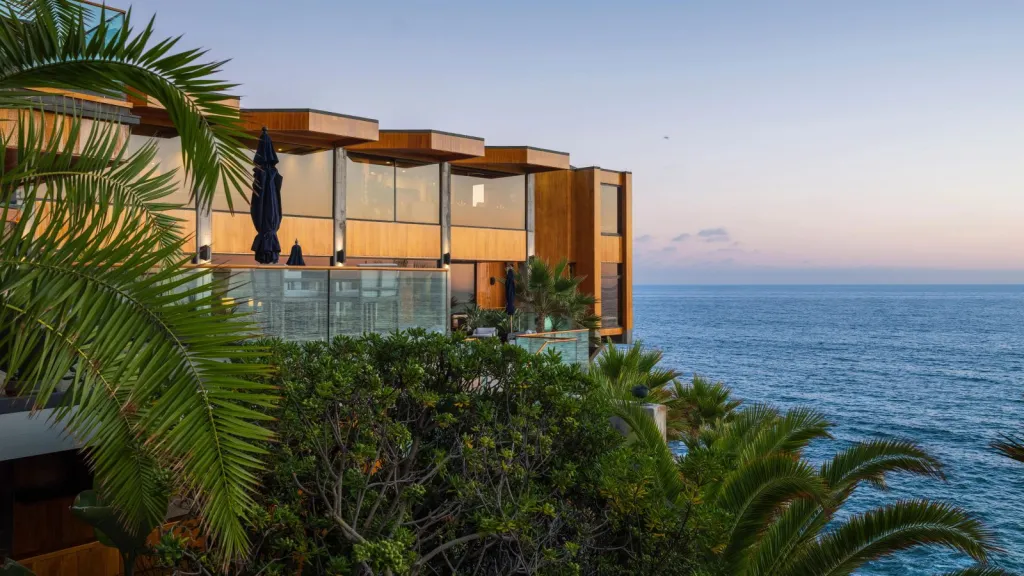
Located in the sought-after Rockledge neighbourhood, the residence extends over a plot of more than one hectare. Designed in 1974 by modernist architect Fred Briggs, the three-level main house benefits from a coastal placement that has become legally impossible today. Built before current regulations on coastal construction setbacks, its structure extends directly over the cliff, offering panoramic views on three sides. The modernist architectural movement, of which Fred Briggs was one of the representatives applied to coastal residences, aimed to abolish the boundaries between the built structure and the surrounding landscape. By exploiting the structural engineering advances of the 1970s, the architect designed a home that seems to defy gravity, anchored in the rock while soaring towards the maritime void.
The real estate complex develops 1,341 square metres of living space divided between the main house and an independent two-bedroom guest house. The property totals 8 bedrooms, 15 bathrooms, a garage for 8 vehicles with a catering kitchen and a reception courtyard capable of accommodating 20 cars. This is the highest transaction in the county for a property located outside a private gated community.
The geographical location of this property within the Rockledge sector constitutes a major asset. This Laguna Beach neighbourhood is renowned for its spectacular rocky promontories that offer an unobstructed view of the Pacific Ocean. The one-hectare plot, a particularly generous size for a parcel directly adjacent to the coastline in this geographical area, allows for total privacy from traffic routes and neighbouring properties. The layout of the buildings on the site was designed to maximise exposure to natural light while taking advantage of the sea breezes. The presence of a fully autonomous two-bedroom guest house allows for the hosting of secondary residents or staff in optimal accommodation conditions, separate from the main building.
The technical and regulatory challenges of cliff constructions
Coastal erosion and the preservation of the coastal environment have gradually led Californian authorities to tighten regulations surrounding seaside building permits. The California Coastal Commission, established in the 1970s, today imposes very strict standards regarding the setback of buildings from the edge of cliffs in order to prevent geological risks and ensure the protection of natural heritage. It is precisely this rigorous regulatory framework that gives this property built in 1974 an irreplaceable heritage and architectural value.
Indeed, no new construction could today obtain authorisation to project so spectacularly over the rock face. Buildings benefiting from an existing right, like this creation by Fred Briggs, constitute a finite real estate collection whose number can no longer increase. This regulatory situation creates an artificial scarcity effect on the luxury market: buyers wishing to own a residence offering a direct overhang over the ocean must necessarily turn to the rare existing historical structures. However, maintaining such suspended architectures requires constant investment in structural engineering to guarantee the durability of the building against the permanent assault of the marine elements and the natural wear of the rocky substrate.
Eighteen months of work and coastal reinforcement
A record transaction on the Californian coast
Previously owned by businessman David Wilson and his wife Holly, the estate was acquired in 2001 for approximately 17 million dollars. After their purchase, the owners invested 20 million dollars in a two-year renovation project. More than 3 million dollars were dedicated to consolidating the steel and concrete foundations to protect the site against coastal erosion. These large-scale works required eighteen months of coastal reinforcement and complex technical interventions at the cliff level, aimed at permanently anchoring the structure into the bedrock and protecting the base of the land against the assaults of the swell.

Put up for sale in July at a price of 112 million dollars, the property found a buyer with the company Primehaven Co LLC after 82 days on the market. The final transaction reflects a 26% discount compared to the initial asking price. Despite this downward negotiation, the sum of 82.6 million dollars remains a peak for the Laguna Beach real estate market and ranks second in the history of Orange County, just behind the absolute record of 110 million dollars established in Emerald Bay.
The marketing period of 82 days proves to be relatively short for a real estate asset located in this ultra-exclusive price bracket. In the market for very high-end luxury goods, where potential buyers are very few and financial verifications particularly thorough, sale times frequently extend over more than a year. The rapid completion of this sale testifies to the persistent attractiveness of exceptional properties combining unique architecture, a prime geographical location and major infrastructure work already carried out by previous occupants.
High-end features and maximum security
Exceptional features and maximum security
The interior spaces are distinguished by their technical fittings and bespoke design. The main suite includes a rotating bed topped by an automated opening ceiling looking out to the sky. This private wing can be completely sealed off from the rest of the house and features a strongroom, a concealed emergency exit and a complete surveillance network.
A spiral staircase running alongside immense bay windows leads to a glass floor giving the impression of directly overhanging the waves. The estate also includes a wine cellar, a cinema room, a swimming pool with spa, an outdoor amphitheatre, a tennis court and private access to the beach.
The design of these facilities illustrates a constant search for balance between living comfort, entertainment and the confidentiality requirements specific to major fortunes. The layout of the outdoor spaces takes full advantage of the terrain’s relief of one hectare. The open-air amphitheatre allows for the organisation of shows or private receptions with the ocean as a backdrop, while the tennis court and the swimming pool equipped with a spa complete the leisure facilities. Finally, the presence of direct private access to the beach represents a rare and sought-after feature on the Californian coast, where most access to the shoreline is public or constrained by the rocky topography.
The garage for 8 vehicles, coupled with a vast reception courtyard capable of accommodating up to 20 cars, meets the logistical needs of large-scale private receptions. The catering kitchen integrated into the parking complex allows for the management of catering services without interfering with daily life in the main residence. The combination of spectacular engineering elements, such as the glass floor or the rotating mechanism of the master suite, with ultra-secure protection infrastructure makes this modernist Rockledge property an emblematic example of the great coastal estates of Southern California.