

In brief
- 120: number of works of art and historical objects brought together for this retrospective.
- Château de Sceaux: venue hosting the exhibition within the former stables.
- 13 September 2026 to 14 February 2027: public opening dates for the Princesse rebelle exhibition.
- 1824: year the duchess invented the fashion for sea bathing in Dieppe.
- 1816: date of Marie-Caroline de Bourbon-Siciles’ arrival in France.
In brief
- A major retrospective bringing together 120 works of art and historical objects at the Château de Sceaux.
- The exhibition covers the life of Marie-Caroline de Bourbon-Siciles, from her arrival from Naples in 1816 to her attempts at political uprising.
- The exhibition is open to the public in the former stables of the estate from 13 September 2026 to 14 February 2027.
- A particular focus on her role as a patron of the arts and her invention of the fashion for sea bathing in Dieppe in 1824.

The Château de Sceaux is dedicating a major exhibition to Marie-Caroline de Bourbon-Siciles, a romantic figure of the 19th century whose life was marked by tragedy, splendour and political insurrection. Through a rigorous selection of 120 pieces, the departmental museum retraces the destiny of this “Princesse rebelle” who left her mark on French history with her indomitable temperament. This cultural event of national scope invites visitors to plunge into the mysteries of the Restoration and the July Monarchy, two pivotal periods in French history when individual destinies were closely intertwined with dynastic upheavals.
The departmental estate of Sceaux, famous for its park designed by André Le Nôtre and its château rebuilt under the Second Empire, offers an ideal setting for this historical retrospective. The choice of this venue is not accidental, as it itself embodies the vicissitudes and rebirths of French heritage through the centuries. By highlighting the extraordinary trajectory of the duchesse de Berry, the exhibition aims to go beyond historiographical clichés to reveal a modern woman, at once a political strategist, a passionate collector and a pioneer of the art of living.

A life of tragedy and dynastic splendour
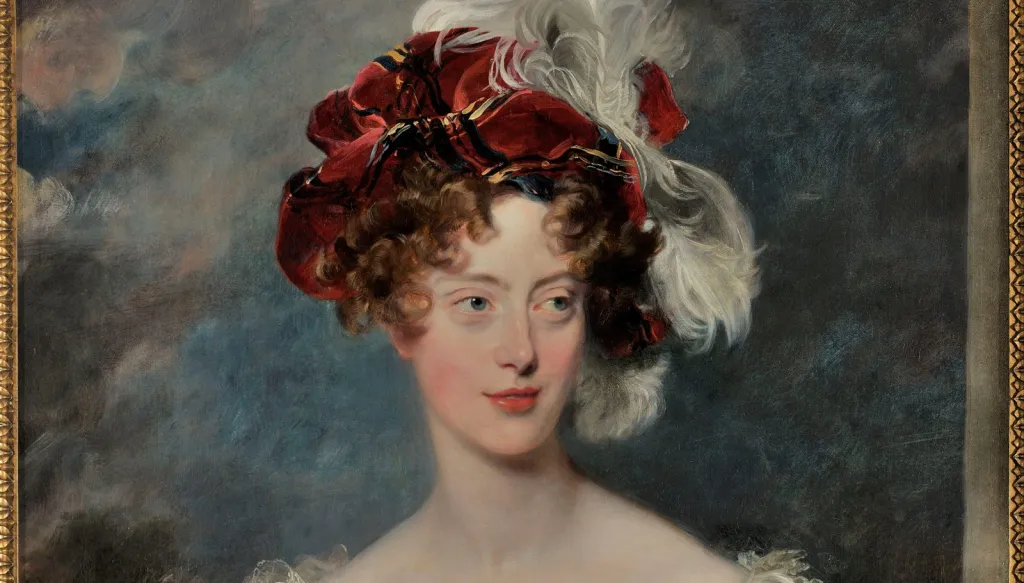
The exhibition opens with the early years of the young Neapolitan, painted by Thomas Lawrence, whose mission was to perpetuate the Bourbon dynasty. Born in Palermo, Marie-Caroline de Bourbon-Siciles grew up in the Mediterranean atmosphere before moving to France in 1816 to marry Charles-Ferdinand d’Artois, duc de Berry and nephew of King Louis XVIII. Her arrival at the French court was perceived as a breath of youth and renewal for a restored monarchy seeking to establish its legitimacy after the turmoil of the French Revolution and the Napoleonic Empire.
At twenty-one, she became a widow after the assassination of her husband, the duc de Berry, stabbed in Rue de Richelieu before her eyes. This attack, carried out by the saddler Louvel, aimed to extinguish the Bourbon line. This founding tragedy is immortalised in the exhibition by Alexandre-Évariste Fragonard’s work, Les Derniers Moments du duc de Berry, where princely blood already becomes the subject of a history painting. The grief of the young widow moved the entire nation, especially as she was then pregnant with the child of last resort. The birth of her son Henri, duc de Bordeaux, dubbed “the miracle child”, would momentarily restore hope to the supporters of monarchical legitimacy.
The official and intimate iconography of this period of mourning and dynastic splendour occupies a central place in the first rooms of the exhibition. Visitors can admire state portraits, personal objects belonging to the ducal couple, as well as material evidence of the duchess’s piety and mourning. Artists of the period extensively documented this status of royal widow, while highlighting the strength of character of a mother resolved to protect her son’s rights to the French throne.

Elegance and the invention of modern leisure
A style icon and avant-garde patron
Beyond mourning, Marie-Caroline established herself as an arbiter of the tastes of her time, surrounded by Troubadour-style furniture and gilded bindings bearing her coat of arms. Endowed with a lively intellectual curiosity and a strong artistic taste, she quickly freed herself from the rigid codes of the Tuileries court to create her own aesthetic universe. Her active patronage supported the most talented painters, sculptors, cabinetmakers and craftsmen of her generation, fostering the emergence of an eclectic and romantic style that characterised the decorative arts of the Restoration.
In particular, we owe her the invention of the modern seaside resort after her memorable entry into the waters of Dieppe in August 1824 in front of a crowd of three thousand onlookers. By launching the fashion for sea bathing, first for therapeutic reasons and then for pure pleasure, the duchesse de Berry transformed the small Norman town into an essential meeting place for the aristocracy and high society. This initiative marked the beginnings of coastal tourism in France, blending health, socialising and outdoor activities. The exhibition illustrates this joyful period through engravings, travel accessories and marine paintings that evoke the sweetness of Norman summers.
This passion for the art of living is reflected in the precious objects on display, including the famous gorget carved by Félicie de Fauveau. This emblematic work bears witness to the duchess’s attraction to the Neo-Gothic aesthetic and the idealised Middle Ages. Her personal collection of precious books, Sèvres porcelain and fine furniture attests to her extreme refinement. She did not hesitate to place orders directly with the most renowned Parisian workshops, stimulating technical and stylistic innovation in the field of artistic creation.

The political epic of a rebellious sovereign
The flame of the Vendée insurrection
The second part of the exhibition explores the most daring facet of the duchess: her political commitment. After the July Revolution of 1830, which saw the fall of Charles X and the accession of Louis-Philippe d’Orléans, the elder branch of the Bourbons was forced into exile. Refusing to see her son’s rights flouted, Marie-Caroline decided to take up arms. In 1832, she landed secretly near Marseille in an attempt to raise the Vendée, a land historically loyal to the royalist cause. This dramatic episode reveals her dimension as a war leader, ready to brave all dangers to restore dynastic legitimacy.
Her epic flight lasted six months, ending behind a fireplace in Nantes, from where smoke eventually forced her out. This intense police hunt, led by the authorities of the July Monarchy under the direction of Adolphe Thiers, fascinated the public opinion of the time. Disguised as a peasant woman, sleeping in barns, she repeatedly escaped her pursuers thanks to the complicity of local legitimist networks. The exhibition reconstructs the highlights of this heroic run through coded secret correspondence, police reports, weapons of the period and pictorial works that dramatised her arrest.
She emerged blackened but victorious in her own narrative, asserting an authority and resilience that still command the admiration of historians today. Her subsequent imprisonment in the citadel of Blaye and the revelation of her secret marriage to an Italian nobleman put an end to her political ambitions, but her romantic destiny would inspire many 19th-century writers, starting with Alexandre Dumas and Chateaubriand. The exhibition pays tribute to this literary and mythological dimension that surrounded the figure of the rebel princess long after her death.
The cultural renewal of the Domaine de Sceaux
Hosting this exhibition dedicated to the duchesse de Berry is part of the dynamic cultural policy pursued by the Département des Hauts-de-Seine to promote the Domaine de Sceaux. By offering retrospectives of this scientific quality, the museum reaffirms its major role in the preservation and dissemination of 19th-century art history. The former stables, an 18th-century architectural masterpiece attributed to the architect Claude Perrault for Colbert, offer exceptional volumes and lighting particularly suited to highlighting the paintings, furniture and precious art objects in the exhibition.
The scenography of the exhibition has been designed to offer an immersive journey into the heart of the different stages of the duchess’s life. The colour contrasts, the lighting atmospheres and the pairing of works of art with archival documents allow different audiences, from history buffs to the simply curious, to make this extraordinary journey their own. Specific mediation tools accompany the visit to shed light on the complex geopolitical context of Restoration Europe and the court rivalries that punctuated Marie-Caroline’s existence.
Practical information and access to the estate
Practical information and access
The exhibition is held at the Château de Sceaux, Musée départemental, in the prestigious setting of the former stables. Visitors can access it via the Allée d’Honneur (92330 Sceaux) or by the RER B Sceaux station. The museum is open from Tuesday to Sunday, with adapted opening hours from 1 November (1pm-5pm). The full price is set at 6 euros, with free admission extended to under-26s. Visitors are invited to combine their discovery of the exhibition with a stroll through the vast park of Sceaux, whose beautiful classical perspectives ideally complement this immersion in national history.