

In brief
- France 3 is broadcasting the second instalment of the Dollars Trilogy this Monday, 24 August 2026, at 9:10 pm.
- The film brings together icons Clint Eastwood and Lee Van Cleef in a ruthless manhunt in New Mexico.
- Ennio Morricone’s score incorporates a musical pocket watch that has become a cult cinema object.
This Monday, 24 August 2026, at 9:10 pm, France 3 invites viewers to rediscover For a Few Dollars More, the masterful second instalment of the Dollars Trilogy directed by Sergio Leone. Originally released in 1965, this monumental Western depicts a memorable confrontation between two bounty hunters with diametrically opposed styles. Driven by the charisma of Clint Eastwood and the magnetic presence of Lee Van Cleef, the feature film stands out as a pivotal work that redefined the codes of the genre, blending raw aesthetics and psychological tension. This television broadcast is an invitation to dive into the golden age of Italian genre cinema, an era when the Western broke free from Hollywood’s simplistic moral codes to explore the grey areas of the human soul.
The film follows the surprise success of A Fistful of Dollars and precedes the legendary The Good, the Bad and the Ugly. In this transitional work, Sergio Leone refines his cinematographic grammar. It is no longer just a story of revenge or survival, but a meticulously timed choreography where silence carries as much weight as lead. Broadcasting this classic in prime time allows us to measure how far the seventh art has come and to see that, despite the decades, the effectiveness of Leone’s directing remains intact, captivating new generations of film lovers with his mastery of space and framing.
Two bounty hunters for the same prey
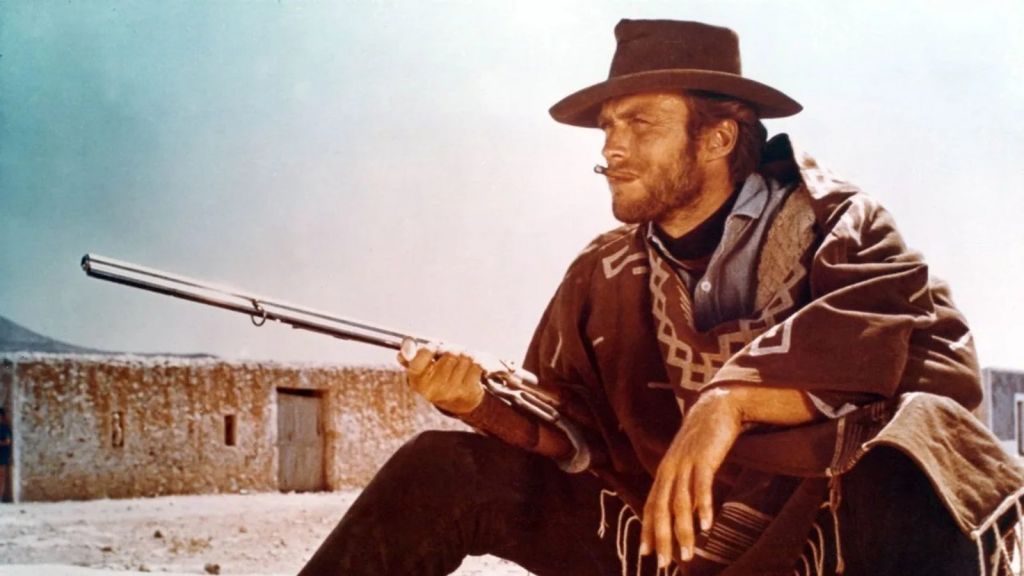
The plot centres on two solitary figures whose paths eventually cross in the arid vastness of New Mexico. The first, nicknamed Manco, is a pragmatic young mercenary whose appearance has already become a cinematic icon: the poncho, the felt hat and the cigarillo. The second, Colonel Douglas Mortimer, is an older man equipped with a sophisticated arsenal and a rigorous work ethic. Both covet the astronomical bounty placed on the head of El Indio, a psychopathic bandit whose cruelty is matched only by his tactical intelligence. This duo dynamic, constantly hesitating between mutual respect and potential betrayal, offers the narrative a psychological depth unusual for the genre at the time.
An anthology duel at the heart of the Spaghetti Western
The plot revolves around the rivalry, and then the forced alliance, of two men in pursuit of the same outlaw: El Indio, leader of a formidable gang of killers and bank robbers. Initially fierce competitors, they eventually realise that it is in their best interest to join forces to defeat an enemy as cruel as he is unpredictable. Clint Eastwood brilliantly portrays a laconic adventurer, cigarillo clamped between his teeth, whose efficiency is matched only by his silence. His character embodies a new form of heroism, stripped of all idealism, guided solely by a personal code of conduct and the need to survive in a lawless world.
Opposite him, Lee Van Cleef plays Colonel Mortimer, an elegant, methodical man of surgical precision. While one seems motivated by financial gain, the other reveals, as the story unfolds, much more personal and tragic motives. This alliance of convenience, fuelled by mutual distrust, is the narrative engine of a film that stretches time to build tension until the final showdown. Colonel Mortimer adds an extra dramatic dimension, revealing that behind the financial hunt lies a quest for personal justice, a theme dear to Sergio Leone that would be fully developed in his later works.
The relationship between the two protagonists is also marked by a form of black humour and technical competition. The scenes where they test each other’s shooting skills, notably during the cult sequence where they shoot at each other’s hats, highlight their extraordinary professionalism. They are not mere shooters, but experts in violence, aware that any mistake could be fatal. This duality between Manco’s impetuous youth and Mortimer’s cold experience creates a perfect balance on screen, making For a Few Dollars More a masterclass in cinematic characterisation.
Sergio Leone’s visual and sonic signature
Considered the inventor of the Spaghetti Western, Sergio Leone displays all his formal genius here. Extreme close-ups of eyes, heavy silences and a sense of spectacle transform every face-off into a moment of pure cinematic tension. Sergio Leone’s 1965 direction established a radical visual style, marked by a management of space and time unprecedented at the time. The Italian director uses the wide Techniscope format to capture both the vastness of the landscapes and the intensity of human expressions, creating a permanent contrast between the individual and their hostile environment.
Leone also reinvents the dynamics of editing. He does not hesitate to extend tense scenes far beyond standard lengths, forcing the viewer to feel the unbearable anticipation preceding the pull of the trigger. Each duel is thus constructed like an opera piece, where framing, lighting and the positioning of bodies follow a rigorous aesthetic logic. This approach, often imitated but rarely equalled, helped transform the Western, a genre then considered moribund in the United States, into a bold and modern playground for formal experimentation.
The Almería desert: a legendary setting
Although the action is supposed to take place in New Mexico and border towns like El Paso, the film was mainly shot in Spain, in the province of Almería. This geographical choice was not insignificant and greatly contributed to the visual identity of the Dollars Trilogy. The Tabernas Desert offers harsh light and rugged terrain that reinforce the wild and desolate nature of the story. The Western towns built for the occasion, with their dusty streets and weathered saloons, have become places of pilgrimage for film buffs worldwide.
The use of these natural settings allows Sergio Leone to anchor his narrative in a tangible physical reality. The dust kicked up by the horses, the heat that seems to radiate from the screen and the aridity of the ground all contribute to the viewer’s immersion. Unlike classic Westerns shot in studios or in greener American landscapes, the Spaghetti Western exploits the harshness of the Mediterranean climate to highlight the difficulty of life on the frontier. This geographical setting becomes a character in its own right, dictating the pace of travel and isolating the protagonists in their respective quests.
The pocket watch, symbol of a cult score
The experience would not be complete without Ennio Morricone’s score. The Italian composer, whose name is inseparable from Leone’s, delivers a revolutionary soundtrack. By using whistling, jaw’s harps and haunting chimes, he creates a sonic atmosphere that fully contributes to the legend of the work. Music and images form an inseparable whole, often imitated but rarely equalled in the history of cinema. Morricone does not merely accompany the image; he gives a voice to the unspeakable, transforming the silences of the desert into a symphony of anxiety and fate.
The pocket watch, the film’s horological signature
At the heart of this dramatic tension is a singular object: a pocket watch whose chime plays a haunting melody during the duels. This musical motif, which paces the confrontations, crystallises the personal stakes between El Indio and Colonel Mortimer. Ennio Morricone transforms this musical watch into a true character that dialogues directly with the protagonists during key scenes. The melody, both sweet and macabre, serves as a countdown before the inevitable explosion of violence, creating an almost unbearable anticipation for both the characters and the audience.
This integration of the horological object as a narrative and sonic device is one of the film’s most brilliant ideas. It introduces a melancholic and fatalistic dimension amidst the dust and gunpowder. For lovers of fine mechanics, this object symbolises the passage of time and the inevitability of fate, while providing the film with its most famous theme. The watch is not just a prop; it is the link connecting the characters’ traumatic past to their violent present. Every time the lid opens and the mechanism engages, the entire story shifts into a tragic dimension.
The evolution of the genre: from classicism to Italian audacity
The success of For a Few Dollars More marked a definitive turning point in the film industry of the 1960s. By breaking free from the constraints of the Hays Code that governed American cinema, Sergio Leone was able to explore more graphic violence and darker themes. The character of the villain, played by Gian Maria Volonté, is not a simple cardboard antagonist, but a man tormented by his own demons and memories. This psychological approach allowed the genre to earn its credentials with international critics, while achieving immense popular success.
The film also established Lee Van Cleef as a major star. A supporting actor in Hollywood, often confined to anonymous henchman roles, he found under Leone’s direction a role matching his piercing gaze and aquiline profile. His performance as Colonel Mortimer, with its icy dignity, offers an ideal counterpoint to Clint Eastwood’s more relaxed but equally precise acting. Together, they defined the aesthetic of the modern action man, a figure who speaks only when strictly necessary and whose every gesture is calculated for maximum efficiency.
A classic that has not aged a day
The indelible mark of a cinematic monument
Sixty years after its release, the film remains an absolute reference. Its influence is still felt today among many contemporary filmmakers, drawn to this way of stretching suspense before the explosion of violence. The character of the Man with No Name, played by Clint Eastwood, permanently shaped the image of the modern hero: solitary, ambiguous and formidably efficient. This figure has spanned decades, influencing action cinema, comic books and video games alike, proving the universal power of the archetypes created by Leone.
The film appeals to a wide audience, from lovers of great classics to viewers curious to discover an essential milestone in cinema history. Its visual generosity and legendary casting make it a safe bet for an evening of great television entertainment. By scheduling it in prime time, France 3 offers an ideal opportunity to dive back into this monument of the Western, where gold, dust and honour mingle over a striking score. Watching this film again today also means appreciating the restoration work, which allows us to savour every detail of the sun-weathered faces and every note of Ennio Morricone’s score with exceptional clarity.
Beyond mere entertainment, For a Few Dollars More is a study of human greed and the quest for redemption. In this world where everything can be bought, even a man’s life, the extra few dollars of the title symbolise overreaching ambition and the price of blood. Yet, through Mortimer’s character, Leone suggests that some things, like memory and justice, remain priceless. It is this permanent tension between the material and the emotional that gives the film its status as a timeless masterpiece, capable of resonating as strongly in 2026 as it did at the time of its creation.