
In brief
- A very young volcanic relief where the seabed exceeds depths of 1,000 metres just a few kilometres from the coast.
- A destination renowned for big-game fishing, home to prestigious species such as blue marlin, swordfish and yellowfin tuna.
- Two distinct fishing seasons, with the austral summer being ideal for bottom fish and the austral winter perfect for pelagic fish.
- The opportunity to test yourself against trophy specimens, notably dogtooth tuna weighing over 50 kg.
The island of La Réunion, a French department in the Indian Ocean located about a ten-hour flight from Paris, stands out for its unique geological identity. Unlike its sister islands Mauritius and Rodrigues, La Réunion is a particularly young volcanic land, which shapes a steep underwater relief and singular fishing techniques. This geological youth gives the territory a distinct personality within the Mascarene Archipelago. The absence of a wide continental shelf transforms every sea excursion into an immediate adventure towards the abyss, contrasting sharply with the navigation and fishing practices observed on other tropical islands in the same region.
For travel and sport fishing enthusiasts, access to this jewel of the Indian Ocean is simple and direct thanks to regular flights connecting mainland France to Réunion airports. This exceptional geographical setting, marked by the majestic silhouette of the island’s volcanoes, including the Piton de la Fournaise, offers a spectacular backdrop for fishermen venturing offshore. The abrupt transition between the mountain peaks rising towards the sky and the abyssal depths plunging below the water’s surface characterises the environment of this extraordinary destination.
A volcanic geology with immediate abysses
An exceptional underwater geography at the gateway to the abyss
The geological youth of the island means that the seabed plunges dizzyingly as soon as you leave the harbours. Réunion’s lagoons are narrow and shallow compared to those of Mauritius. You only need to travel a few kilometres from the coast to exceed depths of 1,000 metres, a configuration that almost entirely rules out surface fishing with poppers or stickbaits. This steep bathymetric profile is a direct result of the volcanic activity that created the island, where the outer slopes of the underwater volcano sink rapidly towards the abyssal plain of the Indian Ocean.
This physical specificity greatly influences marine currents and the concentration of nutrients. Coastal waters benefit from upwellings of cold, nutrient-rich water from the deep ocean, a phenomenon that attracts a diverse and dense marine life in close proximity to the mainland. For local skippers and crews, this geographical layout means there is no need to navigate for long hours to reach productive fishing grounds. As soon as you clear the passes of harbours like Saint-Gilles or Port, lines can be cast, offering maximum fishing efficiency on full-day or half-day trips.
The reigning techniques of Réunion’s depths
With such depths, the island stands out as a premier location for big-game fishing, inhabited by prestigious blue marlin, black marlin, swordfish and yellowfin tuna. For vertical fishing enthusiasts, La Réunion offers an exceptional playground where jigging, slow-jigging, bay-jigging and live-bait fishing are practised. These technical approaches require robust equipment and a perfect knowledge of local currents, as drifts can be rapid along the steep drop-offs.
State-of-the-art techniques to challenge the depths
Jigging, in particular, has established itself as an essential discipline for exploring the island’s steep underwater reliefs. This physically demanding technique involves working a heavy metal lure vertically from the boat to trigger attacks from predators lying in ambush near the bottom or along underwater cliffs. Sport fishermen also appreciate live-bait fishing, which allows them to target large predators using baitfish caught beforehand. Mastering these different methods makes it possible to adapt to the changing behaviour of fish according to the tide, moon and current conditions that govern marine life around La Réunion.

The rhythm of the seasons and the species calendar
The seasonal calendar and pelagic encounters
The fishing calendar revolves around the austral summer and winter, two seasons that are reversed compared to Europe. During the austral winter (around August), the weather remains dry but trade winds can complicate access to the east of the territory. Conversely, the austral summer (around December) is wetter but generally offers calmer seas, ideal for targeting carangids or bottom fish. Understanding this seasonality is essential for planning your stay in La Réunion according to your preferred fishing techniques and target species.
During the austral winter, the influence of the south-easterly trade winds shapes the island’s climate. Sea excursions are mainly concentrated on the west coast, sheltered from the wind by the island’s imposing mountainous relief. This time of year is particularly sought after by pelagic fish enthusiasts who navigate along current lines in search of large migratory predators. During the austral summer, despite the risk of more frequent rainy spells, the decrease in wind strength offers greater freedom of movement on the water, allowing for the exploration of more varied sectors and precise bottom fishing on submerged rocky structures.
The crucial role of Fish Aggregating Devices (FADs)
In this immense ocean with dizzying depths, the search for pelagic life relies heavily on the use of Fish Aggregating Devices, commonly known as FADs. These structures, anchored in depths of several hundred or even thousands of metres, act as genuine oases in the middle of the blue desert. Algae and small organisms attach themselves to them, quickly attracting small fish, which in turn attract large predators such as tuna, mahi-mahi and marlin.
The presence of these devices around the island of La Réunion structures both recreational and professional fishing activities. Skippers integrate FADs into their daily itineraries, navigating from one buoy to another to maximise the chances of encountering large pelagics. Around these floating structures, fast trolling with skirted lures or drifting with live bait prove particularly effective, offering intense battles for thrill-seekers testing their skills against passing fish.
A destination of choice for large specimens
In search of the island’s legendary predators
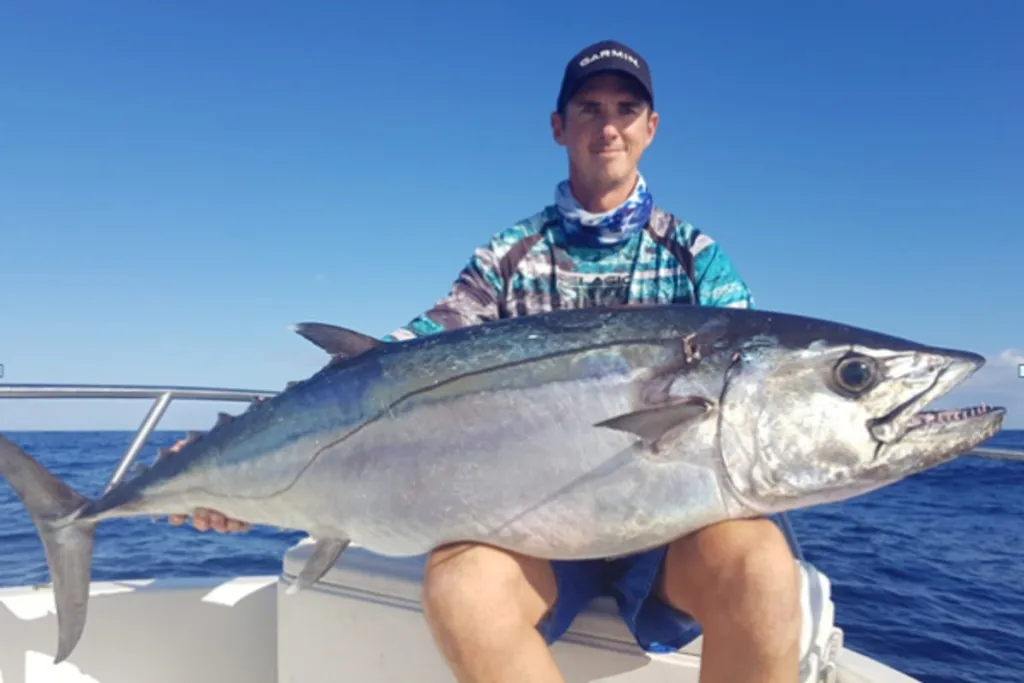
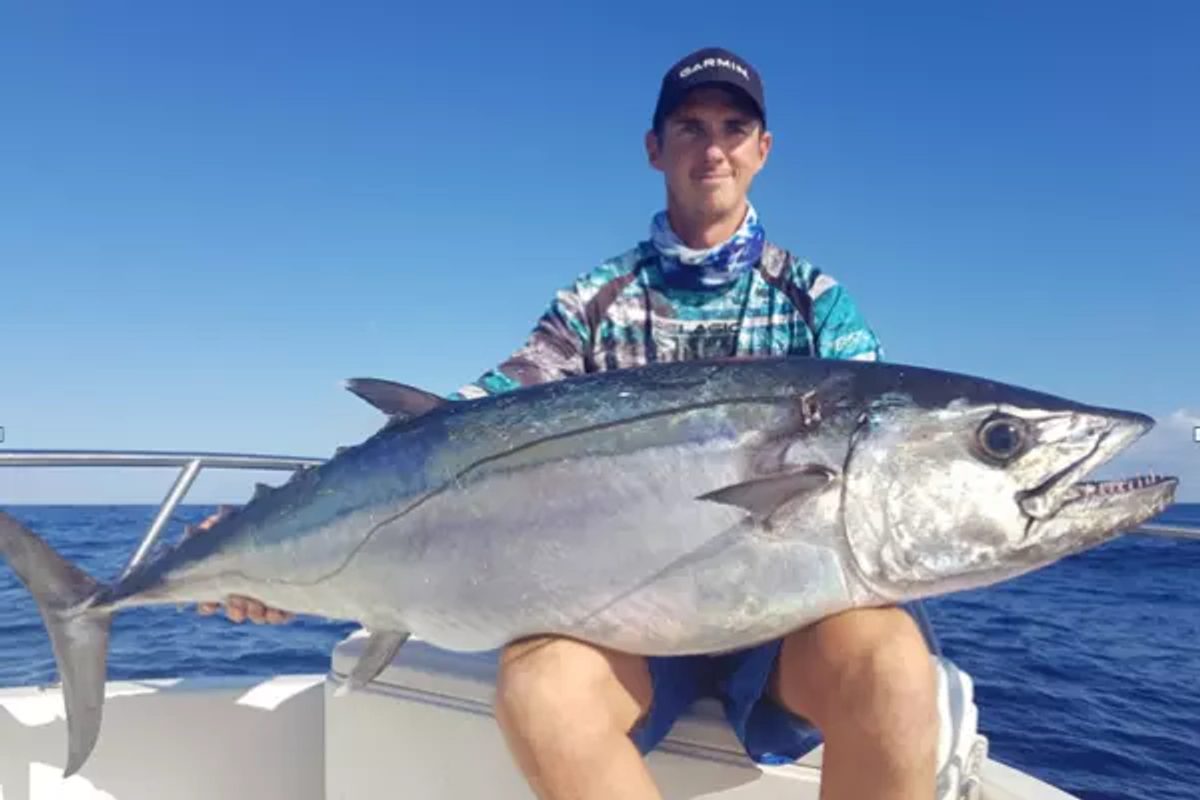
While all species can be encountered year-round, winter favours the search for yellowfin tuna, while summer smiles upon those tracking groupers, jobfish and barracudas. This destination is primarily aimed at anglers seeking power, offering the opportunity to encounter large dogtooth tuna that can exceed 50 kg. Capturing these legendary fish requires perfect mastery of the equipment and absolute physical endurance during memorable battles.
Tracking these large specimens requires meticulous preparation of lines, leader knots and reel drags, as the slightest weakness is immediately punished by the raw power of these predators. Dogtooth tuna, renowned for their extremely violent initial runs towards the rocky bottom, force anglers to use heavy-duty rods and high-strength lines to stand a chance of extracting them from their hostile environment. Giant groupers and jobfish inhabiting deep structures complete this high-level sport fishing experience, ensuring every outing brings its share of surprises and adrenaline within the grandiose setting of Réunion’s waters.