

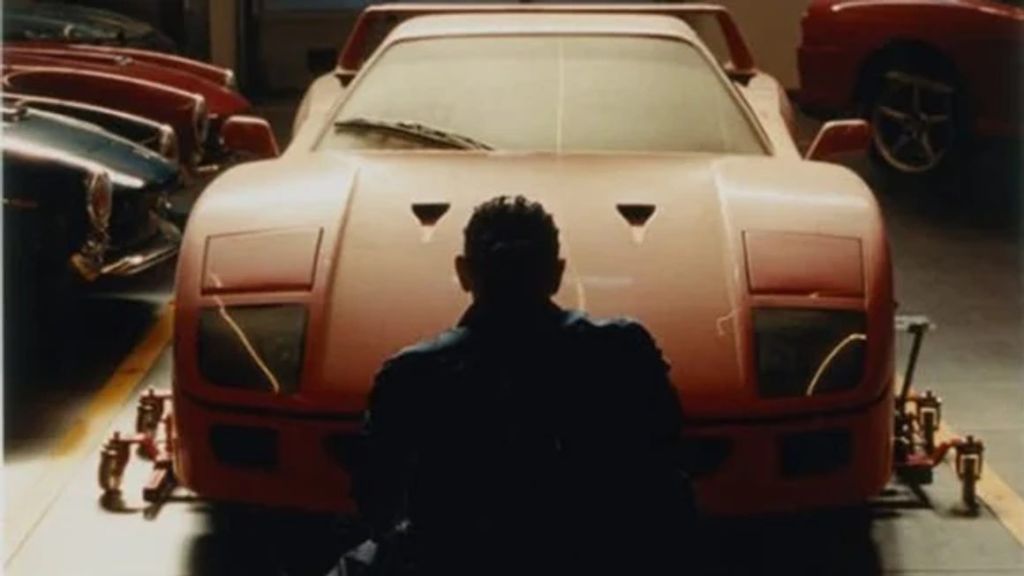
Lewis Hamilton once again owns a car. This is rather mundane news for a seven-time Formula 1 world champion, except that the Briton announced the exact opposite less than a year ago. In September 2025, on the sidelines of the Azerbaijan Grand Prix, the Ferrari driver revealed that he had parted with his entire car collection, then valued at around 15 million euros. This announcement caused quite a stir among motoring enthusiasts and paddock observers, who were stunned to see an athlete whose entire life is dictated by speed detach himself so completely from his finest road-going jewels.
And as one might imagine for such a champion, the garage was well-stocked. Among the models attributed to him was a Pagani Zonda 760 LH, an extravagant piece of engineering built especially for him and finished in a unique purple hue, in which he was often photographed on the streets of Monaco. His former collection also included a Ferrari LaFerrari, the hybrid hypercar from Maranello combining an exceptional combustion engine with electric technology derived from the racetrack, a Mercedes-AMG One directly housing a road-legal Formula 1 engine, and a 1966 Shelby Cobra 427, a timeless symbol of pure American raw power. Yet, Hamilton had decided to wipe the slate clean and distance himself from this accumulation of purely technical objects. “I don’t own any cars anymore. I got rid of all my cars. I’m more into art now,” he explained at the time in remarks reported by the Daily Mail, marking a major philosophical shift in his relationship with luxury items and industrial performance.
He did, however, immediately make one exception: If I were to buy a car
He did, however, immediately make one exception: “If I were to buy a car, it would be the Ferrari F40. But it’s a beautiful work of art.” Less than a year later, this exception has become a reality. For the British driver, the legendary Italian berlinetta is clearly not just a sports car designed to tackle corners, but a sculptural masterpiece worthy of the greatest contemporary art museums. This choice reflects his desire to reconcile his historic passion for racing with his growing aesthetic sensibility for objects endowed with a soul and a unique cultural heritage.
The art of collecting: from the splendour of hypercars to classic minimalism
Lewis Hamilton’s transition towards acquiring classic cars is part of a dynamic well known to major collectors. After owning the most technologically advanced machines, where electronics and driver aids redefine the limits of physics, the need to return to more organic sensations is often felt. The Ferrari F40 embodies this transition par excellence. It represents the last creation from Maranello developed and approved during Enzo Ferrari’s lifetime, designed to celebrate the fortieth anniversary of the Prancing Horse brand.
In the world of automotive art, the F40 occupies a unique place. Its stripped-back architecture, lack of frills, cabin reduced to the bare essentials with no carpets or traditional door handles, and its carbon fibre and Kevlar bodywork make it a monument of functional minimalism. By abandoning the hybrid technologies of the LaFerrari or the engineering complexities of the Mercedes-AMG One in favour of the analogue purity of the F40, Hamilton confirms his aesthetic evolution. This shift in perspective shows that for an exceptional driver, the true value of a vehicle no longer lies in its contemporary spec sheet, but in the visual and historical emotion it evokes.
A F40 emerging from over thirty years of slumber
The rebirth of a Maranello icon
Lewis Hamilton has indeed just revealed on Instagram the acquisition of his very own Ferrari F40. The history of this particular model still retains a good deal of mystery. The driver specifies neither its year of manufacture, nor its mileage or the identity of its former owner. He merely explains that he discovered it covered in dust after it had been left stationary in a garage for over thirty years. The photographs he published indeed show the car in its original, untouched state, before the start of its restoration. Seeing such a legend covered in a thick grey layer, asleep far from prying eyes and spared from the ravages of time, is the ultimate fantasy for any classic car enthusiast.
Hamilton then had it transported to Maranello, where Ferrari engineers and mechanics worked for several weeks to, in his own words, “bring it back to life”. The images notably show the mechanical components removed. However, it is difficult to speak of a complete restoration at this stage: the Briton does not detail the extent of the work and promises to reveal more soon. One can easily imagine the complexity of such an undertaking, which requires meticulously checking every component after three decades of inactivity, replacing rubber elements dried out by time, and ensuring the structural integrity of this historic jewel.
The technical challenge of a mechanical resurrection in Maranello
Getting a 1980s supercar that has not run for over thirty years back on the road is a major challenge, even for the Scuderia’s most qualified engineers. Prolonged inactivity is often more damaging to mechanical parts than regular track use. Lubricants lose their protective properties, seals harden and crumble, while the flexible fuel bladders, specific to the F40 and legally required to be replaced every ten years, require immediate attention.
The 2.9-litre twin-turbo V8 engine, capable of delivering raw power without the aid of any electronic driver assists, requires a high-precision overhaul. The complete removal of the engine block and the five-speed manual gearbox allows for the scrutiny of the slightest structural weaknesses. The turbochargers, key to the F40’s famously wild behaviour, must be inspected with absolute rigour. For Hamilton, entrusting this work to Maranello’s historic workshops guarantees the strictest respect for the car’s authenticity, thereby preserving the heritage value of what now resembles an industrial relic.
It is also impossible to estimate the value of his F40 without knowing its history
A masterpiece of priceless value
It is also impossible to estimate the value of his F40 without knowing its history. The most exceptional examples now fetch several million euros. At the end of April 2026, a 1989 F40 with just 1,799 km on the clock, kept in dry storage for 29 years and certified by Ferrari Classiche, sold for €4,336,250. By way of comparison: we still do not know the year, mileage, or original condition of Hamilton’s car. Other than the fact that it was dusty. The identity of its owner, a seven-time Formula 1 world champion, will inevitably add considerable historical value the day this car is presented again on the prestige auction market.
From the F44 to a spin in an F40 in Japan
This acquisition looks even less like an impulse buy given that Lewis Hamilton has been making frequent references to the F40 since his arrival at Ferrari. For his first day as an official Scuderia driver, in January 2025, he chose to pose in front of an example in Maranello, a powerful symbolic gesture marking his integration into the great Italian family. Today, he claims that this car has been his dream since childhood, a time when posters of the scarlet supercar adorned the bedrooms of young speed enthusiasts worldwide.
The ultimate dream of a bespoke creation
A few weeks after this first photo, he even mentioned his desire to participate in the creation of a Ferrari directly inspired by his favourite model. “One of the things I really want to do is design a Ferrari. I want to make an F44,” he explained in March 2025. The specifications imagined by the driver were quite clear: “As a base, it would be an F40, with a manual gearbox. That’s what I’m going to work on for the years to come.” This vision of a bespoke project, combining the timeless lines of Maranello’s former queen with his favourite racing number, 44, reflects his ambition to leave a lasting mark beyond the Formula 1 circuits. However, there is no indication that this project has since led to the development of a model at Ferrari. It may never have actually existed, remaining for now at the stage of a driver’s sweet dream.
The story does not end there. In the spring of 2026, before the Japanese Grand Prix, Hamilton had also been spotted driving an F40 at the famous Daikoku parking area in Yokohama, a notable gathering spot for Japanese car culture where enthusiasts, tuners, and collectors of all generations mingle under the lights of the highway interchanges. There was nothing at the time to suggest that this particular car belonged to him, especially since the Land of the Rising Sun is home to fabulous private collections containing Italian models in clinically pristine condition. A few months later, the Briton can now speak of “[his] own F40”, thus materialising a long-standing quest for mechanical purity.