
In brief
- The film brings together Kate Winslet, Liam Hemsworth and Hugo Weaving in a striking Australian production.
- A running time of 1 h 58 min for a tale combining revenge, drama and haute couture in the 1950s.
- A work available on VOD from €2.99 on platforms such as CanalVOD or PremiereMax.
In 1950s rural Australia, Tilly Dunnage returns to her native village of Dungatar in a quest for truth and justice. Kate Winslet brilliantly portrays this prodigy dressmaker who uses her art as a weapon to transform bodies and reveal the buried secrets of an austere community. This homecoming quickly takes on the air of a stylistic and moral confrontation within a micro-society governed by gossip and everyday hypocrisy.
Australian cinema has a long tradition of stories rooted in its vast and wild bush, a geographical space that often becomes a character in its own right. In this 2015 work, the arid, dusty landscape serves as a backdrop for a geometric, colourful aesthetic imported from the great Paris fashion salons. The striking contrast between the harshness of the local environment and the extreme sophistication of the fabric cuts creates constant dramatic tension, carrying the narrative far beyond a simple provincial chronicle.
The plot revolves around memory, collective guilt and individual redemption. Returning to the village that banished her as a child following a tragic event, the heroine seeks not simply to find her eccentric mother, but to unravel the lies of the past. Every garment she crafts for the women of Dungatar becomes a psychological eye-opener, an armour of fabric that highlights the suppressed desires, complexes and accumulated grudges of this community isolated from the rest of the world.
The historical and social context of 1950s Australia
To fully appreciate the dynamics of the film, one must examine the social reality of Australia during the 1950s. At that time, the country was undergoing a major period of transition, torn between a deeply conservative colonial heritage and a timid aspiration towards Western modernity. Small rural towns like the one depicted in the film lived in isolation, disconnected from the cultural upheavals starting to shake the world’s major metropolises.
The arrival of an independent woman, trained in Parisian haute couture techniques, acts as a true sociological earthquake. Fashion then becomes a vehicle for emancipation for women accustomed to sartorial monotony and traditional domestic roles. By redefining silhouettes, the protagonist shakes up established hierarchies and introduces an unprecedented form of female power that scares as much as it fascinates the town’s male notables.

A prestigious cast led by Kate Winslet
A magisterial Kate Winslet at the peak of her art
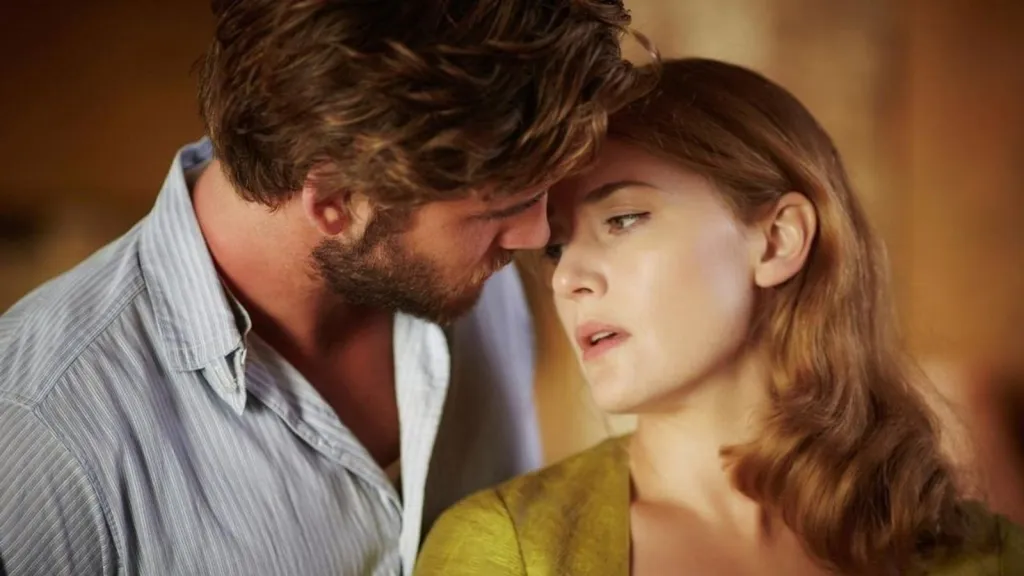
The film relies on the imperial performance of Kate Winslet in the role of Myrtle ‘Tilly’ Dunnage. Her magnetic presence is complemented by a top-tier cast, notably Liam Hemsworth as Teddy McSwiney and Sarah Snook in the role of Gertrude Pratt. We also find Hugo Weaving, who delivers a memorable performance as Sergeant Farrat, a lawman secretly enamoured with fine fabrics and textile creations. This character, torn between his official duties and his clandestine passion for fashion, brings a particularly welcome touch of sensitivity and humour to this unforgiving universe.
Kate Winslet displays a range of emotions of rare intensity, naturally oscillating between the calculating coldness of a wounded woman and the vulnerability of a rejected little girl. Opposite her, Liam Hemsworth brings essential human warmth through the character of Teddy, a benevolent soul who refuses to bend to the village’s prejudices. As for Sarah Snook, her physical and psychological transformation perfectly illustrates the liberating, yet alienating, power of physical appearance in an environment where image is everything.
Jocelyn Moorhouse’s direction of the actors allows every supporting role to shine, transforming the gallery of villagers into a remarkably effective tragi-comic chorus. The interactions between the various protagonists reveal sharp writing, where undertones and unspoken words often carry more weight than direct statements. This ensemble work gives remarkable depth to this rural micro-society, making each confrontation all the more striking for the viewer.

Visual aesthetics between desert and silk
Visual aesthetics serving the narrative
Jocelyn Moorhouse’s work is distinguished by a striking visual contrast: the dust of the Australian desert versus the refinement of Parisian dresses. The direction highlights the warm colours of Australia while emphasizing the detail of the fabrics. This 2015 feature film is often described as a feast for the eyes, where each costume becomes a narrative element in its own right, underlining the characters’ evolution throughout the story.
The care given to the texture of the fabrics, the vibrancy of the shades and the precision of the cuts transforms the film into a true lesson in fashion history. One detects the direct influence of the great couturiers of the era, from Christian Dior to Cristóbal Balenciaga, whose architectural silhouettes redefined post-war femininity. The camera lingers willingly on technical gestures, the sound of scissors slicing through taffeta, the glide of needles and the fall of a drape, bestowing upon dressmaking an almost sensory and hypnotic dimension.
Light also plays a fundamental role in this staging. The blazing sun of the Australian outback crushes the settings of weathered wood and corrugated iron, making the burst of colourful silks, tulles and satins all the more surreal. This permanent aesthetic clash symbolises the struggle between the archaism of a frozen way of life and the aspiration to transcendent beauty, making haute couture a form of artistic and personal resistance against the ugliness of everyday life.
The theme of revenge through the prism of art
Clothing as a weapon of subversion and power
Unlike traditional revenge stories that rely on physical violence or financial ruin, the film explores a much more subtle and original path: revenge through beauty and metamorphosis. Tilly Dunnage does not seek to destroy her enemies with weapons, but to subjugate them by revealing their own vanity. By offering the women of Dungatar sumptuous outfits, she prompts them to unveil their true nature, often made of pride, envy and petty jealousy.
This approach makes fashion a distorting mirror that traps the villagers in their own contradictions. By altering their outer appearance, the dressmaker changes their behaviour, exacerbating internal rivalries and causing the gradual collapse of the established social order. Artistic creation thus becomes an extremely powerful tool of social deconstruction, proving that style can turn out to be far more formidable than any conventional weapon.
An audacious and unprecedented blend of genres
A subtle balance between drama and dark comedy
Far from being a simple drama, “The Dressmaker” plays the card of constant shifts in tone. The viewer navigates between dark comedy, western and poignant melodrama. The film uses sharp humour to depict human mediocrity before pivoting into raw emotion. This singularity makes it a unique cinematic work, capable of surprising as much by its ferocity as by its formal beauty.
This hybrid structure disorients and charms at the same time. The tone at times recalls Italian baroque comedies or theatrical satires, where absurd situations follow one another to better highlight the underlying tragedy. Western tropes are also clearly summoned: the arrival of the lone female stranger with her sewing machine acting as a pistol, the standoff in the middle of the dusty main street, and the final reckoning that cleanses the past to pave the way for an uncertain future.
The soundtrack and editing embrace these variations in pace perfectly. Slapstick comedy scenes, driven by the eccentricities of the villagers, abruptly give way to moments of pure visual poetry or intense psychological distress. This permanent stylistic stretch demands constant attention from the viewer, who finds themselves tossed between liberating laughter and tears, never able to anticipate the direction the story will take.
Where to watch the film currently
Although it is sometimes overlooked, the film has built a solid reputation among cinephiles. It is accessible in France via various video-on-demand services. You can notably find this work on CanalVOD, VIVA or PremiereMax from €2.99, or explore available offers for physical media.
This singular 2015 work, driven by Kate Winslet’s masterly performance, stands out as an absolute benchmark for aesthetes and fashion enthusiasts. This grand melodrama combining revenge and Parisian silhouettes can be enjoyed right now on VOD via the CanalVOD platform.