

In brief
- A landmark exhibition co-organised by the Musée de l’Orangerie and the Tate Modern on the occasion of the centenary of Claude Monet’s death.
- An exceptional selection of nearly forty paintings tracing the Impressionist master’s obsessive quest for time.
- The reunion of legendary series, from the first Parisian railway stations to the mythical Nymphéas of Giverny.
- The exhibition will be held in Paris from 30 September 2026 to 25 January 2027 before being presented in London.

The exhibition Monet, peindre le temps stands out as the major cultural event
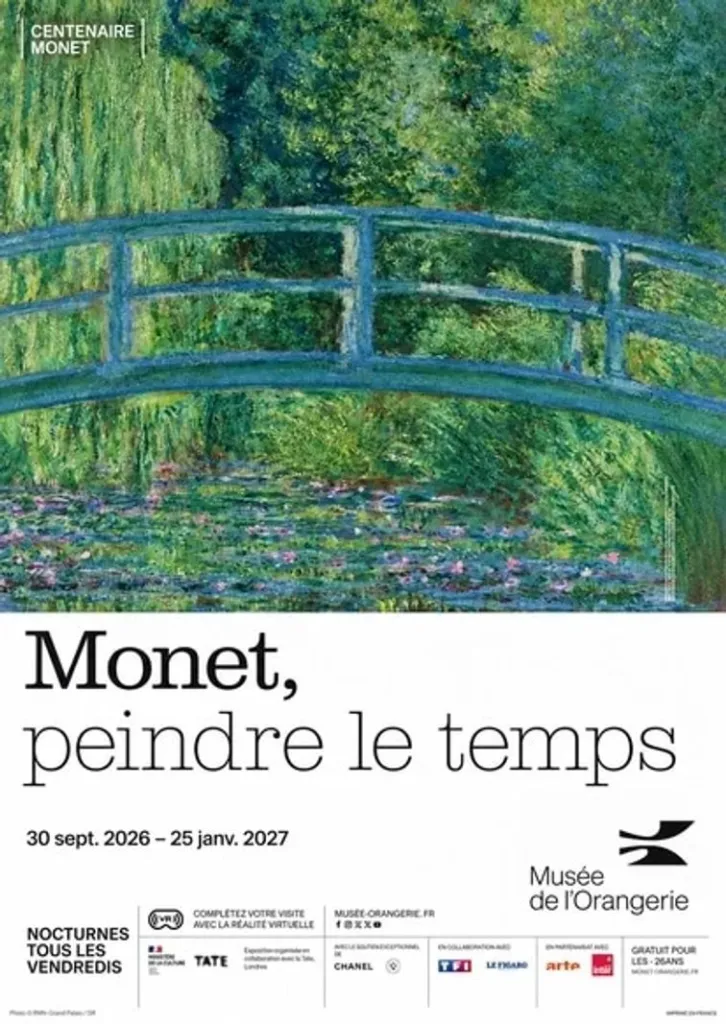
The exhibition “Monet, peindre le temps” stands out as the major cultural event of the Parisian season at the Musée de l’Orangerie, from 30 September 2026 to 25 January 2027. One hundred years after the passing of Claude Monet, this thematic retrospective explores how the master of Impressionism made temporality, light and atmospheric variations the beating heart of his pictorial revolution. To organise your visit in the best possible conditions, it is highly recommended to book your entry ticket online.

Speed and the instant of industrial modernity
Industrial modernity and the speed of the instant
From the 1870s, Claude Monet established himself as the Impressionist painter par excellence, although he only participated in five of the group’s exhibitions. At that time, time was becoming standardised in the public space and the expansion of railway networks radically transformed the relationship to travel and landscape. The section of the exhibition entitled “Acceleration and Modernity” highlights this constant dialogue between Monet’s painting and the speed of his era. It is in this context of celebrating modernity that the famous canvas of La Gare Saint-Lazare appeared, painted in 1877 and exceptionally on loan from the Musée d’Orsay.
In this masterpiece, the artist immortalises a locomotive emerging from a thick cloud of blue and grey steam, sheltered under the monumental glass roof of the Parisian station. Working from life in the open air, the artist developed an unprecedentedly rapid brushstroke to capture the immediacy of the scene, even if it meant perfecting the structure of the composition later in the privacy of his studio.

The great series in the face of light variations
The obsession with series and changing light
At the dawn of the 1890s, Claude Monet refined his working method by designing thematic series. The principle consisted of painting a single subject on several canvases worked on simultaneously throughout the hours of the day. The work Meule, effet de neige, soleil, painted in 1891 and coming from the Hasso Plattner collection at the Museum Barberini in Potsdam, wonderfully illustrates this technical prowess where the frozen straw reflects the final rays of a winter sun.

This systematic approach reached its peak with Rouen Cathedral, of which Monet painted the facade under every possible light between 1892 and 1893. Le Portail, brouillard matinal, dated 1894 and on loan from the Museum Folkwang in Essen, is the perfect example. The pictorial material, worked in thick and dense layers, gives body to the blue and pinkish fog that seems to dissolve the sculpted stone of the Gothic monument.
The great spiritual cycle of the Nymphéas of Giverny
The absolute triumph of the Nymphéas
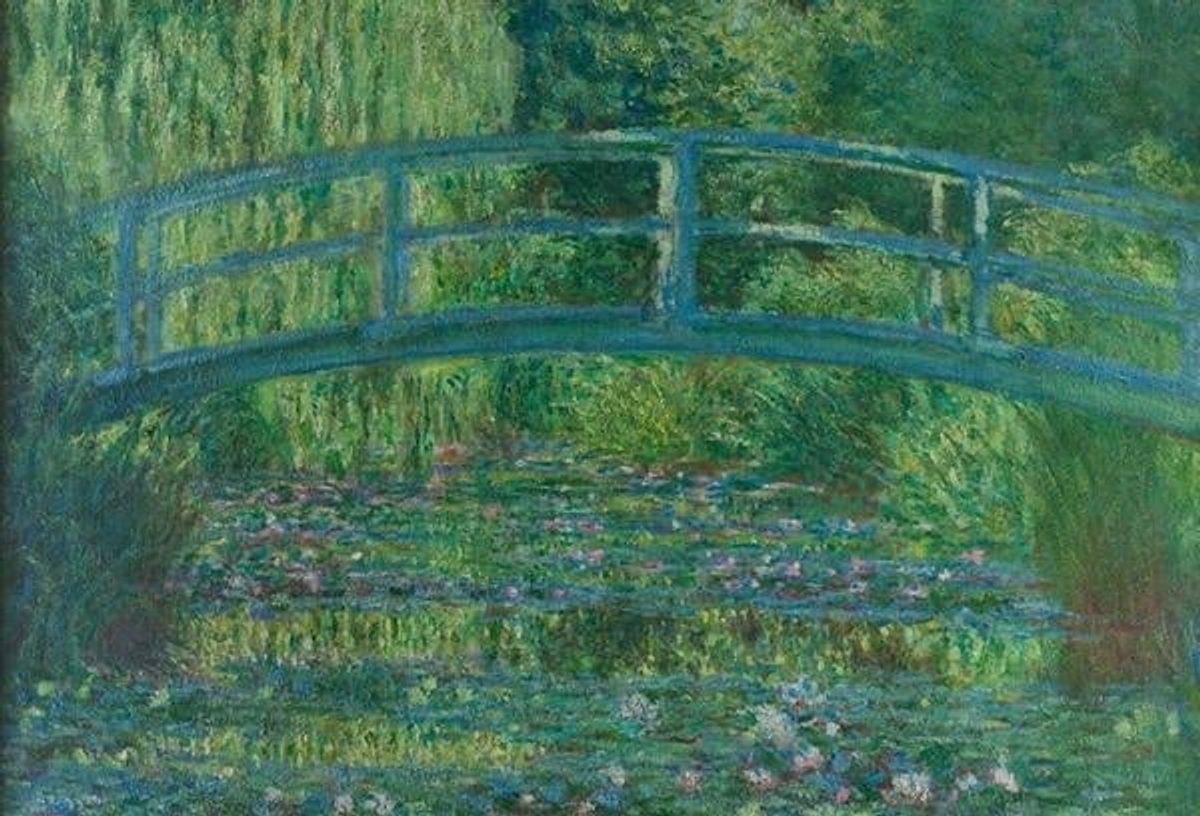
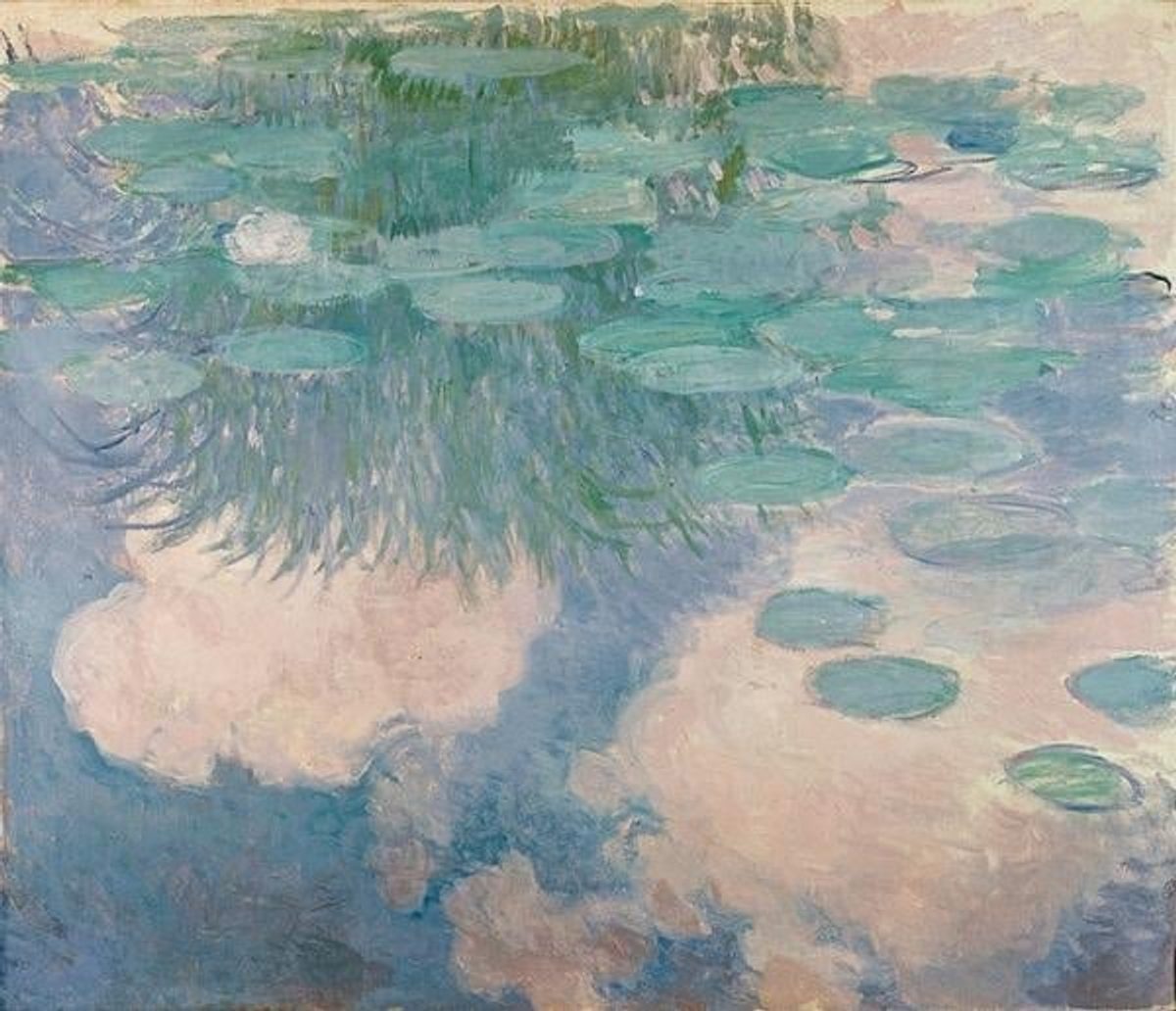
The exhibition route culminates with the legendary cycle of the Nymphéas, the water garden that the painter meticulously shaped from 1893 in Giverny. The emblematic work Le Bassin aux nymphéas, harmonie verte, created in 1899, bears witness to the creation of this plant sanctuary surmounted by a wooden bridge inspired by the Japanese prints that the artist collected with passion.
Later, despite severe visual impairment caused by cataracts which appeared in 1908, the painter continued his great work. The two late canvases of the Japanese Bridge, painted between 1918 and 1924, reveal an extraordinary freedom of execution that borders on pure abstraction. The material breaks free from contours to offer the viewer a unique immersive experience, similar to that of the eight large decorative compositions permanently installed at the Orangerie in 1927.

London and the Parliament dissolved in the fog
The Thames and the Parliament dissolved in the fog
The exhibition also devotes a major section to Claude Monet’s three stays in London between 1899 and 1901. Installed on the terrace of St Thomas’ Hospital, the painter tirelessly contemplated the Thames and drew the hazy outlines of the Palace of Westminster. Le Parlement de Londres, effet de brouillard, painted in 1903 and preserved at the MuMa in Le Havre, elegantly illustrates this atmospheric quest where architecture fades behind purple and crimson chromatic veils.
By reworking all of his London views in Giverny to unify their harmony, Monet succeeded in capturing the very essence of the air and the industrial mist, transforming the urban landscape into a pure symphony of colours and fleeting sensations.