

In brief
- An historically early start to the harvest from 8 August 2026 for crémants and 17 August for still wines.
- Weather marked by an uninterrupted heatwave since 20 June 2026, accelerating the ripening of the grapes.
- Excellent sanitary conditions in the vineyard, preserved from disease, guaranteeing a high-quality vintage despite limited production volumes.
The 2026 harvest in Burgundy came to an historically early close under the influence of a persistent drought and heatwave, placing this new vintage in the solar lineage of 2020. Beginning as early as mid-August for still grapes, this ultra-rapid harvest shakes up the vineyard’s centuries-old benchmarks and forces winemakers to adapt immediately to climate change.
The disrupted schedule of the 2026 harvest in Burgundy
An historically early harvest schedule
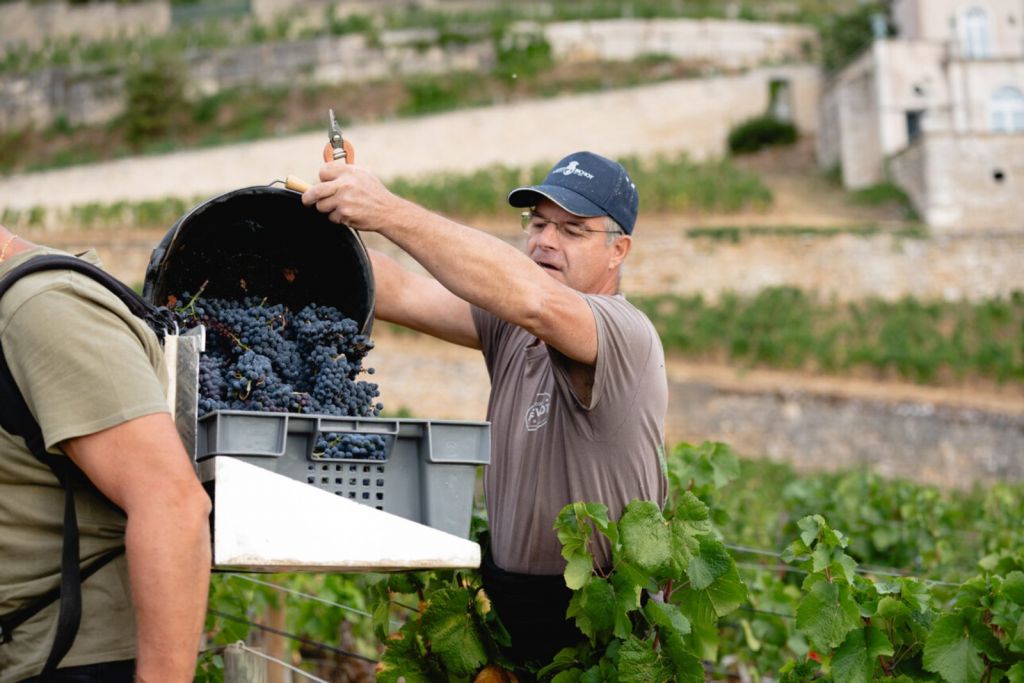
Throughout the region, the speed of the vegetative cycle has left a strong impression this year. While the first pickings began on 8 August for plots destined for crémants, the kick-off for still wines was given on 17 August for Chardonnay and 20 August for Pinot Noir. According to the work of climate historian Thomas Labbé, who analysed seven centuries of harvests in Beaune, the average harvest date was around 27 September between the end of the Middle Ages and 1988. This shift of more than a month confirms the spectacular acceleration of global warming, transforming what were once exceptional situations into a new summer norm.
As Albéric Bichot points out, whose teams were active in the vineyards from mid-August, the intensity and recurrence of weather phenomena no longer have anything to do with the situation forty or fifty years ago. Scorching summers now follow torrential rains with tenfold strength. For the estate, daily monitoring of the vines and taking random samples have become essential to determine the optimum balance of the grapes and trigger the harvest at the right moment.
The challenge of grape over-ripeness
The major challenge of this ultra-early harvest lies in the balance of the juices, put to the test by an almost uninterrupted heatwave since 20 June. With scorching temperatures, the main risk is reaching over-ripeness of the berries, which could lead to an alcoholic imbalance in grape varieties renowned for their freshness and minerality. Laurent Delaunay, of the Édouard Delaunay estate, nevertheless observes good tartaric acidity and high pH levels, a reassuring combination that should preserve the tension and drinkability of the wines.
While wine-growing history shows that dry years yield excellent results, producers are closely monitoring the expected alcohol level, which historically ranges between 12% and 13.5% ABV for Pinot Noir and Chardonnay, but could flirt with the 14% recorded during the 2020 harvest.
A healthy harvest but limited yields
Controlled volumes for optimal sanitary quality
In terms of quantity and sanitary condition, the results are mixed but of extremely high quality. The total absence of rainfall during the summer period blocked the development of fungal diseases, notably downy mildew and powdery mildew, which are among the greatest scourges of the Côte-d’Or. The harvested bunches thus display irreproachable cleanliness, sparing teams from tedious sorting in the winery.
However, the persistent drought limited the swelling of the berries. The harvested grapes are particularly small and low in juice, which will inevitably result in a restricted production volume for this vintage, despite its excellent intrinsic quality.
The necessary revolution in viticultural practices
Faced with the repetition of these extreme heat episodes, the Burgundy wine industry agrees on the need to adapt its cultivation methods in the long term. While immediate solutions such as reducing leaf thinning help protect the bunches against sunburn and scorching, they will prove insufficient over the coming decades.
Winemakers are now talking about a genuine plant and cultural mutation. Laurent Delaunay stresses the importance of conducting research into new rootstocks and considering the replanting of ageing plots to preserve the identity of traditional grape varieties. The objective is to continue to sublimate Pinot Noir and Chardonnay without having to yield, in the future, to the introduction of more southern grape varieties such as Syrah.
An immersive spectacle for wine lovers
When prestigious wine tourism adapts to the new schedule
This unprecedented earliness shifts the excitement of the harvest to the very heart of the summer season, opening up new prospects for high-end wine tourism. Several estates in the Côte d’Or and Chablis are adapting to welcome visitors wishing to observe this key moment in the creation of a great wine.
![[Vendanges 2026] En Bourgogne, un millésime solaire dans la lignée de 2020](https://res.cloudinary.com/dytsb9dyl/image/upload/v1787849790/larevue_articles/larevue_articles/vendanges-2026-en-bourgogne-un-millesime-solaire-dans-la-lignee-de-2020-terre-de-la-revue-des-restaurants-2.jpg)
The Philippe Le Hardi estate thus offers a dedicated welcome to discover the behind-the-scenes of manual harvesting. Even more spectacularly, Château la Commaraine in Pommard integrates its winery into the heart of a new 5-star hotel, allowing its clientele to witness the winemaking process live, sealing the alliance between luxury, hospitality and winemaking traditions.
Technical sheet of the 2026 vintage
- Region: Burgundy (Côte d’Or, Chablis, Nuits-Saint-Georges, Pommard)
- Main grape varieties: Pinot Noir and Chardonnay
- Key dates: Start on 8 August (crémants) and from 17 to 20 August (still wines)
- Climate profile: Continuous heatwave from 20 June, marked drought, absence of disease
- Wine characteristics: Expected alcohol level around 13.5% to 14% ABV, maintaining good tartaric acidity