

In brief
- Prince Philip passed on a golden rule to Kate Middleton: prioritise official duty over personal fame.
- The Duke of Edinburgh reminded the future Princess of Wales: “You are not a celebrity”.
- This strategy of individual self-effacement aims to preserve the royal institution from the excesses of ultra-mediatisation.
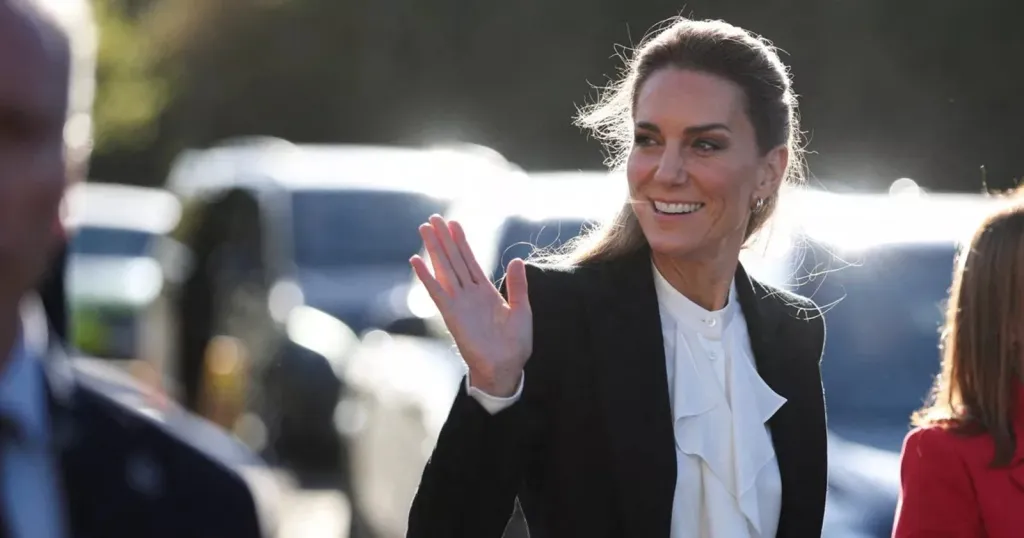
Kate Middleton has established herself as a solid pillar of the British monarchy by following to the letter a rule of conduct passed on since her entry into the Royal Family. At 44, Prince William’s wife embodies a vision of duty where the role takes precedence over the quest for individual notoriety.
In a modern context characterised by the constant search for attention and the culture of personal image on social media, the position adopted by the British Crown remains singular. The House of Windsor rests on a very rigorous protocol developed over centuries and perfected throughout the historic reign of Elizabeth II. The integration of new members into this secular dynasty requires a methodical learning of the workings of symbolic power and public representation. It is within this demanding framework, at the heart of Buckingham Palace and Windsor Castle, that the fragile balance between the private sphere of individuals and the constitutional requirements of the Crown is articulated.
A fundamental principle dictated by the Duke of Edinburgh
From her first steps within the Crown, Prince William’s wife received decisive advice from Prince Philip. According to analyses by royal expert Gyles Brandreth, the Duke of Edinburgh was keen to instill in her a clear distinction between personal celebrity and institutional mission. For Prince Philip, royal obligations were never to serve to fuel an individual image.
The warning formulated by the husband of Queen Elizabeth II summarised his entire philosophy of public service: “You are not a celebrity, you represent the Royal Family”. A strict instruction requiring the individual to step back behind the function to guarantee the continuity and neutrality of the institution.
For more than six decades, the Duke of Edinburgh himself embodied this iron discipline by constantly remaining behind the Sovereign, walking a few steps behind her during state visits and official ceremonies. Having lived through the major changes of the 20th century, from the democratisation of television to the beginnings of the digital age, Prince Philip perfectly understood the pitfalls of ephemeral notoriety. His role within the Royal House notably consisted of ensuring the firmness of the moral foundations of the Windsor clan. By passing this precept to the younger generation, he sought to perpetuate a model of symbolic governance based on the renunciation of the benefits of purely media-driven fame.

The legacy of Diana and the trap of notoriety
The legacy of past media crises
This warning drew its source from past media crises suffered by the monarchy. Prince Philip had been a direct witness to the extraordinary popularity of Princess Diana, an individual notoriety so vast that it sometimes eclipsed the institution itself. This period had profoundly reconfigured the complex relations between the Royal Family, the media and the public.
Without ignoring the differences in eras and contexts, the approach aimed to protect the young Princess against the risks of excessive media exposure. It was about channelling media coverage around official engagements rather than private life.
The end of the 20th century was marked by intense tensions between the British press, notably the high-circulation tabloids of Fleet Street, and members of the Royal Family. The over-mediatisation of the romantic lives of princes and princesses had threatened the stability of the institution and altered the public perception of the role of the constitutional monarchy. The frenzy of the celebrity press around every move, outfit or social interaction risked transforming the representatives of the State into simple figures of the sensationalist press. To avoid the repetition of these destructive dynamics, the Crown’s advisors and Prince Philip worked to establish a much more controlled communication framework.
The transmission of royal codes and dynastic continuity
Progressive integration into the Royal Firm obeys unwritten but rigorously observed rules. The transition to high-ranking responsibilities requires meticulous preparation, where every gesture, speech or choice of clothing is scrupulously analysed by international public opinion and Crown observers.
Prince William and his wife have chosen a methodical construction of their public image. By placing the institution above their personal aspirations, they follow directly in the footsteps of Queen Elizabeth II, whose entire existence was dedicated to her oath of service. This choice of relative self-effacement requires constant discipline, particularly during international tours within the Commonwealth or during major state ceremonies in London or at the Palace of Holyrood. The transmission of these values represents the cornerstone of dynastic permanence, ensuring the stability of the British monarchical system through societal transformations.

A reserve that has become a strategic asset
The Duke of Edinburgh had quickly identified Kate Middleton’s pragmatic temperament. Her ability to show restraint has proven to be a major strength for the balance of the Royal House.
This approach still dictates the conduct of the Princess of Wales during her travels today. Each public appearance is designed to highlight the organisations and patrons supported, thus concretising the discretion formulated at her beginnings.
Over the years, the measured posture of the Princess of Wales has become a central element of the Palace’s communication strategy. By avoiding untimely statements and focusing on targeted charitable causes, she has been able to establish a lasting climate of trust with the British public and institutional partners. This form of controlled reserve does not mean a complete erasure of personality, but rather a strict channelling of public speech towards subjects of general interest.
The impact of the method on the modern image of the princely couple
The rigorous application of Prince Philip’s precept influences the daily management of the princely couple’s affairs. Whether it concerns their official engagements across the United Kingdom or the support provided to various patronages, the focus remains constantly on the work accomplished by the associations rather than on the staging of their royal actors.
This doctrine allows for a clear boundary to be established between the representative function and the family life led out of the public eye. By maintaining this protective distance from the celebrity industry and the tabloid press, the Princess of Wales preserves the dignity attached to royal rank. This rigour in public behaviour contributes to consolidating the population’s support for the monarchical institution, by offering a model of selfless service in line with the traditional principles of the British Crown.
Find out more
- Google (opens in a new tab)
- Google Discover (opens in a new tab)
- Google News (opens in a new tab)
- Create an account
- Log in