



In brief
- A Google engineer has filed over 2,500 reports flagging rental abuses in San Diego.
- The region faces a shortage of 134,500 affordable homes according to data.
- The organisation Nice Neighbors uses an algorithm to track legal loopholes exploited by property investors.
In San Diego, the seasonal rental market has become the battlefield for a fierce struggle led by Jay Goldberg, a 42-year-old engineer employed by Google, who tracks investors illegally transforming primary residences into transient hotels. This data specialist uses his technological skills to identify buildings that, after evicting their long-term tenants, re-emerge on platforms like Airbnb as highly profitable tourist complexes.
The Californian coastline, particularly prized for its climate and exceptional living environment, is bearing the full brunt of aggressive property speculation. Coastal neighbourhoods in San Diego, once characterised by social diversity and long-standing residents, are seeing their character rapidly transformed. Faced with traditional rental yields deemed insufficient by investment funds, the use of short-term rental platforms has emerged as a preferred strategy to maximise profits, creating unprecedented tension in the local rental market.


The digital hunt for apartment-hotels
The digital hunt against clandestine hospitality
Jay Goldberg’s obsession began when a neighbouring townhouse was converted into a permanent holiday rental. Drawing on his experience at the tech giant, he developed a system to cross-reference short-term rental licences, property registers, and online listings. His vigilance group, named Nice Neighbors, now maps properties that warrant particular attention from municipal services.
The engineer has already reported over 2,500 potential violations to San Diego authorities, viewing these reports as essential milestones in documenting the radical transformation of the urban landscape. This civic initiative aims to compensate for the lack of resources available to municipal inspectors in the face of the explosion of booking platforms. The automation of data collection allows for the real-time analysis of thousands of active listings, detecting administrative anomalies and highlighting discrepancies between a property’s declared use and its operational reality.
By analysing booking trends and occupant turnover, the algorithm designed by Nice Neighbors manages to isolate behaviours typical of disguised hotel operations. This meticulous work of cross-referencing information highlights the scale of the phenomenon: entire residences, initially intended to house families or local workers, are removed from the traditional market to feed a continuous flow of passing tourists, profoundly altering neighbourhood life and community relations.

A legal loophole at the heart of the system
Legal loopholes at the heart of the conflict
The heart of the problem lies in a gap in the municipal ordinance that came into force in May 2023. Currently, the city does not block the granting of a seasonal rental licence if the former tenants were evicted without fault or accepted a lease buyout. This loophole allows landlords to empty entire buildings to transform them into more lucrative holiday units, a practice that exacerbates the local housing crisis according to shared data.
This situation highlights the complexity of the municipal legislative arsenal. Although the stated intention of the regulations is to preserve the balance of neighbourhoods and protect access to housing for permanent residents, the enforcement mechanisms suffer from significant legal voids. Property investors, often advised by specialised law firms, exploit these loopholes systematically. Eviction procedures for major renovations or the use of financial incentive agreements to push occupants out have thus become common tools for circumventing the spirit of the law.

The example of a complex in Pacific Beach perfectly illustrates this drift: after the building was bought in 2023, tenants, some of whom had been paying moderate rents for over ten years, were encouraged to leave. Shortly after, Jay Goldberg’s system detected the appearance of multiple short-term licences for this same address. This textbook case demonstrates how communities established for years can be dismantled in a matter of months, replacing stable homes with a volatile tourist clientele.
The concentration of licences in a few hands
Although regulations theoretically limit the number of licences per host, schemes allow this rule to be bypassed. Investigations have revealed that some landlords are connected to more than a hundred short-term licences in popular areas like Ocean Beach. This property concentration deprives long-term residents of access to housing, while prices on platforms like Zillow reach heights inaccessible to the middle class.
To circumvent the restrictions imposed by the city of San Diego, which aim to prevent a single operator from monopolising the market, investors resort to complex arrangements. These techniques include the use of intermediary management companies, nominees, or the creation of multiple distinct legal entities each holding a handful of licences. Thus, a single financial actor can operate a veritable hotel empire scattered throughout the residential fabric behind the scenes, without classic administrative filters detecting the anomaly.
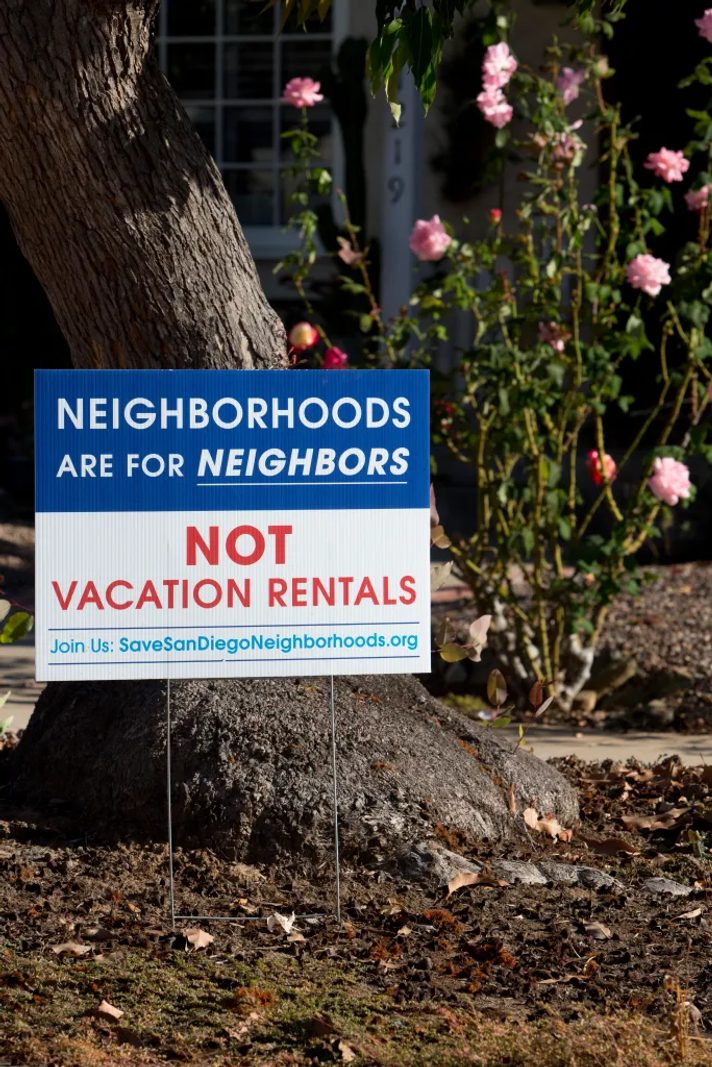
Faced with this situation, Airbnb has stated it supports efforts aimed at removing actors who circumvent the original intent of the regulations. However, on the ground, Jay Goldberg continues his audits, even physically checking for the presence of mandatory signage on suspicious properties. These physical checks allow for the confirmation of digital data collected by his algorithm, providing tangible proof of infractions observed during on-site inspections.
The impact on the local economy and social diversity
The constant reduction in the supply of long-term housing is creating major economic and social consequences for the city of San Diego. Service sector workers, teachers, medical staff, and young professionals are finding it increasingly difficult to find housing near their place of work. This situation leads to longer commute times, an increase in transport-related pollution, and a loss of attractiveness for local businesses struggling to recruit.
Furthermore, the gradual disappearance of permanent residents in favour of a transient population weakens traditional local businesses, such as grocery shops, schools, and neighbourhood services, which depend on a regular clientele throughout the year. The affected neighbourhoods thus risk losing their authenticity and social dynamism to become zones exclusively dedicated to seasonal tourist activity, permanently altering the cultural identity of the region.
An issue of power for tenants
A fight for the preservation of the residential stock
For the founder of Nice Neighbors, the action is not directed against the principle of holiday rentals, but against an imbalance of power. “A tenant is not equipped to fight against the financial power of an investor” capable of acquiring and renovating multi-family buildings simultaneously. Thanks to his reports, a dozen hosts have already lost their right to operate seasonal rentals.
The civic initiative led in San Diego illustrates the need for active monitoring by civil society to ensure the effectiveness of public housing regulation policies. The use of big data analysis offers new perspectives for rebalancing the power relationship between major property players and local residents, by providing concrete and actionable evidence for municipal inspection services.
By exposing these practices, Jay Goldberg hopes for a revision of the municipal ordinance. The objective is to prevent the residential property stock from being permanently transformed into a scattered hotel park, to the detriment of the soul and viability of San Diego’s neighbourhoods. The sustainability of local communities will depend on the authorities’ ability to quickly adapt the regulatory framework in the face of circumvention strategies deployed by short-term tourist accommodation operators.